
If you long for the good old days when BMW model numbers referred to the engine capacity (just don't mention the 3.2-litre 745i, the 1.8-litre 316 or countless others that didn't), I've got bad news for you: the car industry's product planners are hard at work devising new and arcane naming schemes in an effort to not make EVs sound like inkjet printers.
These systems need to be designed, with roughly equal importance, to help customers make sense of batteries and motors on the one hand and to gently upsell them to the more expensive model on the other. I'm not sure they're succeeding with the former, but they're getting the hang of the latter.
I've written in the past about how it's a struggle to make fast EVs truly appealing. When a normal Audi A5 gets a four-cylinder engine and the S5 gets a V6, you know which one you really want. But when the base Q6 EV is silent and already very fast, why would you pay more for an SQ6 that feels broadly the same but has less range?
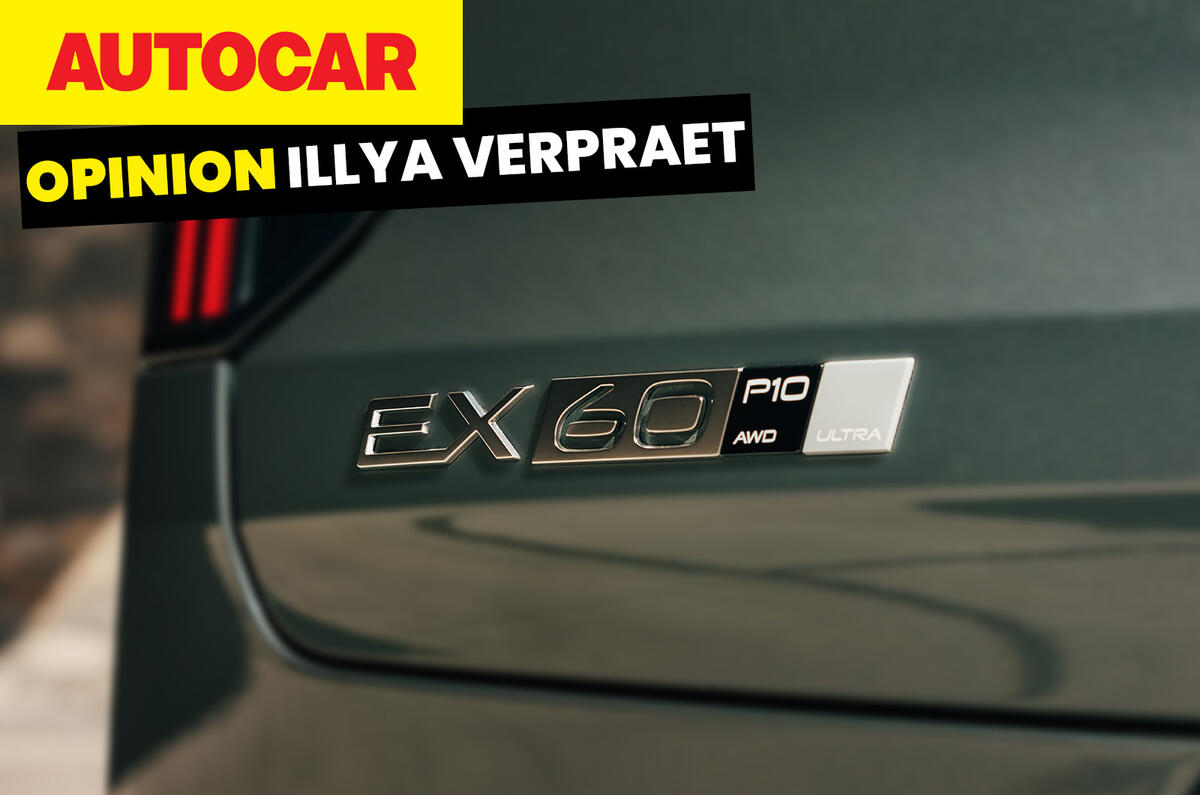
One possible solution is to subtly downplay the cheaper one and hope nobody notices and just upgrades. If you value order and mathematical regularity, you might have noticed something odd about the line-up of the new Volvo EX60. It goes P6, P10, P12, which begs the question of what happened to the P8. What Volvo has done is give each one a different-sized battery - something it can easily do by filling the pack with more or fewer cells. Notably, the P6's battery is substantially smaller than the P10's.
Because the P6 only has a single motor and is therefore a bit more efficient than the dual-motor P10, the gap in range isn't huge (380 versus 410 miles), but it definitely exists. This hierarchy gives you a neat range walk, in which each version has both more power and range than the one below it. More is better. So buy the spendy one. Simple. BMW has done something similar with the new iX3, giving the single-motor 40 variant a smaller battery than the dual-motor 50. Which brings us back to the case of the missing P8.
Manufacturers don't tend to comment on future products unless they're backed into a corner or want to soft-launch something, so there's nothing official, but it's easy to see what a P8 would look like: big battery, and single motor for a range of around 450 miles. It would be the EX60 we'd recommend, but I don't actually think Volvo will build it. I suspect the illogical naming is partly to keep the option open just in case but mainly to give people another reason to pony up the extra £3000 and go for the one that's not just two but four Ps better.
This whole thing also makes me wonder how much range a person really needs. Until now, the answer has always been more, because when that 300-mile WLTP range turns into a 200-mile real-world range, and you subtract another 50 for comfort, and have to deal with a patchy charging network, you need all the safety net you can get.
Now that we're seeing 500-mile WLTP ranges, 400kW charging and forests of fast chargers popping up at most service stations, you might well be happy to settle for a bit less. When I'm road testing a car, I tend to do between 500 and 600 miles in the week that I have it. The road test involves draining the battery for the low-charge acceleration run and the charging test, and with really long-range EVs like the iX3, that takes a bit of planning. If you do 50 miles a day, it might not need charging for a whole week.