
How cars are assembled may not be the first thing that springs to mind when entering a car showroom but it might further down the line if unreliability strikes.
Robots have played a part in production since the early 1970s and ad agency Collett Dickenson Pearce broke new ground in the UK in 1979 with what became a famous TV commercial for the Fiat Strada, rejoicing in the tagline: 'Handbuilt by Robots.'
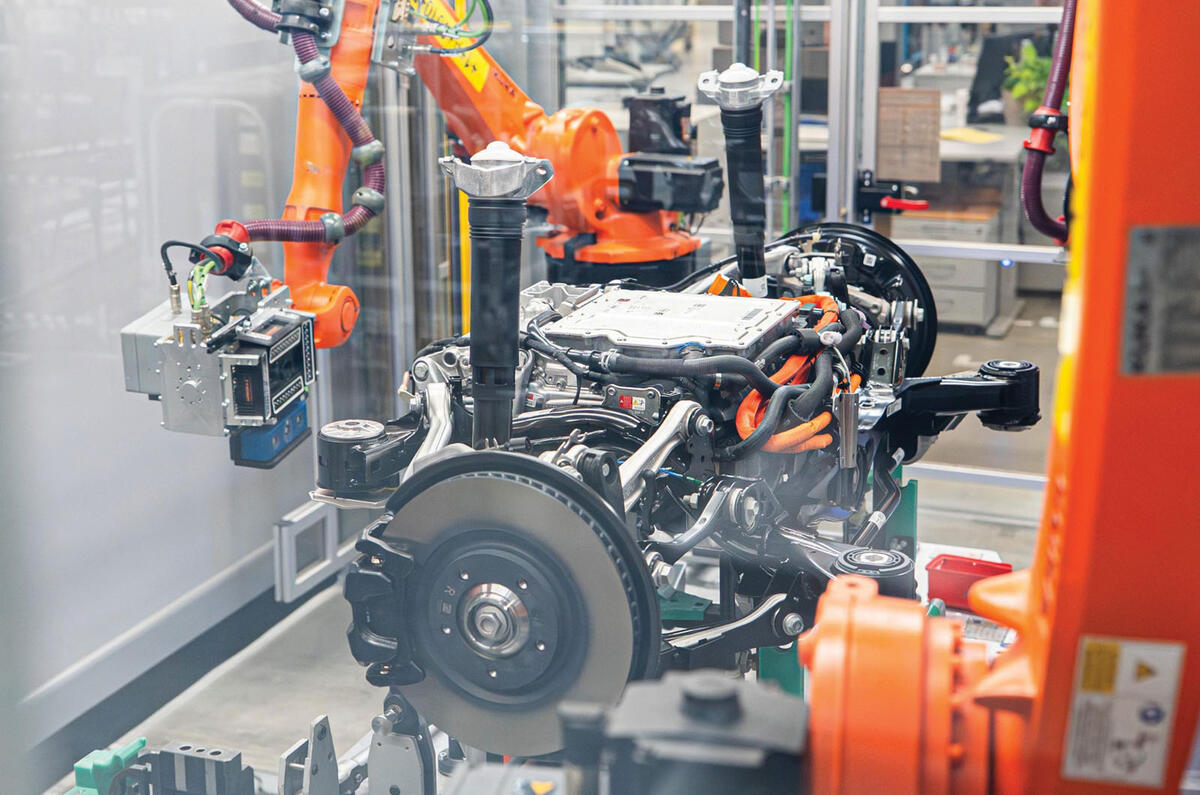
Porsche has, perhaps unknowingly, echoed that sentiment at the Leipzig plant where it produces the Macan and Panamera, using robots for checking the rear axle assembly while retaining a human touch.
Rear axles are complicated and the type of complexity varies depending on whether the axle is passive, as in front-wheel drive, or 'live', as in rear-wheel or four-wheel drive. EVs add another layer of detail with rear-mounted drive motors and associated electronics.
However unglamorous they may be, rear axles are precision components that play a crucial role in driving dynamics and comfort. They're one of the most complex assemblies in a Porsche, says the maker, and once assembled they undergo thorough checking before being fitted to a car.
Porsche has developed the 'automated end-of-line inspection' for the job that combines human expertise with robot assistance.
Robots handle the repetitive inspection tasks, scanning the entire axle assembly, identifying connectors, measuring distances and checking components are installed correctly based on stored information.
Each inspection point is photographed and analysed and the image data stored for three years, so if anything goes wrong, the condition of the axle at the time of its production can be checked.
The effectiveness of such validation work during the manufacture of a new car will have a bearing on how reliable it's going to be and it's a key part of the quality control process. Yet in most cases, what those checks look like is largely invisible to the buyer.
Porsche says this system was developed during series production and each inspection point was deliberately "manipulated" to ensure faults would be corrected and the number of false alarms reduced. If the image processing system incorrectly flags an error, the system is fine-tuned to make sure it doesn't happen again.
Despite the march of AI, Porsche still considers humans indispensable in this role. Human technicians work in sync with the robots and perform the jobs that, says Porsche, "require experience and human sensitivity. Not everything can be checked visually and, for example, the robotic system is unable to pick up a rubbing noise from a brake disc.
So although much of car production is automated it's perhaps comforting to know there are some aspects of a new car for which only a good old-fashioned 'spanner check' will do.