
The EU is tightening up its laws governing in-car safety. As of 7 July, all new vehicles must be fitted with camera-based systems monitoring driver fatigue and distraction. Safety testing organisation Euro NCAP is focusing on driver attention monitoring too, plus the effectiveness of restraint systems (such as seatbelts) in real-world use.
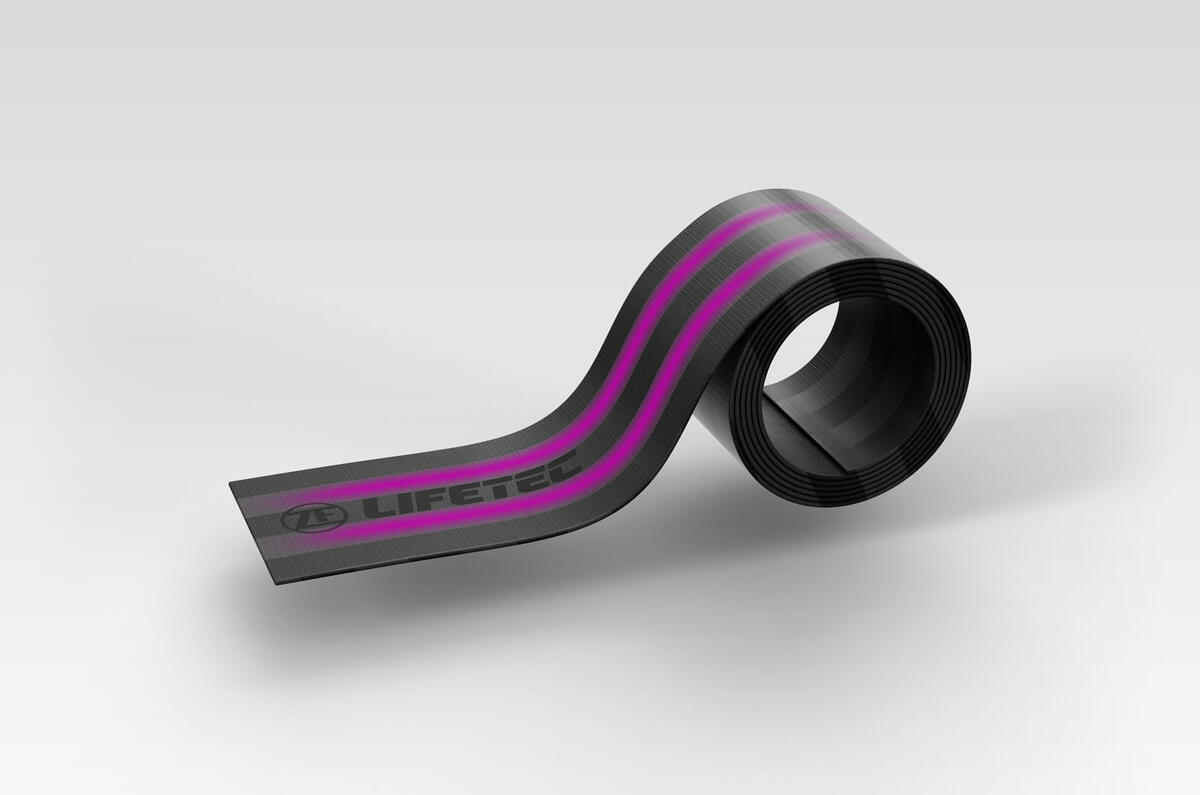
With that in mind, components supplier ZF Lifetec has developed a new technology called the infrared belt, which lets camera-based systems reliably detect whether belts are being not just worn but worn correctly.
Seatbelt buckles are designed to detect whether the 'tongue plate' is inserted and trigger a warning if it isn't, but that doesn't necessarily mean the seatbelt is being worn safely or at all.
Likewise, conventional RGB cameras can only do so much: optical reflections or identically coloured backgrounds can make the detection of a seatbelt's path difficult. ZF Lifetec now claims to have solved this problem through a combination of special materials and infrared cameras.
Its infrared belt combines different yarns with specific spectral properties, which produce an optical signature that the infrared cameras can interpret clearly. Cameras working on this spectrum can detect differences in the reflection and light absorption of materials, and in their view the seatbelt stands out from clothing, skin or seat surfaces no matter how poor or diverse the lighting conditions within the cabin. The result is a stable, high-contrast image.
One important factor of infrared cameras is that they can track the path of a seatbelt along the wearer's body. Based on this, a car's manufacturer can use intelligent algorithms to figure out whether the seatbelt is correctly and safely positioned over the shoulder or is unsafely positioned - for example, being worn under the arm or behind the back.
ZF Lifetec maintains that it's only the combination of its new seatbelt's special material properties and infrared detection that allows a car to accurately check that all is well and wearers will be properly protected in real-world conditions.
The company claims the system meets Euro NCAP's requirement that seatbelt misuse be communicated to the driver through the usual audio-visual warnings.
Beyond this kind of technology and the new driver distraction monitoring, it's anticipated that further enhancement to occupant monitoring will come as part of Euro NCAP's Vision 2030 Roadmap plan.
ZF Lifetec has designed its infrared belt to work for all seating positions. Series production will begin this month.