Currently reading: Chaos, hand signals and the 'code': Driving in 1950s London

Policemen ran junctions with hand gestures and road markings weren't yet painted

"Londoners drive abreast, packed nose to tail and side to side, and they have gradually evolved a complicated code of their own, as different from the Highway Code as contract bridge conventions are from the simple rules of auction.

"The selection of traffic lane, the right of way, all seems to be governed by bids, leads and responses. It is only by this queer but on the whole practical code that London traffic avoids bogging down completely in one solid mass."

This was the situation as Autocar found it in 1952, and not dissimilar to that which we find today in the capital.

What is notably different, however, is that whereas London traffic is today strictly controlled, under constant surveillance and threat of fines and punishment, in the 1950s the authorities "tolerated and even approved unofficially" of the mass bending of certain rules.

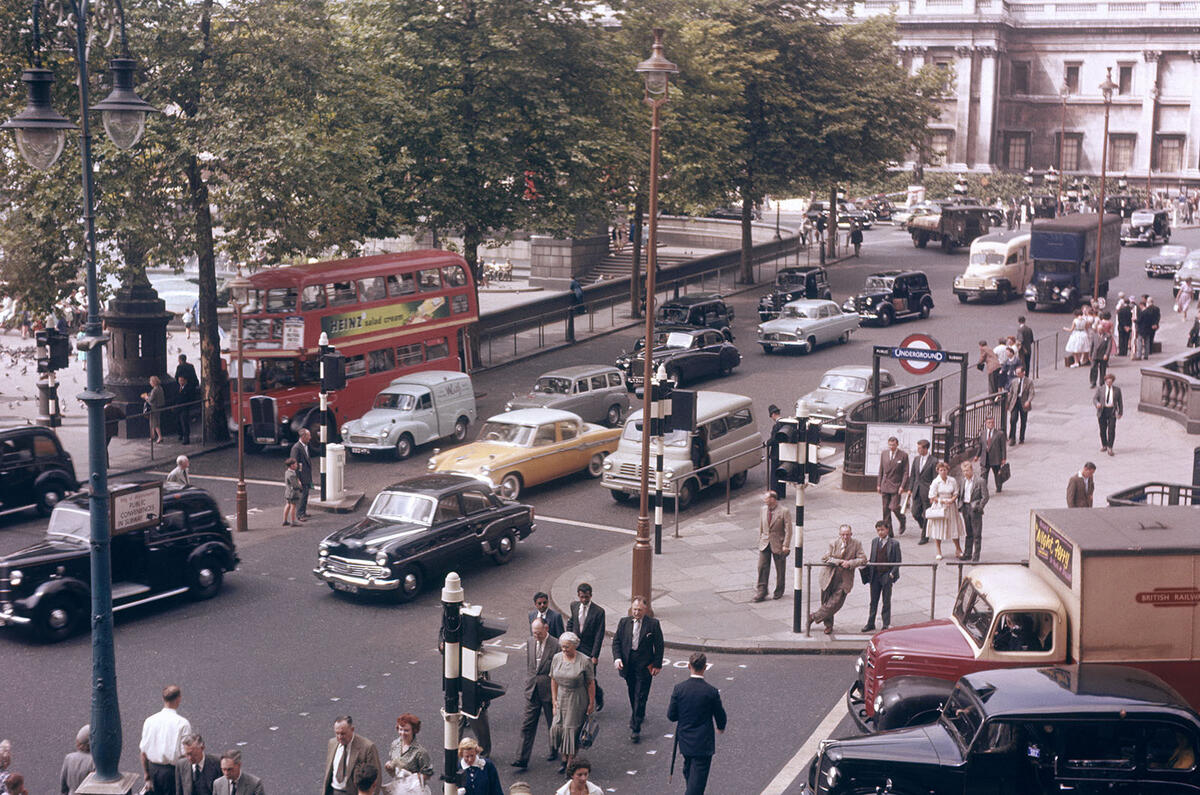
Back then, lanes were rarely demarcated and vehicles were all far narrower, such that a bus, a truck and a car might breathe three-wide on a road where today two cars would feel squeezed. Traffic lights were quite rare. And flashing indicators weren't yet in use: instead drivers would drop 'trafficator' arms, if fitted, or else perform hand signals.

Enjoy full access to the complete Autocar archive at the magazineshop.com

Autocar explained: "The left lane will be used by very slow vehicles, anything that will be stopping shortly and, above all, anything that is planning to turn off to the left. The outside lane traffic includes those who wish to turn off to the right in due course.

"The operation of working one's way over into the correct lane is carried out well in advance, in the clearer stretches between intersections and major obstacles, and is done by tending or veering a little that way while waiting for a gap, or for a kind soul to hang back a little and let one into the desired stream. It is a delicate compromise between forcing and coaxing one's way in but it is better to coax.

"Thrusters arbitrarily force to and fro according to which lane seems to have a temporary advantage. Generally this is regarded as selfish. As far as possible, one should stick loyally to one's lane, says public opinion, and share its fortunes but leave the rebuke or active resisting of offenders to others."

All British drivers were expected to know the hand signals for right and left turns, but Londoners knew a few unofficial ones too. "A hand stretched out and palm to the rear in a restraining gesture" meant to hold back for a pedestrian crossing out of view in front; another relayed that a driver was stuck just beyond the lights; a nod of the head ushered a waiting driver out of a side road.

Back to top

"A little flip of the trafficator means 'I should like to get over to the left' or 'a bit farther on I'm going off to the left, though not yet'." Coppers even had a 'hurry up' gesture.

Another complication was knowing where you were going. Today any driver can use sat-nav, but then they had to plan carefully before setting off, as landmarks and signage would usually be obscured by a mass of surrounding traffic. Indeed, we noted, "the regular' is so crafty at dodging the more famous and more choked spots that he may rarely see Eros, the Law Courts or Nelson on his column".

In a happy coincidence, British Pathé was also observing London traffic in 1952, immortalising this milieu. Its footage is fascinating to watch, reminiscent of modern-day Rome in its organised, functional chaos.

This is largely due to how much was left to drivers' discretion, the road markings and infrastructure being strikingly minimal to modern eyes. Aside from the lack of white lines to demarcate lanes, there were no painted turn arrows, yellow or double-yellow lines (these would be introduced from 1960), hatched box junctions (1964) or similar clutter.

There were no speed cameras in fact, no cameras of any distinction, because there were no bus lanes, no congestion charge or ultra low emission zones. Traffic lights were less common and less prominent too (the modern standard design dates from 1968), traffic flow at busy junctions instead being dictated by policemen standing in the road. (This duty was obsolete by the mid-1970s, when the number of traffic light sets in London reached 1000.)

Yes, it was chaotic, daunting for outsiders and much less safe, but it was also pure - which in some way seems less stressful than what motorists experience in London today.

Join our WhatsApp community and be the first to read about the latest news and reviews wowing the car world. Our community is the best, easiest and most direct place to tap into the minds of Autocar, and if you join you’ll also be treated to unique WhatsApp content. You can leave at any time after joining - check our full privacy policy here.

Add a comment…