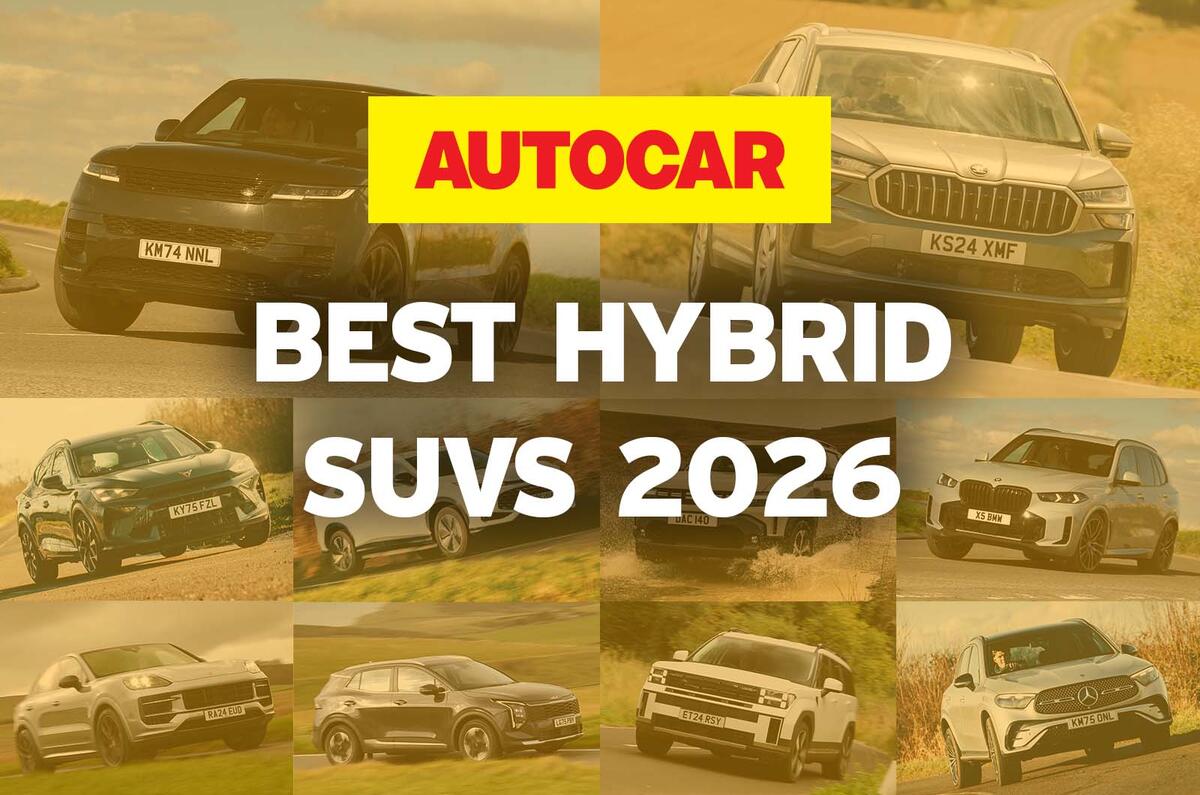
Currently reading: The best hybrid SUVs – PHEVs and regular hybrids rated
UP NEXT

We pick the very finest hybrid SUVs on the road, with compact, family and luxury models all making the cut

For those not yet sold on the idea of an electric family car, the vast and ever-growing variety of hybrids is proving more popular than ever – particularly among SUV drivers who require a family hauler that’s as parsimonious as it is practical. 

In a market that’s now divided by petrol and electric (and at a push diesel), hybrid SUVs are now the pragmatic alternative. 

From a hybrid SUV you get the seamless and smooth drivability of an EV for maximum urban efficiency plus the extra punch of a petrol engine for long-distance cruising. 

And while they’re a hit with families, company car drivers are also buying into the low benefit-in-kind tax rates that hybrids (HEVs) and plug-in hybrids (PHEVs) offer.  

SUVs are well suited to plug-in hybrid powertrains, their generous footprints enabling engineers to tuck the battery and motors neatly away without compromising interior space and practicality.

Right now we think the Skoda Kodiaq IV is the best hybrid SUV on sale. We were impressed by its comfort, interior usability, versatility and impressive electric-only range of up to 74 miles. 

https://images.cdn.autocar.co.uk/Best hybrid SUVs Skoda Kodiaq
  • Design8
  • Interior9
  • Performance8
  • Ride & Handling8
  • Costs9

Best for: All-round ability

The Volkswagen Tiguan, Volkswagen Passat, Skoda Superb and Skoda Kodiaq all share the same platform and powertrains, but it’s the Kodiaq that really stands out to us.

Corners are something the Kodiaq deals with remarkably well. Maybe too well. It grips reassuringly, it stays fairly level and lifting off the throttle will even start to bring the back around.

The PHEV version's impressive 74-mile electric range puts head and shoulders above most other PHEVs in its class, while its tall, practical design makes it a family-friendly powerhouse.

The middle row is so spacious that it rivals the Mercedes-Benz S-Class limousine for leg room. The boot is massive too, offering 745 litres worth of space.

There is a catch, though: there’s no seven-seat option for the PHEV. That’s exclusive to the pure-ICE models.

Advertisement

Read our review

Car review

Medium-sized SUV, the sales star of the Mercedes range, is re-engineered to stay fighting fit

Back to top
https://images.cdn.autocar.co.uk/Best hybrid SUVs Range Rover Sport
  • Design9
  • Interior9
  • Performance8
  • Ride & Handling8
  • Costs6

Best for: Luxury

Now in its third generation, the most dynamic of all Range Rover models is, unsurprisingly, the best Sport yet.

The car earns particular credit for its excellent mechanical refinement and smooth drivability.

At the heart of the car’s appeal is JLR's latest PHEV drivetrain, which combines a lusty 3.0-litre turbo petrol straight six with a gearbox-mounted electric motor and very generous, 38.2kWh battery.

The result is an impressive electric range of up to 76 miles. So provided you don't put too many heavy options or big wheels on your car, this is one of the few SUVs in our top 10 to give you access to 6% BIK tax. 

For cosseting luxury, no car on this list can match the Range Rover Sport, its spacious and opulent interior dripping in rich materials and the sort of slick tech that adds plenty of showroom appeal.

On the move, it’s nearly as quiet and comfy as the full-size Range Rover, but the addition of four-wheel steering and active anti-roll adds an extra dimension of agility and driver engagement.

Find Land Rover Range Rover Sport deals with Autocar

3. BMW X5

9
https://images.cdn.autocar.co.uk/Best hybrid SUVs BMW X5
  • Design8
  • Interior8
  • Performance9
  • Ride & Handling8
  • Costs6

Best for: Performance 

The star attraction of the X5 xDrive50e PHEV is its smooth 3.0-litre straight six, which works in tandem with an electric motor to give both a startling turn of speed and surprisingly low running costs.

Set the suspension to Sport mode and, while you’re always aware of the X5’s size and weight, it can be quite enjoyable on a twisty road.

This combination musters an impressive 485bhp and the electric motor has enough urge to make the car feel brisk enough while mooching around.

Speaking of which, thanks to a 25.7kWh battery, this X5 can travel on pure electricity for up to 66 miles, which is both nifty and allows it to qualify for 9% BIK tax.

Despite its 2495kg kerb weight, it's polished, slick and refined and controls its mass well with a compelling level of poise for such a big car. 

Read our BMW X5 review

Back to top
https://images.cdn.autocar.co.uk/
  • Design9
  • Interior8
  • Performance7
  • Ride & Handling7
  • Costs8

Best for: Space

The Santa Fe offers standout looks (love them or hate them), a huge amount of space, seven seats and a genuinely plush interior.

We would stick with the Premium, because the upper-level trims don't feel like a massive upgrade, either in terms of materials or features. The second-row captain's chairs aren't quite as adjustable as you might hope.

The range opens with a 1.6-litre hybrid powertrain, which uses a turbocharged petrol engine supported by an electric motor. Total power stands at 212bhp and 270lb ft, and it’s nice to drive, with electric power available in town. 

Hyundai’s seven-seater also offers a PHEV powertrain, which uses the same 1.6-litre turbocharged engine but with a 13.8kWh battery and a 96bhp electric motor. With 249bhp, the 0-62mph sprint takes just 9.3sec, which is competitive, but it’s slightly let down by its 33-mile electric range, which is behind much of the competition. 

Overall, though, the Santa Fe is a great hybrid SUV and should definitely be considered by those seeking a larger-than-average model.

Find Hyundai Santa Fe deals with Autocar

https://images.cdn.autocar.co.uk/Best hybrid SUVs Porsche Cayenne
  • Design7
  • Interior8
  • Performance9
  • Ride & Handling8
  • Costs6

Best for: Driver appeal

The Cayenne remains the segment's defining performance SUV. It has always offered knockout performance powertrains, but for its third generation Porsche put at least as much emphasis on PHEV power, in order to keep it relevant as the high-powered business executive's status SUV of choice.

The V6 makes more sense on paper. But should you buy a Porsche on paper?

Between the E-Hybrid, S E-Hybrid and Turbo E-Hybrid versions, there are now three PHEV models to choose from. 

The two lesser models combine V6 turbo petrol engines with their electric motors, with the S E-Hybrid making a little over 500bhp and managing 0-62mph in a little under 5.0sec. The Turbo E-Hybrid cuts this to 3.7sec and is one of few V8 hybrid PHEVs on the market, offering in excess of 700bhp. 

Bristling with driver appeal and with a refreshed interior packed with material quality and digital technology, there's no other PHEV quite like this - and few that justify a high price in such clear and direct sporting terms.

Back to top
https://images.cdn.autocar.co.uk/
  • Design9
  • Interior8
  • Performance8
  • Ride & Handling8
  • Costs7

Best for: Fun

If you’re willing to sacrifice some practicality and interior space for a generous helping of sporting flair then the Cupra Formentor is the PHEV of choice. 

It’s clearly no hot hatch, but the Formentor turns in well and tucks in neatly on a trailing throttle. It’s a very enjoyable steer.

With taut handling, a free-revving engine and a willingness to be driven hard, the Formentor is as rewarding to drive as a family PHEV can get.

Cupra has even managed to digitally mimic the sound of a five-cylinder engine, which gives it a bit more character on the fly.

Like the rest of Volkswagen Group’s PHEVs, the Formentor gets a 25.7kWh battery, which promises a range of up to 74 miles, or around 60-65 miles in the real world. 

Sure, it may not be the most practical car here, but with a solid electric range and pleasing dynamics, it certainly makes a strong case for itself. 

https://images.cdn.autocar.co.uk/
  • Design8
  • Interior8
  • Performance7
  • Ride & Handling8
  • Costs10

Best for: Small families

Is it the ruggedness of its design, the seamlessness of its usability and drivability, or perhaps its excellent economy that makes the Dacia Duster such an appealing family car?

This is a big statement, but I mean it: the Duster really could be all the car you're ever going to need.

Indeed, the Romanian value brand’s diminutive off-roader has a lot going for it, but it also makes a strong case for itself when it comes to running costs.

The Duster originally came with a 138bhp full hybrid powertrain but recently inherited the 156bhp unit from the Bigster. It will easily muster more than 50mpg day to day, if slightly less on the motorway. 

Prices for the full hybrid start from £25,000, undercutting rivals like the Hyundai Kona. Inside, the Duster is large and versatile enough to meet the daily needs of any family, plus its rides well and trumps all its rivals when it comes to off-road ability. 

Back to top

8. MG HS

7
https://images.cdn.autocar.co.uk/
  • Design7
  • Interior8
  • Performance7
  • Ride & Handling6
  • Costs9

Best for: Value

MG might be gunning for budget-busting value with the sub-£35k HS, but climb inside this roomy SUV and you would assume its list price was higher. 

On the motorway, the engine's contribution is more regular and important – but it always seems to run commendably quietly, unlike some hybrid systems.

Prod and poke the HS’s innards and you will be impressed by its material quality and overall fit and finish. It’s airy and spacious and there’s a generous amount of standard kit thrown in to keep you satisfied. 

What makes the HS really stand out is its 75-mile electric range, which is enough to rival more premium offerings from established European brands. 

Its road manners are pleasing too and there’s a level of maturity and sophistication to the ride.

Ultimately it's a solid all-round family car that offers much more than its sticker price suggests.

Read our MG HS review

Find MG Motor HS deals with Autocar

https://images.cdn.autocar.co.uk/
  • Design7
  • Interior7
  • Performance8
  • Ride & Handling8
  • Costs8

Best for: Versatility

You will have to look long and hard for a family car that is as practical as this. It's a fairly compact SUV but offers adult-appropriate passenger accommodation in both rows of seats and a robust and high-quality cabin.

The trim to go for is 3, as it comes with heated seats and digital instruments.

The 48V mild-hybrid powertrain will easily achieve more than 40mpg day to day, but if you want more electric range, we would wait for the inbound 261bhp plug-in hybrid variant (expect around 45 miles of range). 

The Sportage's slightly anodyne handling is unlikely to excite you, but its styling remains really distinctive and its ownership credentials are clear.

With distinctive looks, endless practicality and easy-going drivability, it’s easy to understand why the Sportage is a best-seller in a widely popular class. 

Back to top
https://images.cdn.autocar.co.uk/Mercedes-Benz GLC best hybrid SUV
  • Design8
  • Interior9
  • Performance8
  • Ride & Handling8
  • Costs7

Best for: Upmarket interior

If it's the potential for lots of electric-only running that attracts you to the idea of a hybrid SUV, one contender currently stands out clearly from the field: the Mercedes-Benz GLC 300e.

The GLC makes the BMW X3 feel a little ordinary and the Audi Q5 a touch joyless.

Mercedes fitted a whacking great 31.2kWh drive battery to this car for its second generation. That would have been unusually large for a full-size luxury SUV, let alone a mid-sized one. It makes the GLC 300e good for a claimed 83 miles of electric range - and one of few cars on this list that will get you a 5% BIK tax qualification even if you lavish plenty of options on it.

The snag is, however, that even base-spec models cost around £65,000. But this is a modern Mercedes SUV, which means it's not short of digital technology or luxury cabin feel.

The GLC 300e is driven by a 2.0-litre four-cylinder turbocharged petrol engine working in tandem with a 134bhp electric drive motor.

Weighing almost 2.3 tonnes, it's not the most dynamic drive in this list and struggles a little with vertical body control on country roads.

Find Mercedes-Benz GLC deals with Autocar

HOW TO CHOOSE THE BEST HYBRID SUV

Choosing the right hybrid depends entirely on your lifestyle and your access to charging. 

Here’s what you need to consider:

Hybrid type
Why it matters:
A self-charging hybrid might work better than a PHEV if you won’t have access to a home charger. 

  • 'Self-charging' or full hybrid (HEV): This is the best option if you can’t charge at home or do high annual mileage. They use a small battery to assist the engine, requiring no cables. They’re also generally cheaper to buy and more efficient than pure-petrol rivals. 
  • Plug-in hybrid (PHEV): If you have a driveway and a short commute, a PHEV is the car for you. They have larger batteries and typically offer anywhere between 40-80 miles of range. If you charge daily, you can do most of your driving without using a drop of petrol.

Fuel-economy when empty
Why it matters:
Once a PHEV’s battery is flat, you're essentially driving a heavy petrol car.

  • Are you a high-miler or a city-hopper?: If you frequently drive 200 miles or more on the motorway without charging, a regular hybrid or even a modern diesel might actually be more fuel-efficient than a PHEV.

Boot space and practicality
Why it matters:
Batteries have to go somewhere. In many hybrid SUVs, the battery lives under the boot floor, which can delete the hidden storage space or even reduce the main luggage area.

  • Boot space: Compare the hybrid's boot capacity against the pure-ICE version. 
  • Seven-seaters: If you need a seven-seater, be aware that many PHEVs lose the third row of seats entirely to make room for the electrical hardware. They also have smaller batteries with a shorter electric range. 

Charging
Why it matters:
Charging at home will make the biggest difference when it comes to slashing running costs. 

  • Home charging: A dedicated 7kW home wallbox will typically charge a PHEV in three to five hours.
  • Public charging: Some PHEVs now support rapid DC charging, which means that if you top up along the motorway, you won’t need to wait as long. But using the public network to charge will be considerably more expensive than charging at home.

How to decide if you actually need a hybrid SUV

A hybrid SUV makes sense if:

  • Most of your driving is in urban or suburban environments where the electric motor can do the heavy lifting.
  • You want the lower benefit-in-kind (BIK) tax rates associated with vehicles that have low official CO2 emissions (ie PHEVs).
  • You need the towing capacity or high driving position of an SUV but want to reduce your local emissions.

You shouldn’t buy a hybrid SUV if:

  • You spend 90% of your time on the motorway. 
  • You don’t have access to a home charger.
  • You need a larger car with a third row of seats. 

HOW WE TESTED AND SELECTED

When reviewing hybrid SUVs, we assess how effectively they bridge the gap between internal combustion and full electrification. Whether they're self-charging or plug-in hybrids, we focus on an SUVs core qualities of practicality, versatility and refinement. 

Here’s what we assessed:

Powertrain 
We evaluated how smoothly the petrol engine fires up under heavy acceleration. We also scrutinised regenerative braking feel – often a weak point of hybrids – to ensure a natural pedal response.

Efficiency and real-world range
For PHEVs, we measured the true electric-only range on UK motorways and A-roads to see how they compare to official WLTP claims. For self-charging hybrids, we monitored fuel economy across varied cycles – urban, rural, and long-distance – to see if the hybrid system actually delivers savings once the battery is depleted.

Refinement and performance
Hybrids often carry extra weight due to batteries. We evaluated how this affects ride quality and body control, particularly over undulations and through corners. We also measured cabin noise levels: a hybrid should be whisper-quiet in EV mode but remain refined when the petrol engine is running. 

Practicality
We measured boot space and checked for flat loading floors. We also tested the ease of installing child seats and the availability of storage for charging cables in PHEV models.

Technology
We assessed infotainment speed, the clarity of hybrid-specific energy displays and the effectiveness of driver assistance systems like adaptive cruise control, which help in the long-distance journeys these cars are built for.

FAQs

What is a hybrid SUV?

A hybrid SUV is a sports utility vehicle that combines two or more power sources to propel the vehicle. Generally, they pair an internal combustion engine (ICE) with a battery and a single (or dual) electric motor.

What types of hybrid SUVs are available? 

There are three types of hybrid, all of which are available in the UK.  The first is a mild hybrid (MHEV), which provides the least electrical assistance. An electric motor supports the engine, but MHEVs cannot be driven on electric power alone. They usually offer minor fuel savings over a regular internal combustion car.  A full hybrid (HEV) can run on both combustion and electric-only power, or both at the same time. Their pure electric usage is usually limited to lower speeds, such as driving through town.  Plug-in hybrids (PHEVs) also combine combustion engines and electric motors but are equipped with much larger batteries for prolonged driving on electric-only power. Some of the best and most expensive plug-in hybrids offer as much as 80 miles of electric-only driving, so if you keep them charged, you might never need to fill up the tank with fuel. While they can be quite heavy, they're usually significantly more powerful than their combustion-only counterparts. 

Which hybrid is best for me?

The type of hybrid car you choose will very much depend on your own personal use case.  Mild hybrids are useful for saving fuel on high-distance journeys, so are a good choice for those with long commutes.  Full hybrids are handy for those who drive in several different environments, such as through town, around a suburb and on faster motorways. As they can be used on electric-only for limited distances, they can be very useful for navigating through traffic silently, and keeping the air clean.  Plug-in hybrids, meanwhile, are a great choice for drivers who want to spend more time driving on electric-only power. If you've got the means to recharge the battery, they can often provide you with enough electric power so you'll never have to top up the tank at the pumps. If you're travelling longer distances, they can also offer considerable economy gains over standard petrol and diesel cars. Be warned, though: plug-in hybrids are often significantly more expensive to buy than regular combustion cars. 

Which hybrid is best for company car drivers?

Plug-in hybrids can be a brilliant option for company drivers. This is because they produce low CO2, meaning they fall into lower benefit-in-kind bands. Even cars with electric-only ranges of less than 30 miles will fall into the 14% BIK band, which is the fifth lowest band. Cars with ranges between 40-69 miles are in the 8% BIK band, while others with 70-129 miles (of which there is a growing number of cars available) are just 5%.  In short, if you want a company car and aren't quite ready for all-electric power, a plug-in hybrid is the way to go. 

Which car companies make hybrid cars?

Hybrids have risen in popularity over the past five years or so, and you'll struggle to find a car maker that doesn't offer electrification. Lexus, Toyota and Suzuki are some of the pioneers of hybrid power with remarkable reliability records, while other brands including BMW, Volkswagen and Audi are also experienced with the technology. Even the more premium sports car brands, such as Lamborghini, Porsche and McLaren, are also responding to the increased importance of electrification. 

Join our WhatsApp community and be the first to read about the latest news and reviews wowing the car world. Our community is the best, easiest and most direct place to tap into the minds of Autocar, and if you join you’ll also be treated to unique WhatsApp content. You can leave at any time after joining - check our full privacy policy here.

Murray Scullion

Murray Scullion
Title: Digital editor

Murray has been a journalist for more than a decade. During that time he’s written for magazines, newspapers and websites, but he now finds himself as Autocar’s digital editor.

He leads the output of the website and contributes to all other digital aspects, including the social media channels, podcasts and videos. During his time he has reviewed cars ranging from £50 - £500,000, including Austin Allegros and Ferrari 812 Superfasts. He has also interviewed F1 megastars, knows his PCPs from his HPs and has written, researched and experimented with behavioural surplus and driverless technology.

Murray graduated from the University of Derby with a BA in Journalism in 2014 and has previously written for Classic Car Weekly, Modern Classics Magazine, buyacar.co.uk, parkers.co.uk and CAR Magazine, as well as carmagazine.co.uk.

Sam Phillips

Sam Phillips
Title: Staff Writer

Sam joined the Autocar team in summer 2024 and has been a contributor since 2021. He is tasked with writing used reviews and first drives as well as updating top 10s and evergreen content on the Autocar website. 

He previously led sister-title Move Electric, which covers the entire spectrum of electric vehicles, from cars to boats – and even trucks. He is an expert in new car news, used cars, electric cars, microbility, classic cars and motorsport. 

Sam graduated from Nottingham Trent University in 2021 with a BA in Journalism. In his final year he produced an in-depth feature on the automotive industry’s transition to electric cars and interviewed a number of leading experts to assess our readiness for the impending ban on the sale of petrol and diesel cars.

Join the debate

Comments
16
Add a comment…
scotty5 28 February 2026

Not on the list is VW Tayron which is essentially the same as the Kodiaq. Depending on your configuration, and against popular opinion, the Tayron can work out cheaper than the Skoda mainly down to the cost Skoda charges for options. That's coming from someone who had a Kodiaq ICE.

The problem? I ordered a Tayron in R-Line Edition spec. 16wk delivery I was told. Then it went to 20wk. The 5mth wait then went to 8mth. That's the point where cancelled the order.

Yeh, fine cars, even better if the manufacturer is able to supply it.

A note of caution to anyone considering a PHEV over an ICE,  my advice would be to get an insurance quote first because some of the cars mentioned above commanded a hefty premium over their ICE and in some cases, EV counterpart.   

Morsuly 10 December 2025

I’m right in the middle of this dilemma because I plan to buy a new car next year and a hybrid SUV is at the top of my list. The Kodiaq PHEV and Sportage both look like that perfect in-between step before going fully electric. Most of my driving is school runs and a weekly motorway trip, so decent EV range plus petrol backup feels ideal. I’ve started checking total ownership costs more carefully now, finance, servicing, even random things like https://mepco.pissedconsumer.com/customer-service.html because hybrids only really shine when the numbers and the daily routine both work for you.

Qucetal 10 December 2025

Hybrid SUVs are a great middle ground if you want to cut fuel bills without going fully electric. The Skoda Kodiaq PHEV stands out with big-car space, a huge 71‑mile electric range and a comfortable, family‑friendly cabin.​