AT Show in Used Car dropdown menu:
AT Show in app feed:
AT Show in car finder dropdown menu:
AT Make Id:
a3a4e028fc21897ef425b5f801ac8b48
The compact exec has always been the first choice of company car drivers looking to cut a dash, but the tax-slashing benefits of going electric mean that corporate tastes have changed.
The Tesla Model 3 has become the user-chooser's first choice, its blend of tech, range, fast charging and rock-bottom tax bills making it a perennial sales chart fixture since it arrived here in 2018. Moreover, it has been joined in the past year or so by a growing number of upstart EV rivals keen to take a slice of this profitable pie.
One of the latest to land is the MG IM5, which actually isn't an MG at all. (You will search in vain for any sign of an octagonal Morris Garages logo.) Instead, it's a rebadged Intelligence in Motion L6, a slick executive saloon that's the product of a joint venture with MG owner SAIC. No matter what it's called, it's hard to ignore the car's sleek lines, massive 100kWh battery, 441-mile range and £44,995 price, plus a tech spec that runs to four-wheel steer and 800V architecture.
The old guard aren't giving up without a fight, though. Like many European brands, Mercedes-Benz has been hampered by legislative flip-flopping and shackled by the need to deliver both battery-powered and combustion-engined models, often offering two totally bespoke machines in effectively the same class (the E-Class and EQE, for example).
With the new CLA, however, it's taking a more joined-up approach. The first car to be built on the brand's new MMA architecture, it's engineered to seamlessly accept any powertrain. For this CLA 250+, that means a highly efficient 85kWh nickel-manganese-cobalt battery and a clever, rear-mounted 268bhp motor with a silicon-carbide inverter that offers lower weight and a more compact size.
There's also a Porsche Taycan-style two-speed transmission and 800V architecture for an ability to charge at 320kW (behind the MG's 396kW but ahead of the Tesla's 250kW). Oh, and a not insignificant claimed range of 484 miles, which is enough to calm the nerves of even the most anxious long-distance traveller.
Alive to the dangers of this challenge to its supremacy, Tesla has revised the Model 3 with an upgraded battery (it's the same size, but software tweaks have made it more efficient) and, praise be, the addition of an indicator stalk, which was bizarrely deleted when the new model was launched just under two years ago.
The Single Motor Long Range version we requested for this test can now travel up to 466 miles between charges. The more expensive and powerful Dual Motor that actually turned up at our offices offers a still impressive 410 miles.
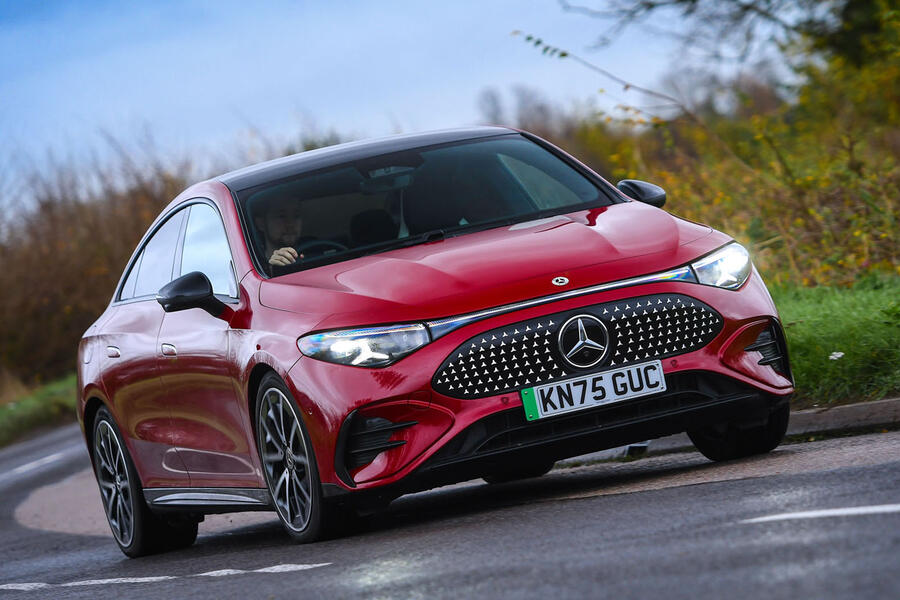
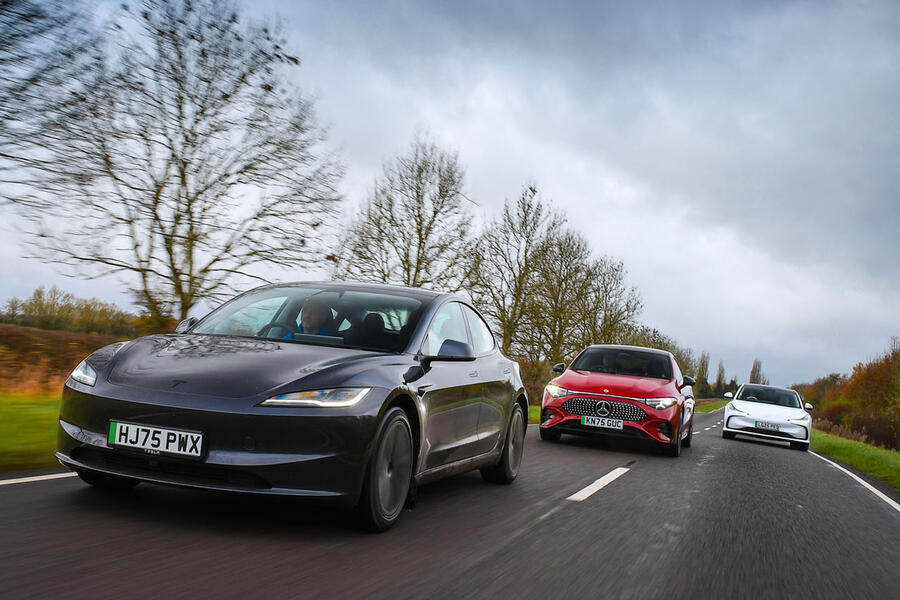
Despite being the newest model here, the Merc looks the most conventional, with its vast three-pointed-star-emblazoned 'radiator' and a slinky silhouette that owes a lot to its predecessor. It's also the slipperiest, cleaving through the air with a Cd of just 0.21. Meanwhile, the sweeping and strobing light show put on by its LED-encrusted grille when unlocking the car prompted one young passer-by to declare it "low-key sick". Praise does not come much higher, apparently.
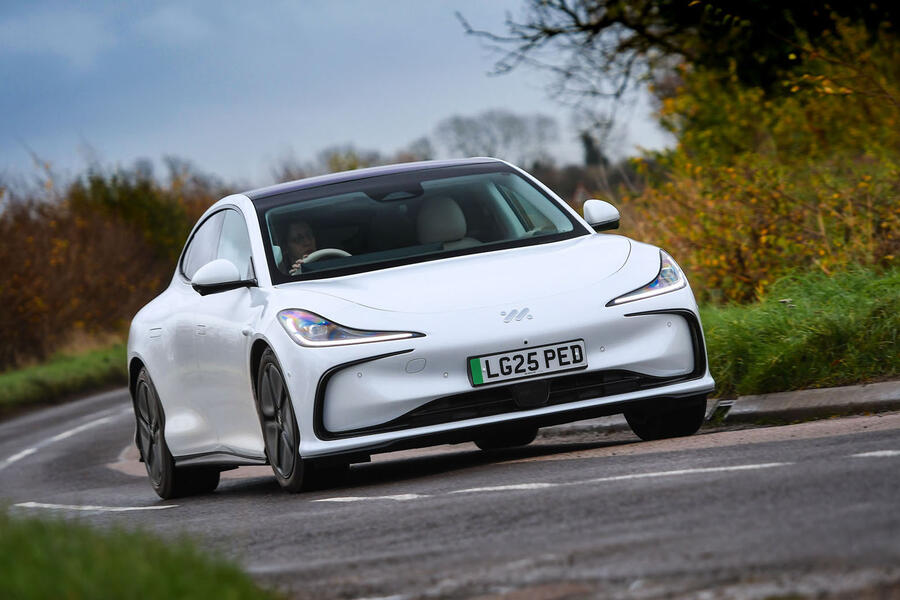
What the MG lacks in eye-dazzling illuminations it makes up for in sheer presence. At 4931mm long, the IM5 is actually closer in size to cars from the class above, such as the BMW i5. It's not exactly distinctive, but the curvaceous and low-slung Chinese saloon does just enough to claim premium credentials.
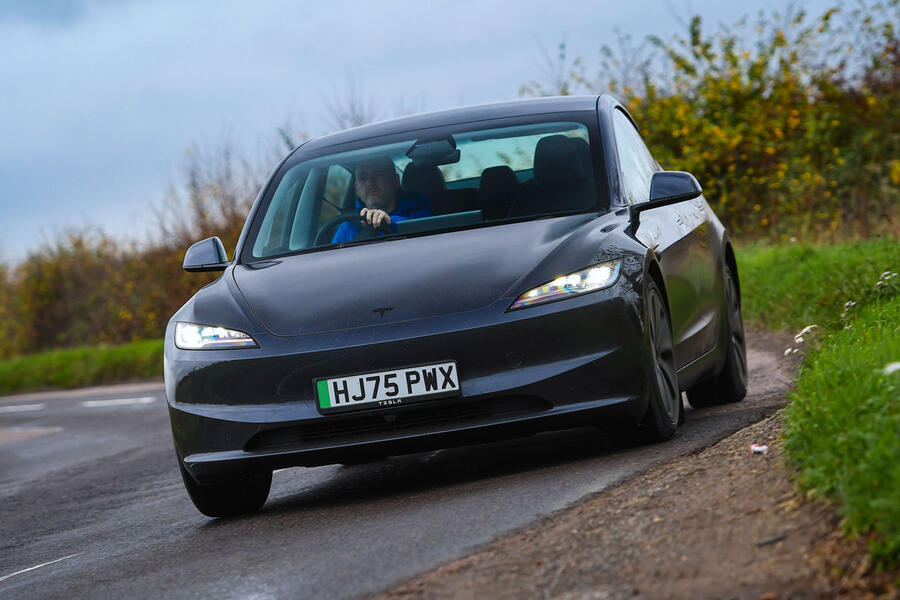
And the Tesla? The slimmer lights, introduced as part of the 'Highland' update, have kept the Model 3 looking fresh, but such is the car's ubiquity that it fails to get a look-in alongside its newer rivals. That said, the old-stager manages to turn the tables on its rivals when it comes to interior style.
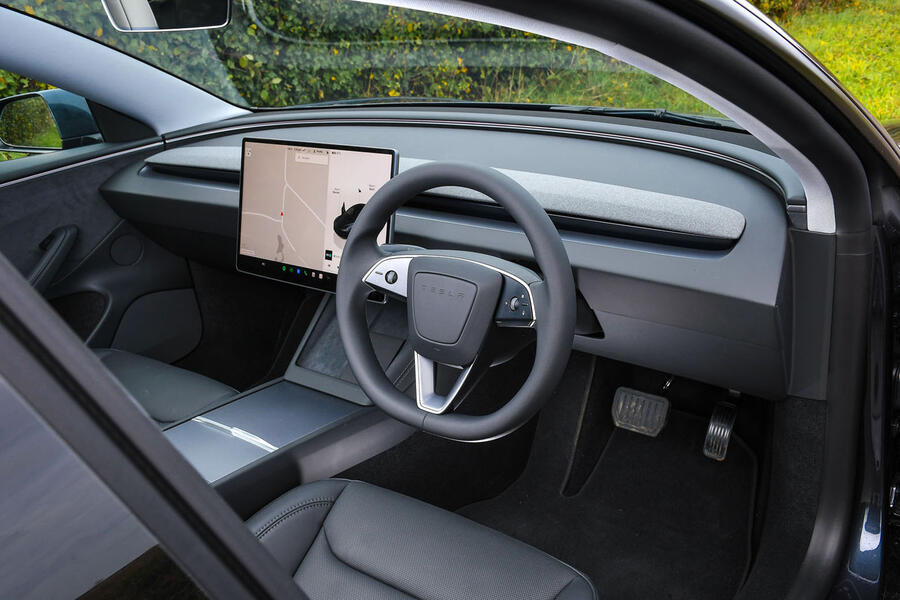
Tesla's minimalist design ethos and large glasshouse - it's the only one with a true panoramic roof, the glass stretching from the top of the windscreen to the base of the rear window - create a bright and airy feel, while the quality and fit and finish of the materials finally match Tesla's premium aspirations.
As ever, the dashboard is dominated by the large touchscreen, which is the easiest to operate here, with crisp responses and logical menus. And did we mention there's now an indicator stalk?
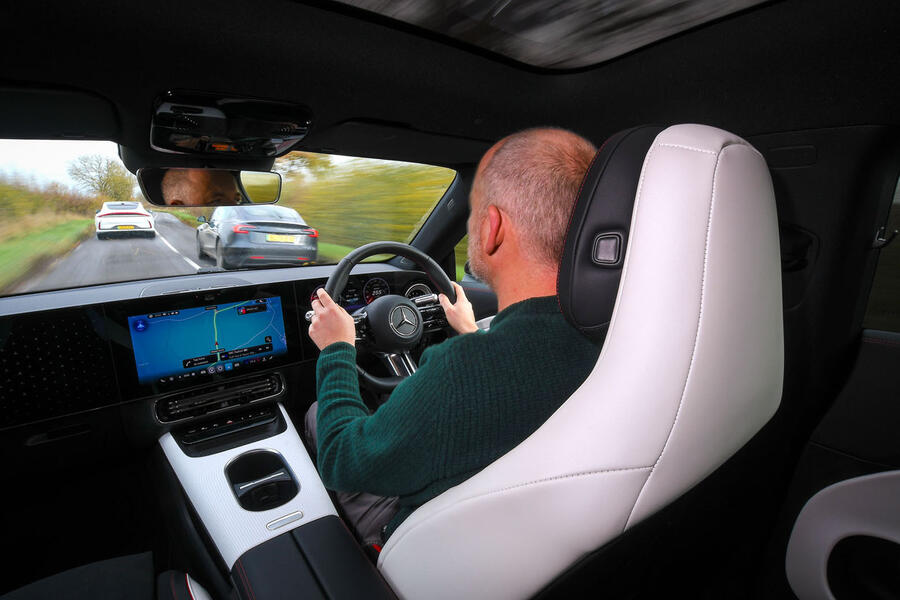
As with its exterior, the Merc's cabin is the most showy, particularly in our test car's garish black and white finish, complete with ambient lighting seemingly lifted from a Stuttgart nightclub. The slab-fronted dash looks a little tacked on and the glossy black finish isn't as upmarket as the brand imagines, but the infotainment almost matches Tesla for slick operation and there are even some physical buttons.
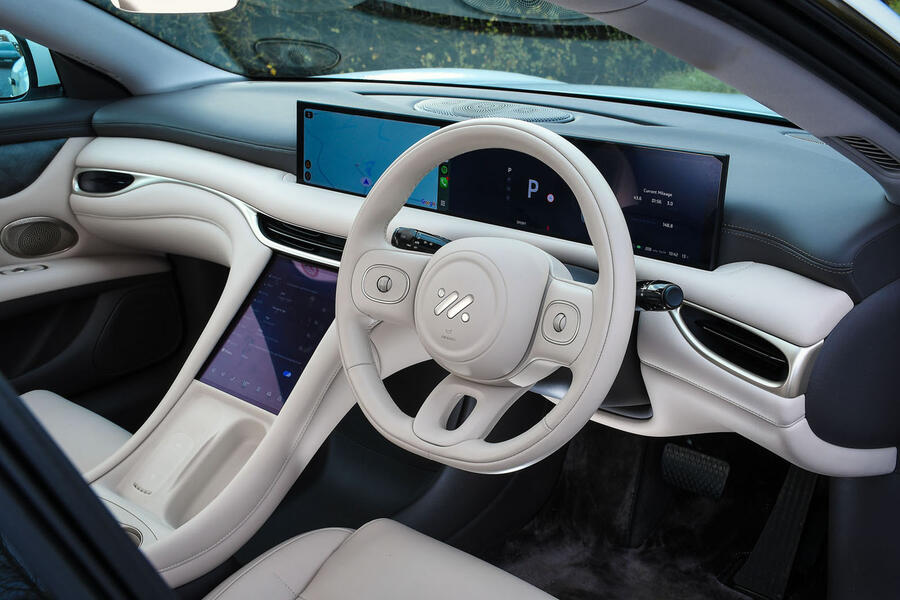
Sitting between these two is the MG, which on first impressions certainly looks and feels the part. Soft-touch materials are everywhere and build quality is easily on a par with its rivals here. Yet it's all a little generic and the impressive-looking touchscreens are fiddly to use (even simple operations keep your eyes off the road long enough for the driver distraction warning to squawk at you), as are the unmarked steering wheel-mounted rollers.
Perhaps most surprising, given its imposing external dimensions, the MG feels a little cramped inside. Those in the rear get no more space than in the more compact CLA, and neither can quite match the roomier Model 3 for occupant accommodation.
The IM5 hits back with a more practical hatchback opening for the luggage area, but all three provide around 500 litres of carrying capacity (the Tesla closer to 700), if you take into account overspill space in the various frunks. So much for practicality.
It's time to drive. First up is the MG and initial reactions are positive. You sit nice and low in the car while, with 402bhp on tap, performance is quick, almost matching the dual-motor Model 3 for instant, horizon-reeling urge. At 2210kg, it is the heaviest here but will still fire from standstill to 62mph in 4.9sec. Sport mode adds some extra zest to the throttle mapping, even if it offers no more actual pace.
Of more concern is the lack of traction, on the wet and greasy roads of our test route at least. Squeeze the throttle with intent and the MG's rear end can slip and slide briefly before the traction control abruptly and scrappily gets a handle on the situation. Incredibly you can actually partially disengage the safety net, which results in enough tyre smoke to impress a Santa Pod season ticket holder.
Obviously there are no such issues with the all-wheel-drive, dual-motor Tesla, which takes the drag strip spoils here. Combining a remarkably low 1840kg mass with 394bhp, it will zip to 62mph in just 4.2sec. Yet our experience of the 315bhp Single Motor version suggests that choosing the cheaper model won't leave you feeling less exhilarated as it matches the MG, to the tenth, in the benchmark sprint.
What's more remarkable is that it combines this turn of speed with an incredibly modest appetite for electricity. We managed an impressive 4.0mpkWh during our hard-driven time with the car and the two-wheel-drive version will be more parsimonious still. The lower-powered Merc came closest to matching it, with 3.9mpkWh. The MG trailed both by a significant margin, with 3.0mpkWh.
Given its relatively lowly 268bhp and a kerb weight of 1980kg, it's no shock to discover the Mercedes is the least swift of our three, requiring nearly two seconds longer than the IM5 to rush to 62mph. Yet, as with all EVs, the CLA's instant low-speed response means it feels faster than the numbers suggest, and the jolt you get as the transmission shifts between its two gears adds a little drama to proceedings.
However, knockout performance is part and parcel of the EV experience these days. Of more importance for any car wanting to rise above its rivals in the compact exec class is the ability to match its pace to a carefully balanced blend of handling elan and soothing comfort.
With its four-wheel steering, the IM5 has a neat technical trick up its sleeve to try to offset its extra mass and length. This lends the car remarkable agility around town, where it feels as wieldy as the smaller CLA. It also gives the MG a heightened sense of tippy-toed agility when the roads get faster because little steering input is required for it to slice cleanly through corners with nicely neutral composure.
There's decent weighting to the steering too, while the body stays incredibly level and grip levels in the dry are high. In the wet, that lack of traction means you need to be wary, even with the safety systems engaged. Yet while it's precise and fairly well composed, the MG fails to engage or entertain, simply going where you point it with clinical efficiency. It's effective and accurate, but fairly humourless.
On the plus side, it's extremely relaxing at a cruise, with low noise levels and, over smoothly surfaced roads, an effortlessly languid gait. On more torn Tarmac, however, the car starts to feel a little unsettled and jittery. The adaptive dampers and air springs from the larger IM6 wouldn't go amiss here.
By contrast, the CLA has a firmer ride but its greater damping control means it nicely rounds off the sharper edges of nastier surface imperfections. It's equally quiet too. That wind-cheating shape allows it to slip effortlessly through the air, while road and suspension intrusions are kept to a minimum.
So it comes as a surprise that the mollifying Merc is up for a laugh when you're in the mood for something more energetic. The steering is the lightest here, even in Sport mode, and it has the slowest-paced rack, but tip the CLA into a corner and you will find taut body control and a front end that bites convincingly while the rest of the car pivots pleasingly around your hips.
More impressively, careful calibration of the motor's mapping means that you can even tighten your line using the throttle. With the ESP disengaged, the CLA will actually indulge in a little gigglesome power oversteer. There's genuine fun to be had here.
Sitting somewhere between the Mercedes and the MG is the Tesla. The double-wishbone set-up is still on the firm side, but it's never anything other than comfortable and the well-judged matching of control weights makes the Model 3 easy to rub along with from the moment you slide behind the wheel.
The standard two-wheel-drive car feels slightly sweeter and fleeter of foot, but this dual-motor model shares the same keen turn-in, impressive resistance to roll and an almost mid-engined willingness to change direction. It's not quite as expressive as the Mercedes, but the Tesla gives you options to subtly trim your line mid-corner.
Regardless of the version, you still can't change its one-pedal regenerative braking but it's the most natural-feeling here. By contrast, in its most aggressive setting the CLA's retardation is so severe as to be unpleasant and near enough unusable. The Model 3 also has the best brake feel here, with a firm and positive action. The MG's stoppers can be a little grabby, the Merc's pedal a little squishy.
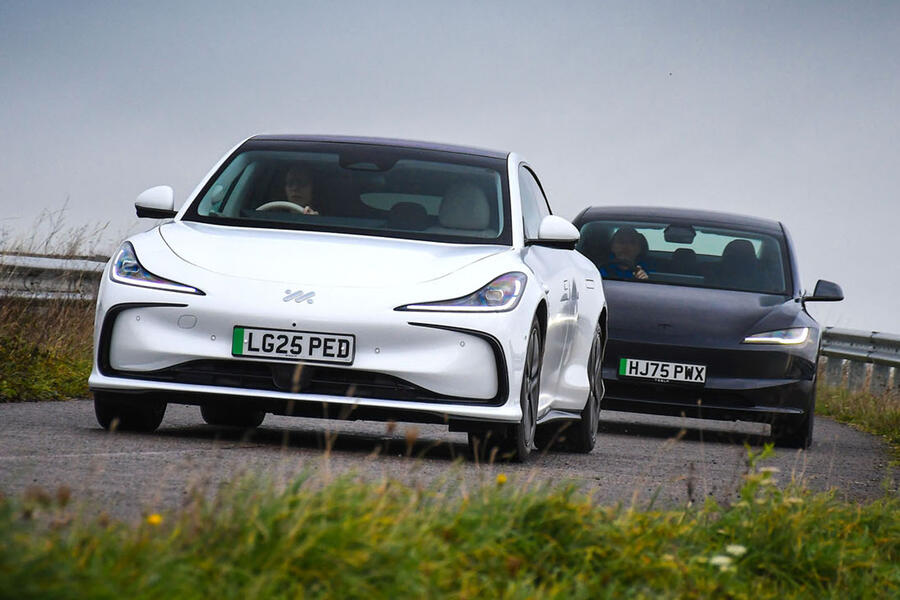
So, another win for Tesla? Well, yes, but it's certainly close. In its current form, the Model 3 remains one of the best electric all-rounders in the business, and that's before you take into account its remarkable efficiency, eye-catching pricing and 0% finance deals.
Yet the Mercedes pretty much matches the Tesla for trailblazing EV tech while also offering a little more dynamic polish and even greater driver engagement. Only in outright urge does the CLA trail the Model 3, plus it costs a little more. But if you were to choose it over the Tesla, we would completely understand.
That leaves the IM5 in third place, but you should be in no doubt that the Chinese newcomer already has the raw ingredients to make life difficult for legacy brands, which now have to include Tesla among their number. For what is effectively a first attempt to topple the compact executive elite, this is a seriously impressive effort.
Factor in the rate of improvement already shown by companies like MG and established operators should be worrying that their 3 Series moment might not be far away.
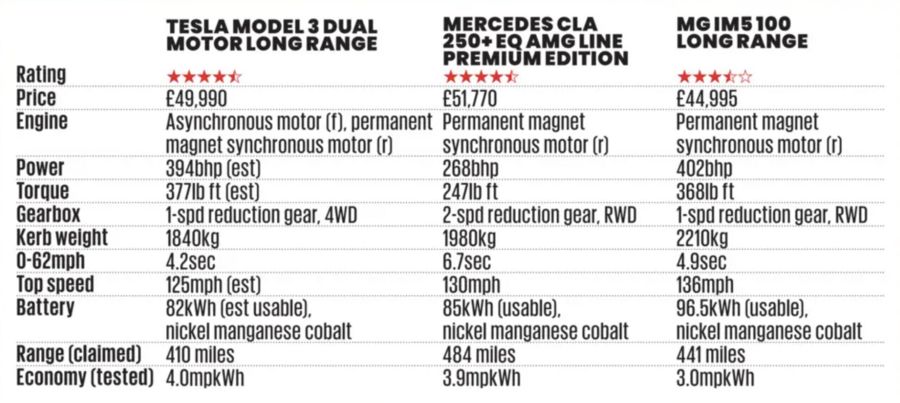
1st: The current Model 3 remains Tesla's most mature offering, with a compelling blend of talents and strong practicality. It's also attractively priced now.
2nd: Good to drive, packed with kerb appeal and promising impressive efficiency, the CLA shows that the old guard isn't ready to throw in the towel just yet.
3rd: The big MG is comfortable, quick and competent, plus it's bursting with tech. But there are some dynamic rough edges and it lacks character.
The compact exec has always been the first choice of company car drivers looking to cut a dash, but the tax-slashing benefits of going electric mean that corporate tastes have changed.
The Tesla Model 3 has become the user-chooser's first choice, its blend of tech, range, fast charging and rock-bottom tax bills making it a perennial sales chart fixture since it arrived here in 2018. Moreover, it has been joined in the past year or so by a growing number of upstart EV rivals keen to take a slice of this profitable pie.
One of the latest to land is the MG IM5, which actually isn't an MG at all. (You will search in vain for any sign of an octagonal Morris Garages logo.) Instead, it's a rebadged Intelligence in Motion L6, a slick executive saloon that's the product of a joint venture with MG owner SAIC. No matter what it's called, it's hard to ignore the car's sleek lines, massive 100kWh battery, 441-mile range and £44,995 price, plus a tech spec that runs to four-wheel steer and 800V architecture.
The old guard aren't giving up without a fight, though. Like many European brands, Mercedes-Benz has been hampered by legislative flip-flopping and shackled by the need to deliver both battery-powered and combustion-engined models, often offering two totally bespoke machines in effectively the same class (the E-Class and EQE, for example).
With the new CLA, however, it's taking a more joined-up approach. The first car to be built on the brand's new MMA architecture, it's engineered to seamlessly accept any powertrain. For this CLA 250+, that means a highly efficient 85kWh nickel-manganese-cobalt battery and a clever, rear-mounted 268bhp motor with a silicon-carbide inverter that offers lower weight and a more compact size.
There's also a Porsche Taycan-style two-speed transmission and 800V architecture for an ability to charge at 320kW (behind the MG's 396kW but ahead of the Tesla's 250kW). Oh, and a not insignificant claimed range of 484 miles, which is enough to calm the nerves of even the most anxious long-distance traveller.
Alive to the dangers of this challenge to its supremacy, Tesla has revised the Model 3 with an upgraded battery (it's the same size, but software tweaks have made it more efficient) and, praise be, the addition of an indicator stalk, which was bizarrely deleted when the new model was launched just under two years ago.
The Single Motor Long Range version we requested for this test can now travel up to 466 miles between charges. The more expensive and powerful Dual Motor that actually turned up at our offices offers a still impressive 410 miles.
Despite being the newest model here, the Merc looks the most conventional, with its vast three-pointed-star-emblazoned 'radiator' and a slinky silhouette that owes a lot to its predecessor. It's also the slipperiest, cleaving through the air with a Cd of just 0.21. Meanwhile, the sweeping and strobing light show put on by its LED-encrusted grille when unlocking the car prompted one young passer-by to declare it "low-key sick". Praise does not come much higher, apparently.
What the MG lacks in eye-dazzling illuminations it makes up for in sheer presence. At 4931mm long, the IM5 is actually closer in size to cars from the class above, such as the BMW i5. It's not exactly distinctive, but the curvaceous and low-slung Chinese saloon does just enough to claim premium credentials.
And the Tesla? The slimmer lights, introduced as part of the 'Highland' update, have kept the Model 3 looking fresh, but such is the car's ubiquity that it fails to get a look-in alongside its newer rivals. That said, the old-stager manages to turn the tables on its rivals when it comes to interior style.
Tesla's minimalist design ethos and large glasshouse - it's the only one with a true panoramic roof, the glass stretching from the top of the windscreen to the base of the rear window - create a bright and airy feel, while the quality and fit and finish of the materials finally match Tesla's premium aspirations.
As ever, the dashboard is dominated by the large touchscreen, which is the easiest to operate here, with crisp responses and logical menus. And did we mention there's now an indicator stalk?
As with its exterior, the Merc's cabin is the most showy, particularly in our test car's garish black and white finish, complete with ambient lighting seemingly lifted from a Stuttgart nightclub. The slab-fronted dash looks a little tacked on and the glossy black finish isn't as upmarket as the brand imagines, but the infotainment almost matches Tesla for slick operation and there are even some physical buttons.
Sitting between these two is the MG, which on first impressions certainly looks and feels the part. Soft-touch materials are everywhere and build quality is easily on a par with its rivals here. Yet it's all a little generic and the impressive-looking touchscreens are fiddly to use (even simple operations keep your eyes off the road long enough for the driver distraction warning to squawk at you), as are the unmarked steering wheel-mounted rollers.
Perhaps most surprising, given its imposing external dimensions, the MG feels a little cramped inside. Those in the rear get no more space than in the more compact CLA, and neither can quite match the roomier Model 3 for occupant accommodation.
The IM5 hits back with a more practical hatchback opening for the luggage area, but all three provide around 500 litres of carrying capacity (the Tesla closer to 700), if you take into account overspill space in the various frunks. So much for practicality.
It's time to drive. First up is the MG and initial reactions are positive. You sit nice and low in the car while, with 402bhp on tap, performance is quick, almost matching the dual-motor Model 3 for instant, horizon-reeling urge. At 2210kg, it is the heaviest here but will still fire from standstill to 62mph in 4.9sec. Sport mode adds some extra zest to the throttle mapping, even if it offers no more actual pace.
Of more concern is the lack of traction, on the wet and greasy roads of our test route at least. Squeeze the throttle with intent and the MG's rear end can slip and slide briefly before the traction control abruptly and scrappily gets a handle on the situation. Incredibly you can actually partially disengage the safety net, which results in enough tyre smoke to impress a Santa Pod season ticket holder.
Obviously there are no such issues with the all-wheel-drive, dual-motor Tesla, which takes the drag strip spoils here. Combining a remarkably low 1840kg mass with 394bhp, it will zip to 62mph in just 4.2sec. Yet our experience of the 315bhp Single Motor version suggests that choosing the cheaper model won't leave you feeling less exhilarated as it matches the MG, to the tenth, in the benchmark sprint.
What's more remarkable is that it combines this turn of speed with an incredibly modest appetite for electricity. We managed an impressive 4.0mpkWh during our hard-driven time with the car and the two-wheel-drive version will be more parsimonious still. The lower-powered Merc came closest to matching it, with 3.9mpkWh. The MG trailed both by a significant margin, with 3.0mpkWh.
Given its relatively lowly 268bhp and a kerb weight of 1980kg, it's no shock to discover the Mercedes is the least swift of our three, requiring nearly two seconds longer than the IM5 to rush to 62mph. Yet, as with all EVs, the CLA's instant low-speed response means it feels faster than the numbers suggest, and the jolt you get as the transmission shifts between its two gears adds a little drama to proceedings.
However, knockout performance is part and parcel of the EV experience these days. Of more importance for any car wanting to rise above its rivals in the compact exec class is the ability to match its pace to a carefully balanced blend of handling elan and soothing comfort.
With its four-wheel steering, the IM5 has a neat technical trick up its sleeve to try to offset its extra mass and length. This lends the car remarkable agility around town, where it feels as wieldy as the smaller CLA. It also gives the MG a heightened sense of tippy-toed agility when the roads get faster because little steering input is required for it to slice cleanly through corners with nicely neutral composure.
There's decent weighting to the steering too, while the body stays incredibly level and grip levels in the dry are high. In the wet, that lack of traction means you need to be wary, even with the safety systems engaged. Yet while it's precise and fairly well composed, the MG fails to engage or entertain, simply going where you point it with clinical efficiency. It's effective and accurate, but fairly humourless.
On the plus side, it's extremely relaxing at a cruise, with low noise levels and, over smoothly surfaced roads, an effortlessly languid gait. On more torn Tarmac, however, the car starts to feel a little unsettled and jittery. The adaptive dampers and air springs from the larger IM6 wouldn't go amiss here.
By contrast, the CLA has a firmer ride but its greater damping control means it nicely rounds off the sharper edges of nastier surface imperfections. It's equally quiet too. That wind-cheating shape allows it to slip effortlessly through the air, while road and suspension intrusions are kept to a minimum.
So it comes as a surprise that the mollifying Merc is up for a laugh when you're in the mood for something more energetic. The steering is the lightest here, even in Sport mode, and it has the slowest-paced rack, but tip the CLA into a corner and you will find taut body control and a front end that bites convincingly while the rest of the car pivots pleasingly around your hips.
More impressively, careful calibration of the motor's mapping means that you can even tighten your line using the throttle. With the ESP disengaged, the CLA will actually indulge in a little gigglesome power oversteer. There's genuine fun to be had here.
Sitting somewhere between the Mercedes and the MG is the Tesla. The double-wishbone set-up is still on the firm side, but it's never anything other than comfortable and the well-judged matching of control weights makes the Model 3 easy to rub along with from the moment you slide behind the wheel.
The standard two-wheel-drive car feels slightly sweeter and fleeter of foot, but this dual-motor model shares the same keen turn-in, impressive resistance to roll and an almost mid-engined willingness to change direction. It's not quite as expressive as the Mercedes, but the Tesla gives you options to subtly trim your line mid-corner.
Regardless of the version, you still can't change its one-pedal regenerative braking but it's the most natural-feeling here. By contrast, in its most aggressive setting the CLA's retardation is so severe as to be unpleasant and near enough unusable. The Model 3 also has the best brake feel here, with a firm and positive action. The MG's stoppers can be a little grabby, the Merc's pedal a little squishy.
So, another win for Tesla? Well, yes, but it's certainly close. In its current form, the Model 3 remains one of the best electric all-rounders in the business, and that's before you take into account its remarkable efficiency, eye-catching pricing and 0% finance deals.
Yet the Mercedes pretty much matches the Tesla for trailblazing EV tech while also offering a little more dynamic polish and even greater driver engagement. Only in outright urge does the CLA trail the Model 3, plus it costs a little more. But if you were to choose it over the Tesla, we would completely understand.
That leaves the IM5 in third place, but you should be in no doubt that the Chinese newcomer already has the raw ingredients to make life difficult for legacy brands, which now have to include Tesla among their number. For what is effectively a first attempt to topple the compact executive elite, this is a seriously impressive effort.
Factor in the rate of improvement already shown by companies like MG and established operators should be worrying that their 3 Series moment might not be far away.
1st: The current Model 3 remains Tesla's most mature offering, with a compelling blend of talents and strong practicality. It's also attractively priced now.
2nd: Good to drive, packed with kerb appeal and promising impressive efficiency, the CLA shows that the old guard isn't ready to throw in the towel just yet.
3rd: The big MG is comfortable, quick and competent, plus it's bursting with tech. But there are some dynamic rough edges and it lacks character.
The compact exec has always been the first choice of company car drivers looking to cut a dash, but the tax-slashing benefits of going electric mean that corporate tastes have changed.
The Tesla Model 3 has become the user-chooser's first choice, its blend of tech, range, fast charging and rock-bottom tax bills making it a perennial sales chart fixture since it arrived here in 2018. Moreover, it has been joined in the past year or so by a growing number of upstart EV rivals keen to take a slice of this profitable pie.
One of the latest to land is the MG IM5, which actually isn't an MG at all. (You will search in vain for any sign of an octagonal Morris Garages logo.) Instead, it's a rebadged Intelligence in Motion L6, a slick executive saloon that's the product of a joint venture with MG owner SAIC. No matter what it's called, it's hard to ignore the car's sleek lines, massive 100kWh battery, 441-mile range and £44,995 price, plus a tech spec that runs to four-wheel steer and 800V architecture.
The old guard aren't giving up without a fight, though. Like many European brands, Mercedes-Benz has been hampered by legislative flip-flopping and shackled by the need to deliver both battery-powered and combustion-engined models, often offering two totally bespoke machines in effectively the same class (the E-Class and EQE, for example).
With the new CLA, however, it's taking a more joined-up approach. The first car to be built on the brand's new MMA architecture, it's engineered to seamlessly accept any powertrain. For this CLA 250+, that means a highly efficient 85kWh nickel-manganese-cobalt battery and a clever, rear-mounted 268bhp motor with a silicon-carbide inverter that offers lower weight and a more compact size.
There's also a Porsche Taycan-style two-speed transmission and 800V architecture for an ability to charge at 320kW (behind the MG's 396kW but ahead of the Tesla's 250kW). Oh, and a not insignificant claimed range of 484 miles, which is enough to calm the nerves of even the most anxious long-distance traveller.
Alive to the dangers of this challenge to its supremacy, Tesla has revised the Model 3 with an upgraded battery (it's the same size, but software tweaks have made it more efficient) and, praise be, the addition of an indicator stalk, which was bizarrely deleted when the new model was launched just under two years ago.
The Single Motor Long Range version we requested for this test can now travel up to 466 miles between charges. The more expensive and powerful Dual Motor that actually turned up at our offices offers a still impressive 410 miles.
Despite being the newest model here, the Merc looks the most conventional, with its vast three-pointed-star-emblazoned 'radiator' and a slinky silhouette that owes a lot to its predecessor. It's also the slipperiest, cleaving through the air with a Cd of just 0.21. Meanwhile, the sweeping and strobing light show put on by its LED-encrusted grille when unlocking the car prompted one young passer-by to declare it "low-key sick". Praise does not come much higher, apparently.
What the MG lacks in eye-dazzling illuminations it makes up for in sheer presence. At 4931mm long, the IM5 is actually closer in size to cars from the class above, such as the BMW i5. It's not exactly distinctive, but the curvaceous and low-slung Chinese saloon does just enough to claim premium credentials.
And the Tesla? The slimmer lights, introduced as part of the 'Highland' update, have kept the Model 3 looking fresh, but such is the car's ubiquity that it fails to get a look-in alongside its newer rivals. That said, the old-stager manages to turn the tables on its rivals when it comes to interior style.
Tesla's minimalist design ethos and large glasshouse - it's the only one with a true panoramic roof, the glass stretching from the top of the windscreen to the base of the rear window - create a bright and airy feel, while the quality and fit and finish of the materials finally match Tesla's premium aspirations.
As ever, the dashboard is dominated by the large touchscreen, which is the easiest to operate here, with crisp responses and logical menus. And did we mention there's now an indicator stalk?
As with its exterior, the Merc's cabin is the most showy, particularly in our test car's garish black and white finish, complete with ambient lighting seemingly lifted from a Stuttgart nightclub. The slab-fronted dash looks a little tacked on and the glossy black finish isn't as upmarket as the brand imagines, but the infotainment almost matches Tesla for slick operation and there are even some physical buttons.
Sitting between these two is the MG, which on first impressions certainly looks and feels the part. Soft-touch materials are everywhere and build quality is easily on a par with its rivals here. Yet it's all a little generic and the impressive-looking touchscreens are fiddly to use (even simple operations keep your eyes off the road long enough for the driver distraction warning to squawk at you), as are the unmarked steering wheel-mounted rollers.
Perhaps most surprising, given its imposing external dimensions, the MG feels a little cramped inside. Those in the rear get no more space than in the more compact CLA, and neither can quite match the roomier Model 3 for occupant accommodation.
The IM5 hits back with a more practical hatchback opening for the luggage area, but all three provide around 500 litres of carrying capacity (the Tesla closer to 700), if you take into account overspill space in the various frunks. So much for practicality.
It's time to drive. First up is the MG and initial reactions are positive. You sit nice and low in the car while, with 402bhp on tap, performance is quick, almost matching the dual-motor Model 3 for instant, horizon-reeling urge. At 2210kg, it is the heaviest here but will still fire from standstill to 62mph in 4.9sec. Sport mode adds some extra zest to the throttle mapping, even if it offers no more actual pace.
Of more concern is the lack of traction, on the wet and greasy roads of our test route at least. Squeeze the throttle with intent and the MG's rear end can slip and slide briefly before the traction control abruptly and scrappily gets a handle on the situation. Incredibly you can actually partially disengage the safety net, which results in enough tyre smoke to impress a Santa Pod season ticket holder.
Obviously there are no such issues with the all-wheel-drive, dual-motor Tesla, which takes the drag strip spoils here. Combining a remarkably low 1840kg mass with 394bhp, it will zip to 62mph in just 4.2sec. Yet our experience of the 315bhp Single Motor version suggests that choosing the cheaper model won't leave you feeling less exhilarated as it matches the MG, to the tenth, in the benchmark sprint.
What's more remarkable is that it combines this turn of speed with an incredibly modest appetite for electricity. We managed an impressive 4.0mpkWh during our hard-driven time with the car and the two-wheel-drive version will be more parsimonious still. The lower-powered Merc came closest to matching it, with 3.9mpkWh. The MG trailed both by a significant margin, with 3.0mpkWh.
Given its relatively lowly 268bhp and a kerb weight of 1980kg, it's no shock to discover the Mercedes is the least swift of our three, requiring nearly two seconds longer than the IM5 to rush to 62mph. Yet, as with all EVs, the CLA's instant low-speed response means it feels faster than the numbers suggest, and the jolt you get as the transmission shifts between its two gears adds a little drama to proceedings.
However, knockout performance is part and parcel of the EV experience these days. Of more importance for any car wanting to rise above its rivals in the compact exec class is the ability to match its pace to a carefully balanced blend of handling elan and soothing comfort.
With its four-wheel steering, the IM5 has a neat technical trick up its sleeve to try to offset its extra mass and length. This lends the car remarkable agility around town, where it feels as wieldy as the smaller CLA. It also gives the MG a heightened sense of tippy-toed agility when the roads get faster because little steering input is required for it to slice cleanly through corners with nicely neutral composure.
There's decent weighting to the steering too, while the body stays incredibly level and grip levels in the dry are high. In the wet, that lack of traction means you need to be wary, even with the safety systems engaged. Yet while it's precise and fairly well composed, the MG fails to engage or entertain, simply going where you point it with clinical efficiency. It's effective and accurate, but fairly humourless.
On the plus side, it's extremely relaxing at a cruise, with low noise levels and, over smoothly surfaced roads, an effortlessly languid gait. On more torn Tarmac, however, the car starts to feel a little unsettled and jittery. The adaptive dampers and air springs from the larger IM6 wouldn't go amiss here.
By contrast, the CLA has a firmer ride but its greater damping control means it nicely rounds off the sharper edges of nastier surface imperfections. It's equally quiet too. That wind-cheating shape allows it to slip effortlessly through the air, while road and suspension intrusions are kept to a minimum.
So it comes as a surprise that the mollifying Merc is up for a laugh when you're in the mood for something more energetic. The steering is the lightest here, even in Sport mode, and it has the slowest-paced rack, but tip the CLA into a corner and you will find taut body control and a front end that bites convincingly while the rest of the car pivots pleasingly around your hips.
More impressively, careful calibration of the motor's mapping means that you can even tighten your line using the throttle. With the ESP disengaged, the CLA will actually indulge in a little gigglesome power oversteer. There's genuine fun to be had here.
Sitting somewhere between the Mercedes and the MG is the Tesla. The double-wishbone set-up is still on the firm side, but it's never anything other than comfortable and the well-judged matching of control weights makes the Model 3 easy to rub along with from the moment you slide behind the wheel.
The standard two-wheel-drive car feels slightly sweeter and fleeter of foot, but this dual-motor model shares the same keen turn-in, impressive resistance to roll and an almost mid-engined willingness to change direction. It's not quite as expressive as the Mercedes, but the Tesla gives you options to subtly trim your line mid-corner.
Regardless of the version, you still can't change its one-pedal regenerative braking but it's the most natural-feeling here. By contrast, in its most aggressive setting the CLA's retardation is so severe as to be unpleasant and near enough unusable. The Model 3 also has the best brake feel here, with a firm and positive action. The MG's stoppers can be a little grabby, the Merc's pedal a little squishy.
So, another win for Tesla? Well, yes, but it's certainly close. In its current form, the Model 3 remains one of the best electric all-rounders in the business, and that's before you take into account its remarkable efficiency, eye-catching pricing and 0% finance deals.
Yet the Mercedes pretty much matches the Tesla for trailblazing EV tech while also offering a little more dynamic polish and even greater driver engagement. Only in outright urge does the CLA trail the Model 3, plus it costs a little more. But if you were to choose it over the Tesla, we would completely understand.
That leaves the IM5 in third place, but you should be in no doubt that the Chinese newcomer already has the raw ingredients to make life difficult for legacy brands, which now have to include Tesla among their number. For what is effectively a first attempt to topple the compact executive elite, this is a seriously impressive effort.
Factor in the rate of improvement already shown by companies like MG and established operators should be worrying that their 3 Series moment might not be far away.
1st: The current Model 3 remains Tesla's most mature offering, with a compelling blend of talents and strong practicality. It's also attractively priced now.
2nd: Good to drive, packed with kerb appeal and promising impressive efficiency, the CLA shows that the old guard isn't ready to throw in the towel just yet.
3rd: The big MG is comfortable, quick and competent, plus it's bursting with tech. But there are some dynamic rough edges and it lacks character.
The compact exec has always been the first choice of company car drivers looking to cut a dash, but the tax-slashing benefits of going electric mean that corporate tastes have changed.
The Tesla Model 3 has become the user-chooser's first choice, its blend of tech, range, fast charging and rock-bottom tax bills making it a perennial sales chart fixture since it arrived here in 2018. Moreover, it has been joined in the past year or so by a growing number of upstart EV rivals keen to take a slice of this profitable pie.
One of the latest to land is the MG IM5, which actually isn't an MG at all. (You will search in vain for any sign of an octagonal Morris Garages logo.) Instead, it's a rebadged Intelligence in Motion L6, a slick executive saloon that's the product of a joint venture with MG owner SAIC. No matter what it's called, it's hard to ignore the car's sleek lines, massive 100kWh battery, 441-mile range and £44,995 price, plus a tech spec that runs to four-wheel steer and 800V architecture.
The old guard aren't giving up without a fight, though. Like many European brands, Mercedes-Benz has been hampered by legislative flip-flopping and shackled by the need to deliver both battery-powered and combustion-engined models, often offering two totally bespoke machines in effectively the same class (the E-Class and EQE, for example).
With the new CLA, however, it's taking a more joined-up approach. The first car to be built on the brand's new MMA architecture, it's engineered to seamlessly accept any powertrain. For this CLA 250+, that means a highly efficient 85kWh nickel-manganese-cobalt battery and a clever, rear-mounted 268bhp motor with a silicon-carbide inverter that offers lower weight and a more compact size.
There's also a Porsche Taycan-style two-speed transmission and 800V architecture for an ability to charge at 320kW (behind the MG's 396kW but ahead of the Tesla's 250kW). Oh, and a not insignificant claimed range of 484 miles, which is enough to calm the nerves of even the most anxious long-distance traveller.
Alive to the dangers of this challenge to its supremacy, Tesla has revised the Model 3 with an upgraded battery (it's the same size, but software tweaks have made it more efficient) and, praise be, the addition of an indicator stalk, which was bizarrely deleted when the new model was launched just under two years ago.
The Single Motor Long Range version we requested for this test can now travel up to 466 miles between charges. The more expensive and powerful Dual Motor that actually turned up at our offices offers a still impressive 410 miles.
Despite being the newest model here, the Merc looks the most conventional, with its vast three-pointed-star-emblazoned 'radiator' and a slinky silhouette that owes a lot to its predecessor. It's also the slipperiest, cleaving through the air with a Cd of just 0.21. Meanwhile, the sweeping and strobing light show put on by its LED-encrusted grille when unlocking the car prompted one young passer-by to declare it "low-key sick". Praise does not come much higher, apparently.
What the MG lacks in eye-dazzling illuminations it makes up for in sheer presence. At 4931mm long, the IM5 is actually closer in size to cars from the class above, such as the BMW i5. It's not exactly distinctive, but the curvaceous and low-slung Chinese saloon does just enough to claim premium credentials.
And the Tesla? The slimmer lights, introduced as part of the 'Highland' update, have kept the Model 3 looking fresh, but such is the car's ubiquity that it fails to get a look-in alongside its newer rivals. That said, the old-stager manages to turn the tables on its rivals when it comes to interior style.
Tesla's minimalist design ethos and large glasshouse - it's the only one with a true panoramic roof, the glass stretching from the top of the windscreen to the base of the rear window - create a bright and airy feel, while the quality and fit and finish of the materials finally match Tesla's premium aspirations.
As ever, the dashboard is dominated by the large touchscreen, which is the easiest to operate here, with crisp responses and logical menus. And did we mention there's now an indicator stalk?
As with its exterior, the Merc's cabin is the most showy, particularly in our test car's garish black and white finish, complete with ambient lighting seemingly lifted from a Stuttgart nightclub. The slab-fronted dash looks a little tacked on and the glossy black finish isn't as upmarket as the brand imagines, but the infotainment almost matches Tesla for slick operation and there are even some physical buttons.
Sitting between these two is the MG, which on first impressions certainly looks and feels the part. Soft-touch materials are everywhere and build quality is easily on a par with its rivals here. Yet it's all a little generic and the impressive-looking touchscreens are fiddly to use (even simple operations keep your eyes off the road long enough for the driver distraction warning to squawk at you), as are the unmarked steering wheel-mounted rollers.
Perhaps most surprising, given its imposing external dimensions, the MG feels a little cramped inside. Those in the rear get no more space than in the more compact CLA, and neither can quite match the roomier Model 3 for occupant accommodation.
The IM5 hits back with a more practical hatchback opening for the luggage area, but all three provide around 500 litres of carrying capacity (the Tesla closer to 700), if you take into account overspill space in the various frunks. So much for practicality.
It's time to drive. First up is the MG and initial reactions are positive. You sit nice and low in the car while, with 402bhp on tap, performance is quick, almost matching the dual-motor Model 3 for instant, horizon-reeling urge. At 2210kg, it is the heaviest here but will still fire from standstill to 62mph in 4.9sec. Sport mode adds some extra zest to the throttle mapping, even if it offers no more actual pace.
Of more concern is the lack of traction, on the wet and greasy roads of our test route at least. Squeeze the throttle with intent and the MG's rear end can slip and slide briefly before the traction control abruptly and scrappily gets a handle on the situation. Incredibly you can actually partially disengage the safety net, which results in enough tyre smoke to impress a Santa Pod season ticket holder.
Obviously there are no such issues with the all-wheel-drive, dual-motor Tesla, which takes the drag strip spoils here. Combining a remarkably low 1840kg mass with 394bhp, it will zip to 62mph in just 4.2sec. Yet our experience of the 315bhp Single Motor version suggests that choosing the cheaper model won't leave you feeling less exhilarated as it matches the MG, to the tenth, in the benchmark sprint.
What's more remarkable is that it combines this turn of speed with an incredibly modest appetite for electricity. We managed an impressive 4.0mpkWh during our hard-driven time with the car and the two-wheel-drive version will be more parsimonious still. The lower-powered Merc came closest to matching it, with 3.9mpkWh. The MG trailed both by a significant margin, with 3.0mpkWh.
Given its relatively lowly 268bhp and a kerb weight of 1980kg, it's no shock to discover the Mercedes is the least swift of our three, requiring nearly two seconds longer than the IM5 to rush to 62mph. Yet, as with all EVs, the CLA's instant low-speed response means it feels faster than the numbers suggest, and the jolt you get as the transmission shifts between its two gears adds a little drama to proceedings.
However, knockout performance is part and parcel of the EV experience these days. Of more importance for any car wanting to rise above its rivals in the compact exec class is the ability to match its pace to a carefully balanced blend of handling elan and soothing comfort.
With its four-wheel steering, the IM5 has a neat technical trick up its sleeve to try to offset its extra mass and length. This lends the car remarkable agility around town, where it feels as wieldy as the smaller CLA. It also gives the MG a heightened sense of tippy-toed agility when the roads get faster because little steering input is required for it to slice cleanly through corners with nicely neutral composure.
There's decent weighting to the steering too, while the body stays incredibly level and grip levels in the dry are high. In the wet, that lack of traction means you need to be wary, even with the safety systems engaged. Yet while it's precise and fairly well composed, the MG fails to engage or entertain, simply going where you point it with clinical efficiency. It's effective and accurate, but fairly humourless.
On the plus side, it's extremely relaxing at a cruise, with low noise levels and, over smoothly surfaced roads, an effortlessly languid gait. On more torn Tarmac, however, the car starts to feel a little unsettled and jittery. The adaptive dampers and air springs from the larger IM6 wouldn't go amiss here.
By contrast, the CLA has a firmer ride but its greater damping control means it nicely rounds off the sharper edges of nastier surface imperfections. It's equally quiet too. That wind-cheating shape allows it to slip effortlessly through the air, while road and suspension intrusions are kept to a minimum.
So it comes as a surprise that the mollifying Merc is up for a laugh when you're in the mood for something more energetic. The steering is the lightest here, even in Sport mode, and it has the slowest-paced rack, but tip the CLA into a corner and you will find taut body control and a front end that bites convincingly while the rest of the car pivots pleasingly around your hips.
More impressively, careful calibration of the motor's mapping means that you can even tighten your line using the throttle. With the ESP disengaged, the CLA will actually indulge in a little gigglesome power oversteer. There's genuine fun to be had here.
Sitting somewhere between the Mercedes and the MG is the Tesla. The double-wishbone set-up is still on the firm side, but it's never anything other than comfortable and the well-judged matching of control weights makes the Model 3 easy to rub along with from the moment you slide behind the wheel.
The standard two-wheel-drive car feels slightly sweeter and fleeter of foot, but this dual-motor model shares the same keen turn-in, impressive resistance to roll and an almost mid-engined willingness to change direction. It's not quite as expressive as the Mercedes, but the Tesla gives you options to subtly trim your line mid-corner.
Regardless of the version, you still can't change its one-pedal regenerative braking but it's the most natural-feeling here. By contrast, in its most aggressive setting the CLA's retardation is so severe as to be unpleasant and near enough unusable. The Model 3 also has the best brake feel here, with a firm and positive action. The MG's stoppers can be a little grabby, the Merc's pedal a little squishy.
So, another win for Tesla? Well, yes, but it's certainly close. In its current form, the Model 3 remains one of the best electric all-rounders in the business, and that's before you take into account its remarkable efficiency, eye-catching pricing and 0% finance deals.
Yet the Mercedes pretty much matches the Tesla for trailblazing EV tech while also offering a little more dynamic polish and even greater driver engagement. Only in outright urge does the CLA trail the Model 3, plus it costs a little more. But if you were to choose it over the Tesla, we would completely understand.
That leaves the IM5 in third place, but you should be in no doubt that the Chinese newcomer already has the raw ingredients to make life difficult for legacy brands, which now have to include Tesla among their number. For what is effectively a first attempt to topple the compact executive elite, this is a seriously impressive effort.
Factor in the rate of improvement already shown by companies like MG and established operators should be worrying that their 3 Series moment might not be far away.
1st: The current Model 3 remains Tesla's most mature offering, with a compelling blend of talents and strong practicality. It's also attractively priced now.
2nd: Good to drive, packed with kerb appeal and promising impressive efficiency, the CLA shows that the old guard isn't ready to throw in the towel just yet.
3rd: The big MG is comfortable, quick and competent, plus it's bursting with tech. But there are some dynamic rough edges and it lacks character.
Saving money on fuel has always been a selling point for electric cars, but the margin is tighter than it used to be.
Charging costs have surged since 2021, due to rising electricity prices, and HMRC’s approved mileage rates for company car drivers don’t always cover those costs.
But whether you’re travelling for work or for pleasure, small changes can add up to big savings. Here’s how.
There’s a lot to love about EVs’ straight-line pace, but they’re much more sensitive to driving style than petrol or diesel cars.
Using Eco mode to blunt that performance and being gentler with the pedals won’t just reduce the amount of energy you’re drawing from the battery but also put more back in.
Although EVs have a traditional friction braking system, they tend to only use them when they need to stop quickly. The rest of the time, they’re using magnetic resistance within the motor to slow down, and this regenerative braking (or regen) produces electricity that can be fed back into the battery.
Look further ahead and back off a bit earlier for junctions and you will wring a few extra miles out every charge.
If you’re lucky enough to have somewhere to plug in at home, it’s almost always the most convenient and cheapest place to charge.
For example, the Tesla Model Y – the UK’s best-selling EV – officially travels 4.4 miles per kWh of electricity in Long Range trim. That’s 6p per mile if you’re on an Ofgem-capped home energy tariff, or around half the cost of the slowest public chargers, according to Zap-Map’s latest price data.
Ordering one is easy. Most leasing companies have options to add a home charger while speccing a company car. Your employer can pay for it without any tax implications. If you’re doing a lot of business mileage, they will quickly recover that cost by avoiding paying for expensive public chargers.
Wholesale electricity costs change constantly, as they’re set by the most expensive source of that energy.
Utility companies pay more during the day, when demand is greater and there’s a larger share coming from fossil-fuelled power plants, and less at night, when cheaper renewables are doing most of the work. Some of them also offer tariffs that pass those cheaper costs onto customers.
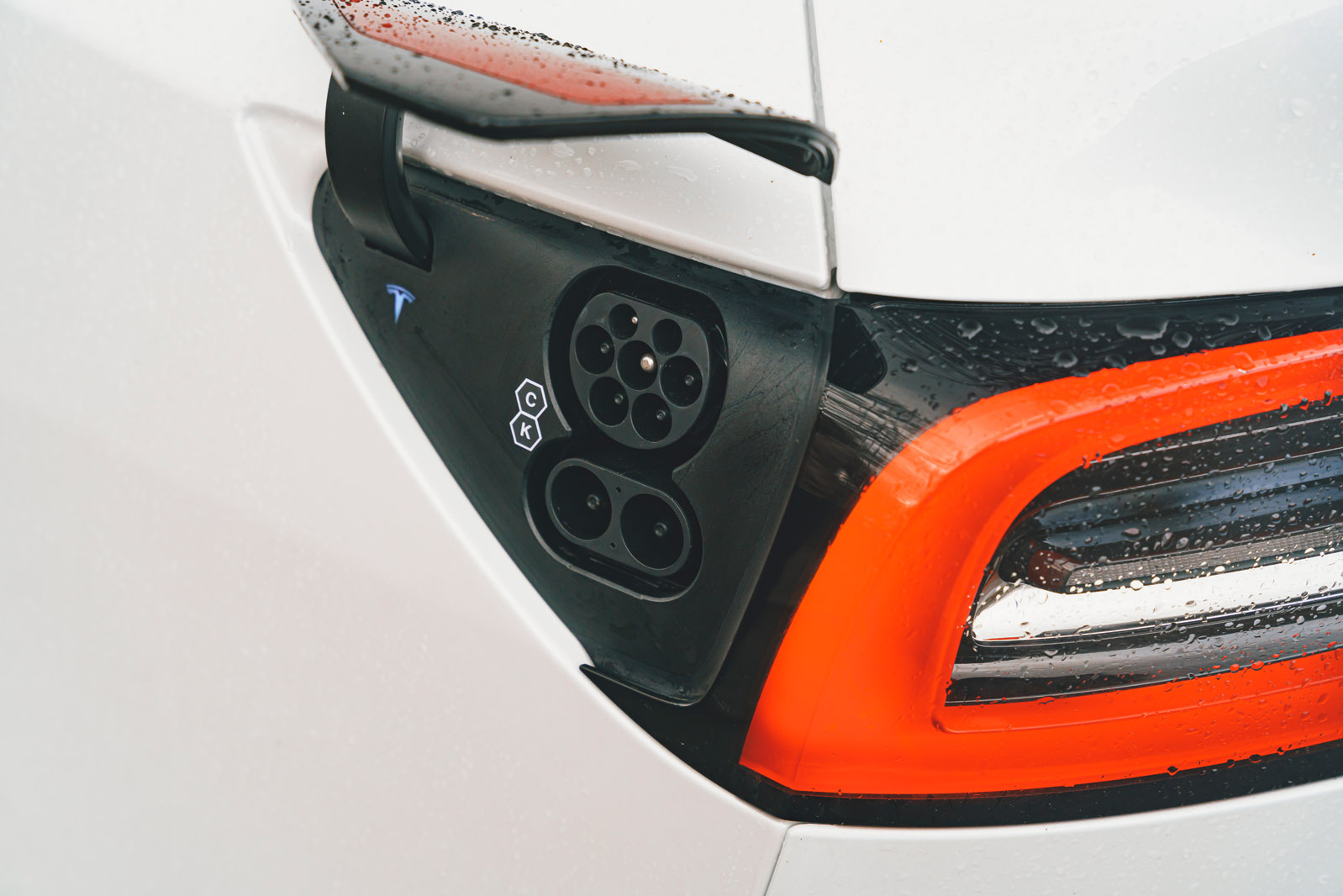
An EV-focused tariff (as offered by E.ON and Octopus) slashes energy costs by around two thirds during off-peak hours, which are typically between midnight and 6am. That’s less than 2p per mile for the Tesla Model Y Long Range, or equivalent to 355mpg in a petrol car.
Most cars and all new home chargers will let you preset charging times to match cheaper energy rates.
It has never been easier to access a public charger. Most new AC and all DC rapid chargers are required by law to offer contactless payments without having to sign up as a member. That’s a positive step, but it’s often the most expensive way to use them.
Several charging networks have paid-for membership schemes with reduced rates. Ionity, for example, offers a 45% discount for £10.50 per month.
Services such as Bonnet offer similar but without restricting drivers to a single provider. Its Turbo Boost membership costs £8 per month and cuts charging costs by 15%. A Tesla Model Y driver would recover that fee in less than 300 miles. That’s worth considering if you’re a high-mileage user.
Workplace charging is more common for van fleets, but it can also help company car drivers to go electric.
Work is a convenient place to plug in if you can’t do it at home, while also avoiding relying on expensive public chargers. That’s a win-win for most employers, and there’s plenty of support available.
Fleets can claim up to £350 per socket for up to 40 workplace chargers and provide free charging without drivers being taxed for it, even if it isn’t used for business trips. That includes plugging in at your passenger’s workplace if you’re carpooling, but check with their boss before you do so.
All cars lose a bit of range when temperatures drop off, but it’s more obvious with an EV. Cold conditions slow the chemical reactions in the battery, which hurts efficiency, and there’s no petrol or diesel engine for the car to scavenge heat from to warm the cabin. The result is reduced efficiency and higher costs.
There are ways to minimise that loss, though. Most EVs can be programmed to pre-warm the cabin and bring the battery up to its most efficient operating temperature before a set departure time, and it can do this using mains electricity if it’s still plugged in.
However, once you’re on the move, the best way to stay comfortable is using heated seats, steering wheels and heated windscreens. It's quicker and uses less energy than heating all the air inside the car.
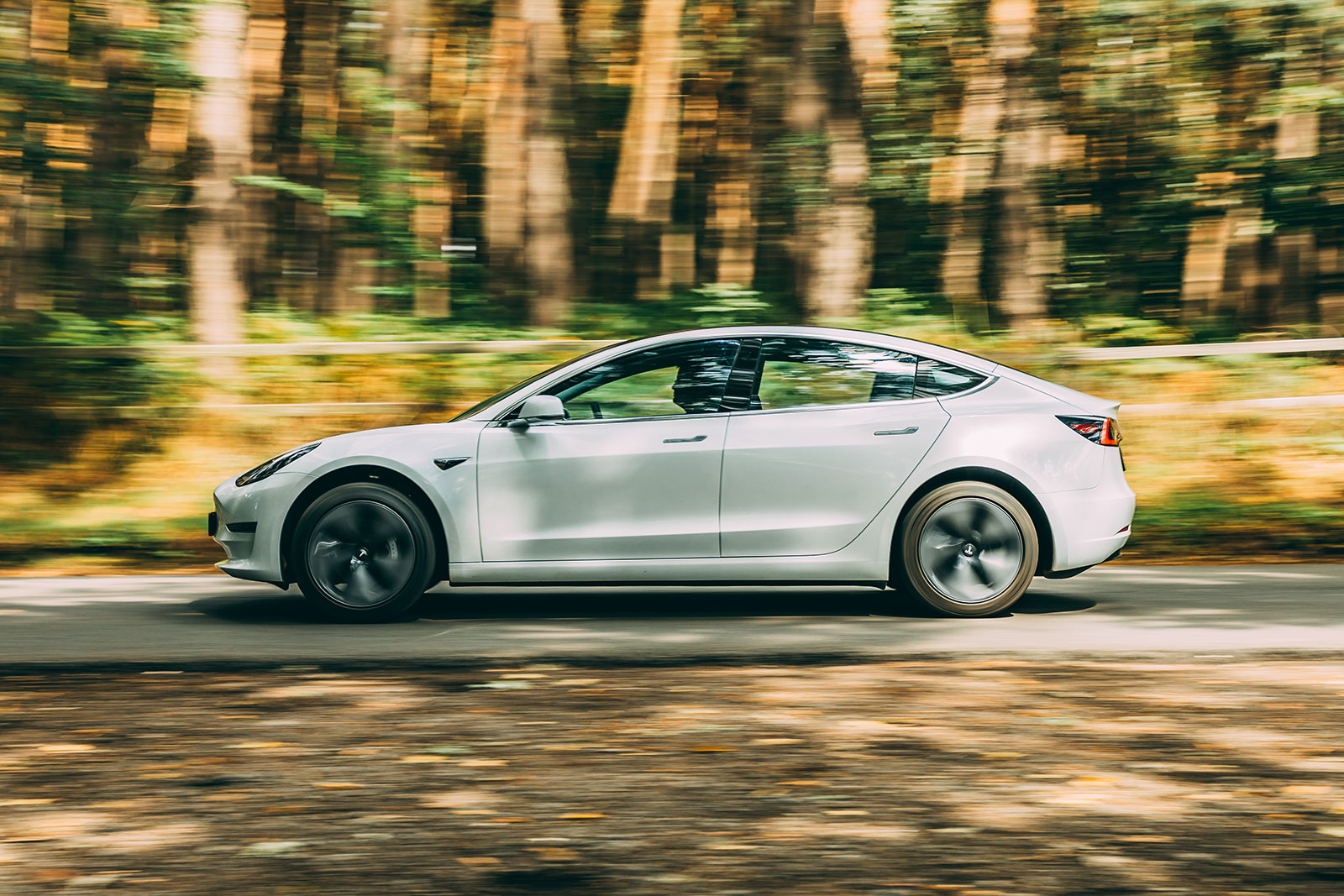
Tesla’s in a spot of bother. Its sales across Europe have dropped and profits have taken an even more vertiginous slump.
Adding to its woes was the recent news that it was forced to issue its eighth (yes, you read that right) recall of its cubist Cybertruck, this time to remedy its propensity for shedding stainless steel bodywork.
So what’s going on? If you look at many of the headlines, the finger points directly at the company’s controversialist CEO, Elon Musk.
His appetite for attracting attention of the wrong kind certainly hasn’t helped lure customers into showrooms – although it has created a cottage industry in ‘not in my name’ bumper stickers – but as ever the answer is, well, more complicated than that.
For starters, there’s the current tariff situation. Then there’s the fact that Tesla is actually more of a tech company than a car firm, which brings its own challenges.
Like a smartphone manufacturer, it’s all about the software, and in this respect it’s one of the best in the business, streets ahead of the legacy brands (and that also includes its understanding of battery chemistry).
Yet this means it doesn’t follow some of the tried and tested methods of the established practitioners, such as model cycles that include visually appealing mid-life refreshes designed to persuade people to part with their cash for cars that might otherwise be getting close to their sell-by date.
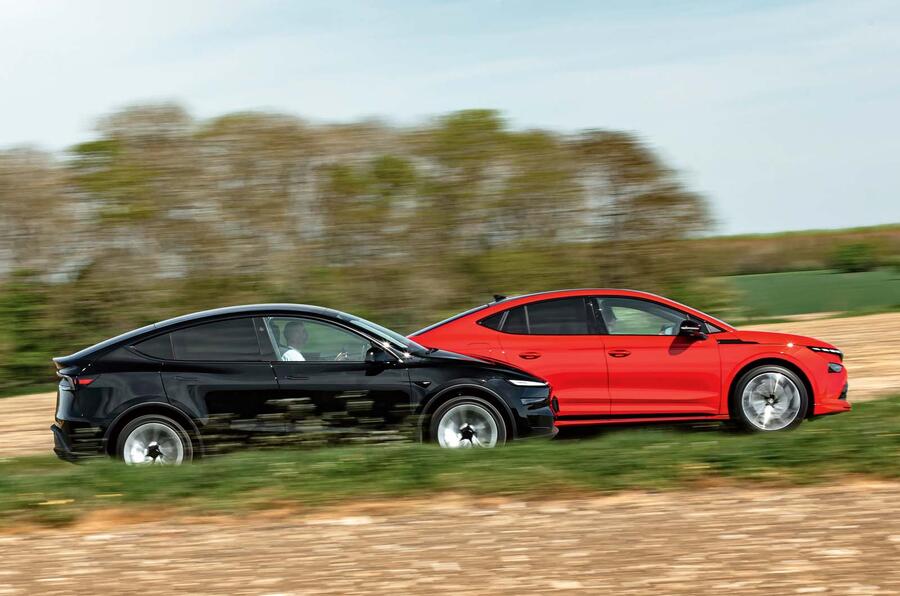
By contrast, Tesla’s line-up comes across visually as a bit old hat, as if the company has been peddling the same, unchanged product from day one. The recent Model 3 ‘Highland’ is a case in point. It’s a thoroughly overhauled car, but to the casual observer it could just as easily be the 2017 original.
The same can be said of the Model S and Model X, which have both benefited from top to bottom technical titivation but are indistinguishable from their decade-old progenitors.
However, the stakes are higher for the Model Y, which is the brand’s best-seller and until very recently topped the sales charts across Europe. As a result, Tesla has taken a leaf out of rivals’ books and delivered a facelift that will leave buyers in no doubt this is a box-fresh proposition.
Speaking of which, the Tesla isn’t the only family-sized all-electric EV to have gone under the knife. The Skoda Enyaq Coupé (and its more sensible SUV sibling) has always been one of our favourite protagonists in this corner of the market, and five years on from its debut the Czech machine has been treated to the industry-standard nip and tuck.
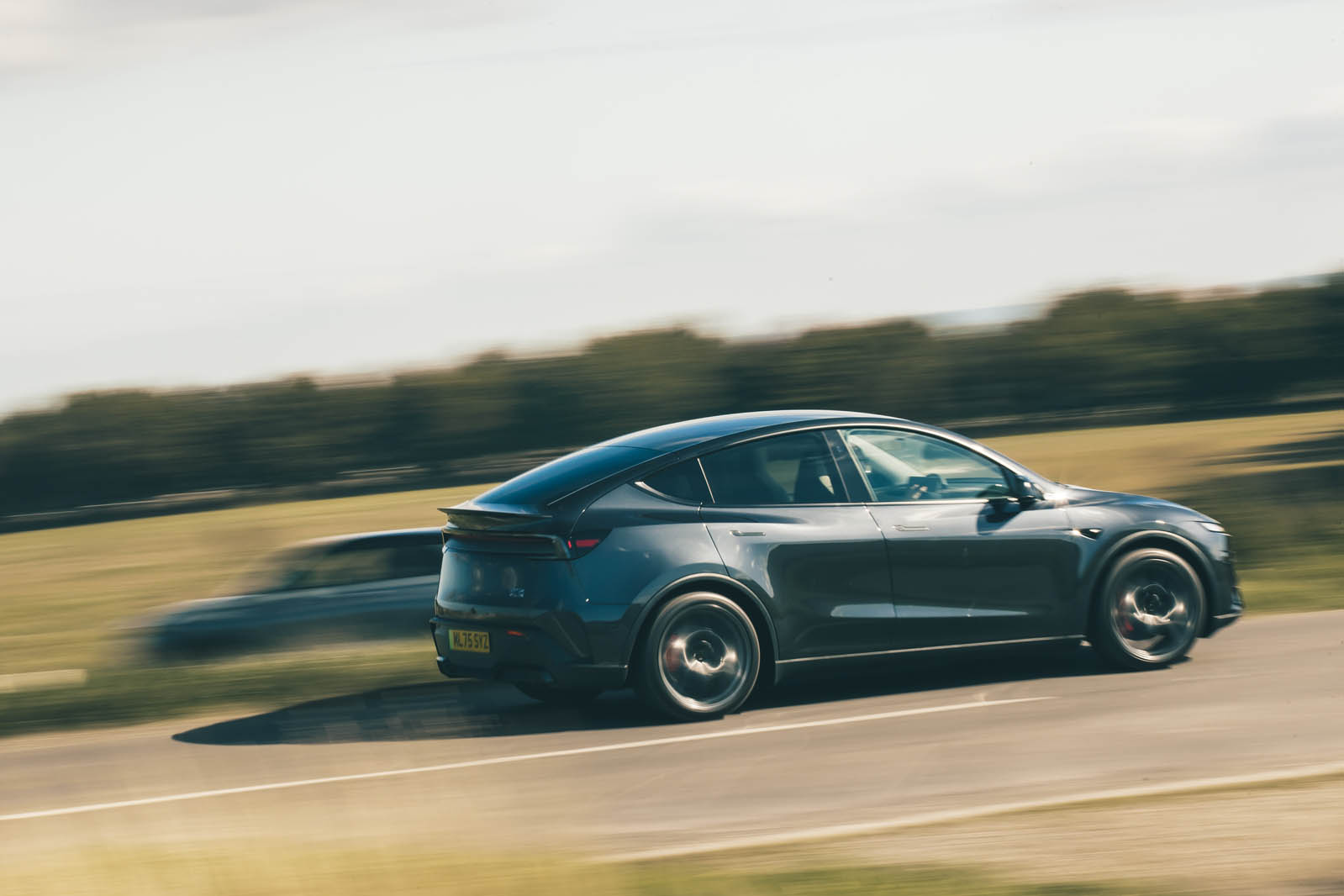
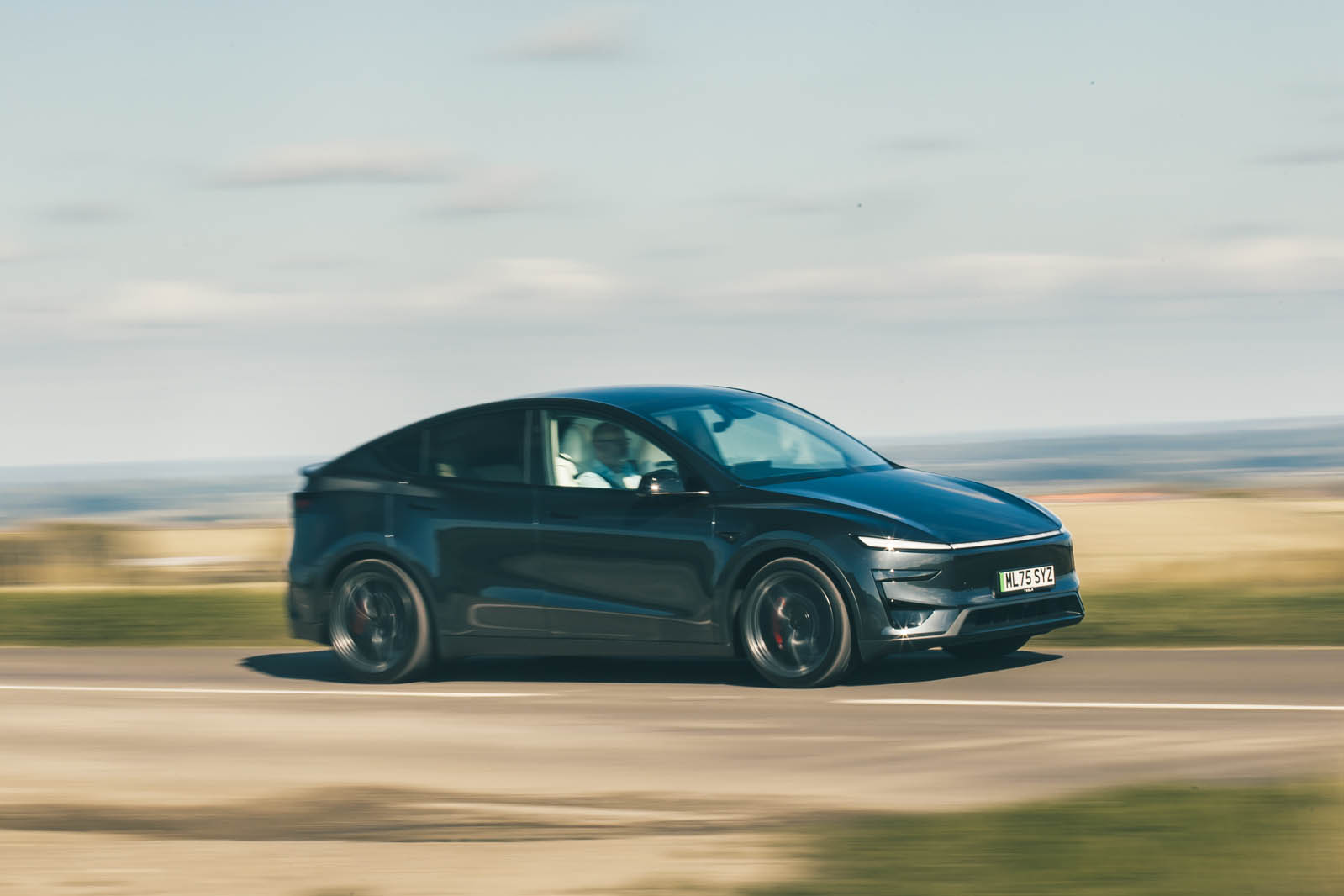
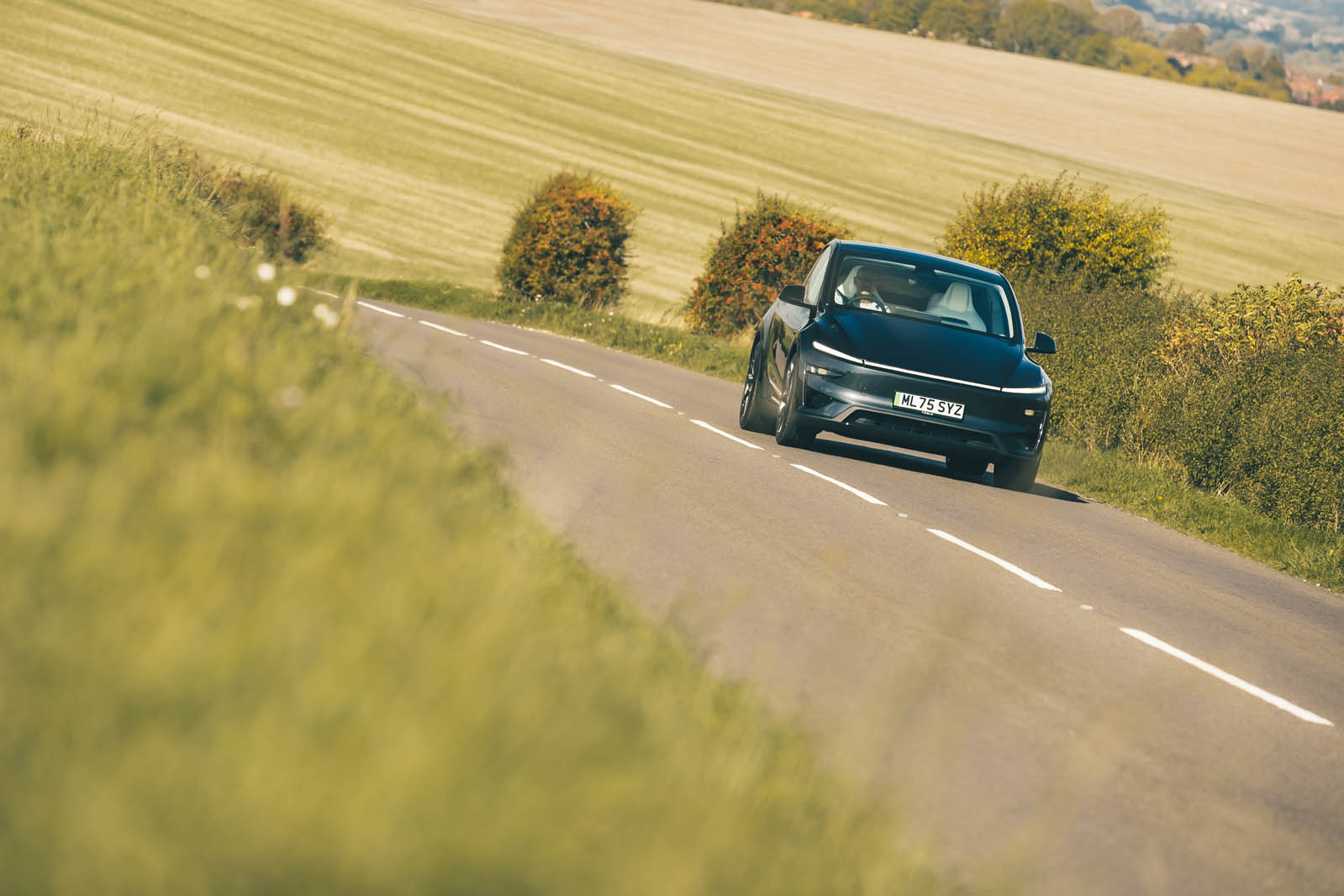
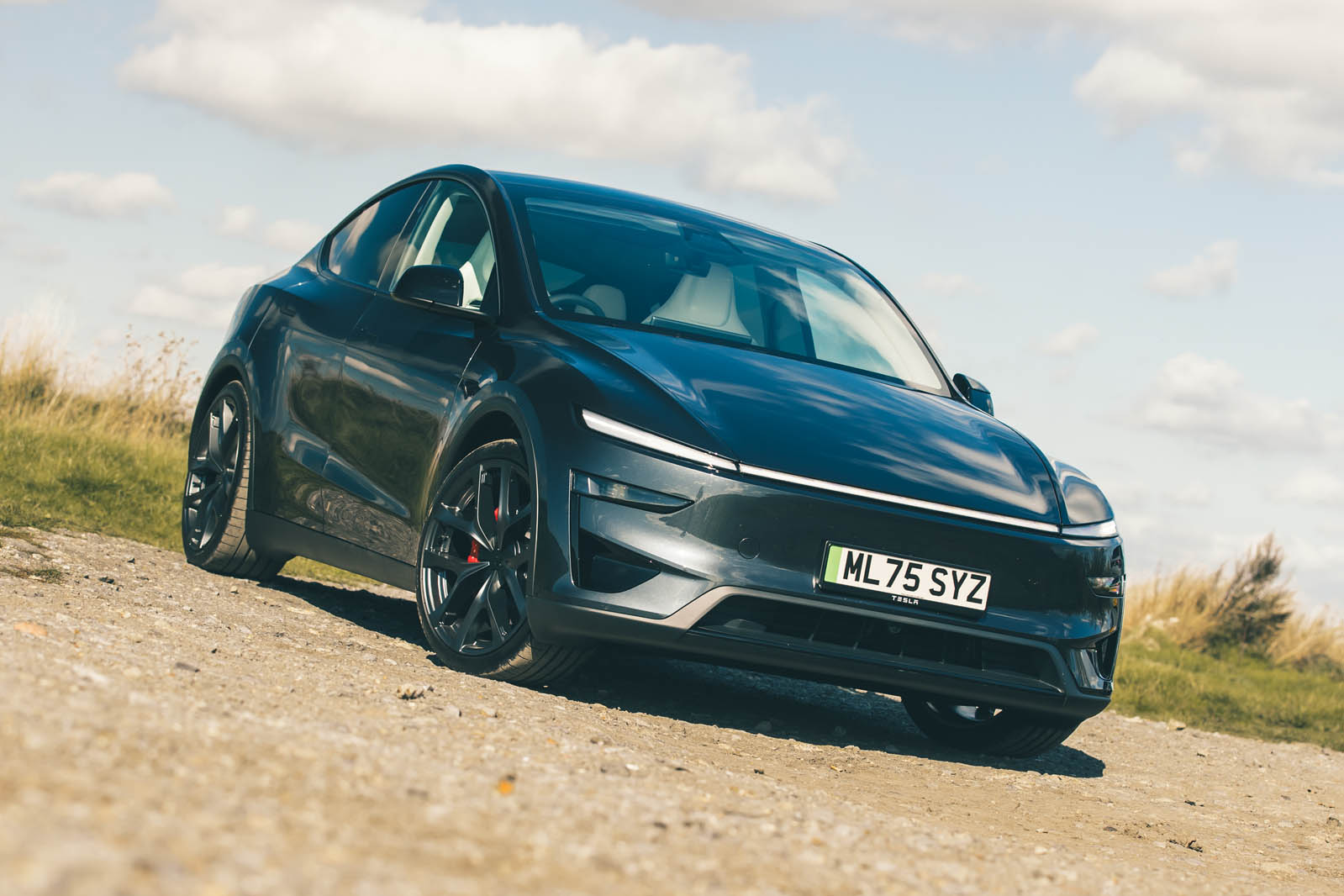
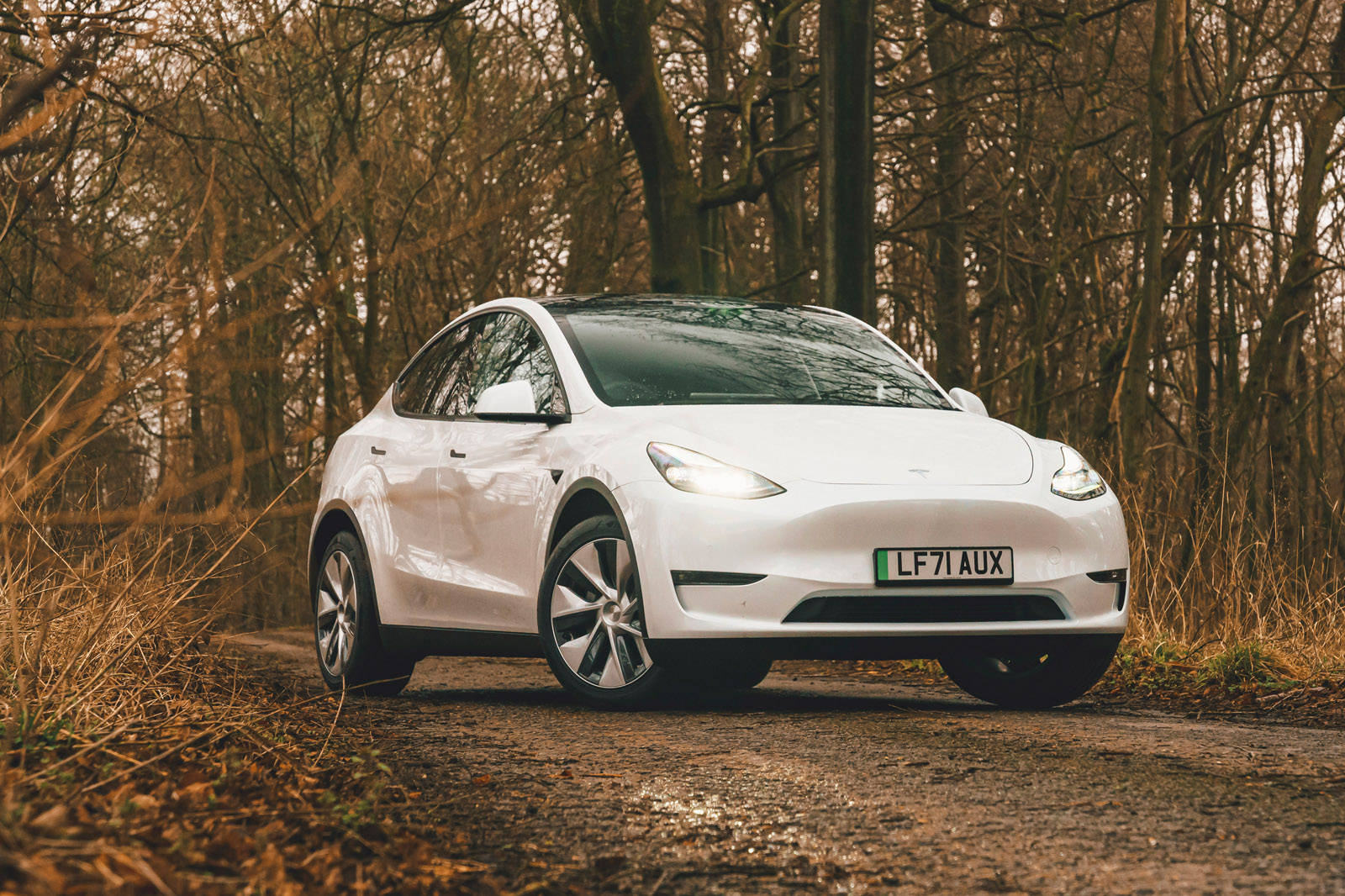
Looks are clearly subjective but, to our eyes, Tesla’s tweaks are more eye-catching. You can see the DNA of the original car between the A- and C-pillars, but at the front there’s a Cybertruck-inspired nose complete with a pencil-thin LED light bar, while the rear features a neat-looking, indirectly lit, full-width tail-light.
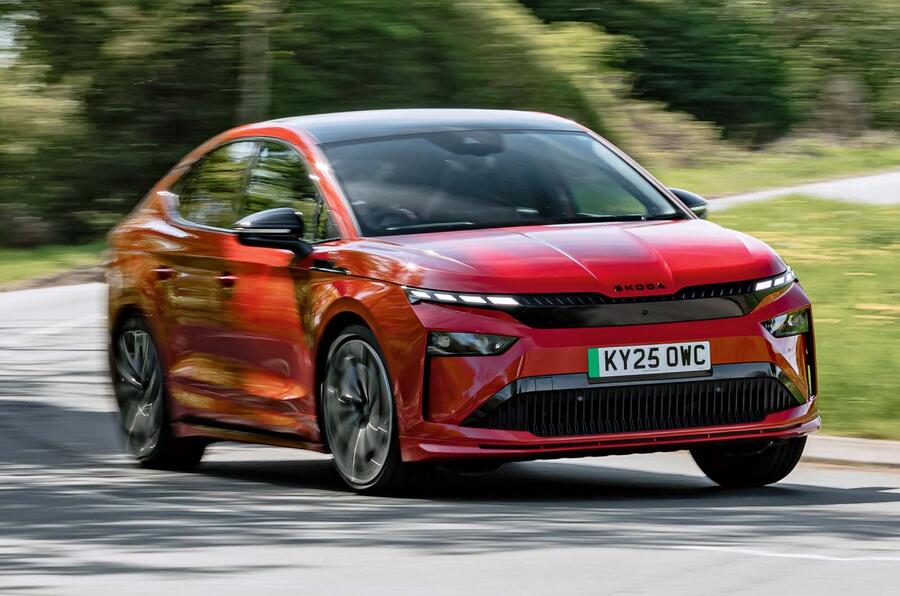
By contrast, Skoda has grafted its bold new ‘Tech-Deck’ nose onto the Enyaq, but the rest of the car’s appearance has been left largely untouched. It’s a similar story inside, where the Skoda looks and feels very much the same as the old car.
There’s a revised 13in infotainment screen that looks slicker and responds more swiftly but otherwise it’s business as usual. This means that, unlike in the Model Y, you do get some handy physical shortcut keys and a separate display ahead of the driver for speed and range information.
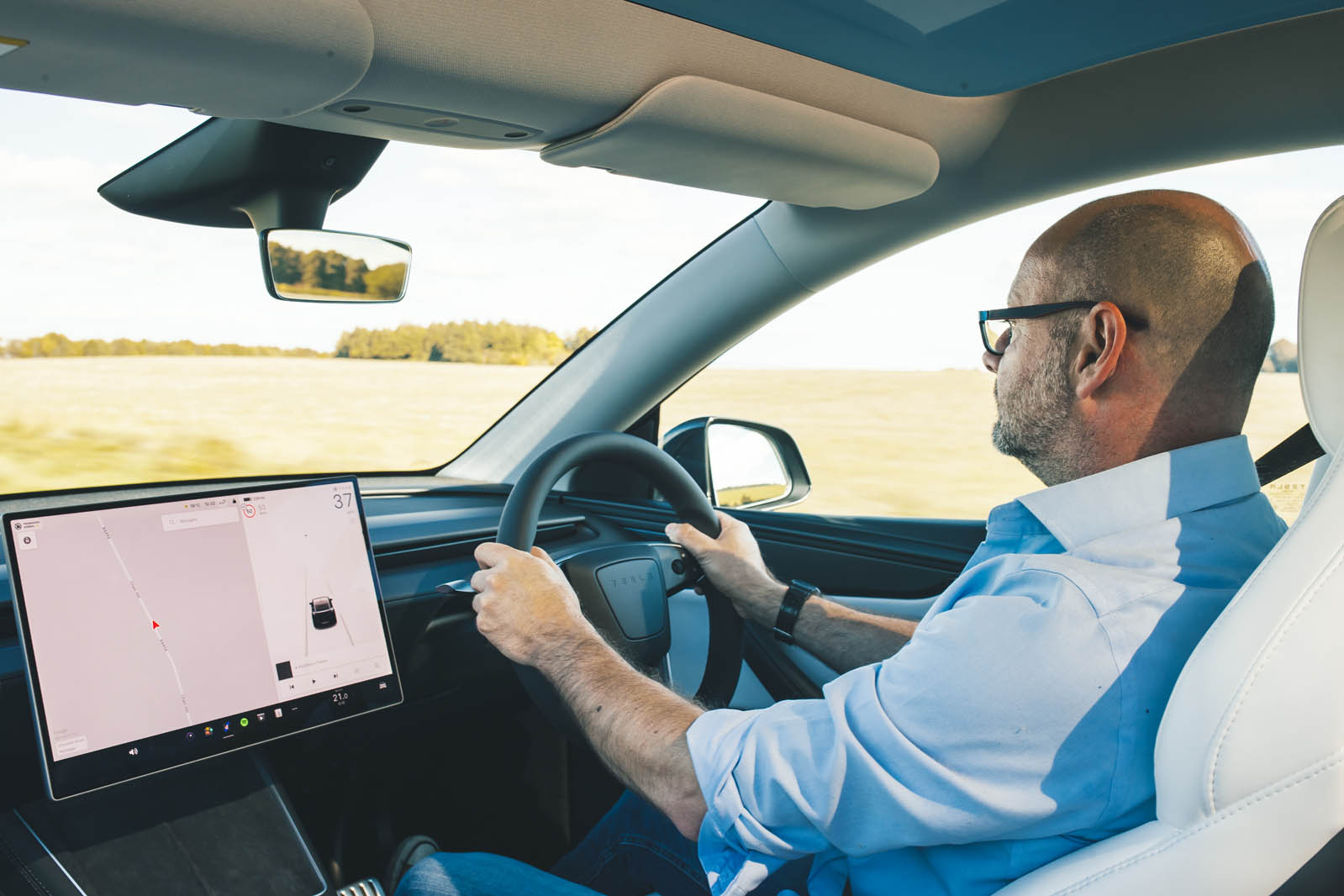
As ever, the Tesla’s dashboard is dominated by its centrally mounted infotainment screen, which literally controls all of the car’s major functions (although, unlike in the Model 3, there is an actual column stalk for the indicators. Hallelujah!). Still, the set-up is one of the best around, proving a doddle to navigate and always responding crisply to your demands.
It’s sufficiently good that you almost don’t miss the odd button or two. With its greater mix of rich materials and more complex dashboard and door mouldings, the Skoda’s cabin looks a little more upmarket than the Model Y’s, but in terms of touchy-feely perceived quality, there’s little to separate the two.
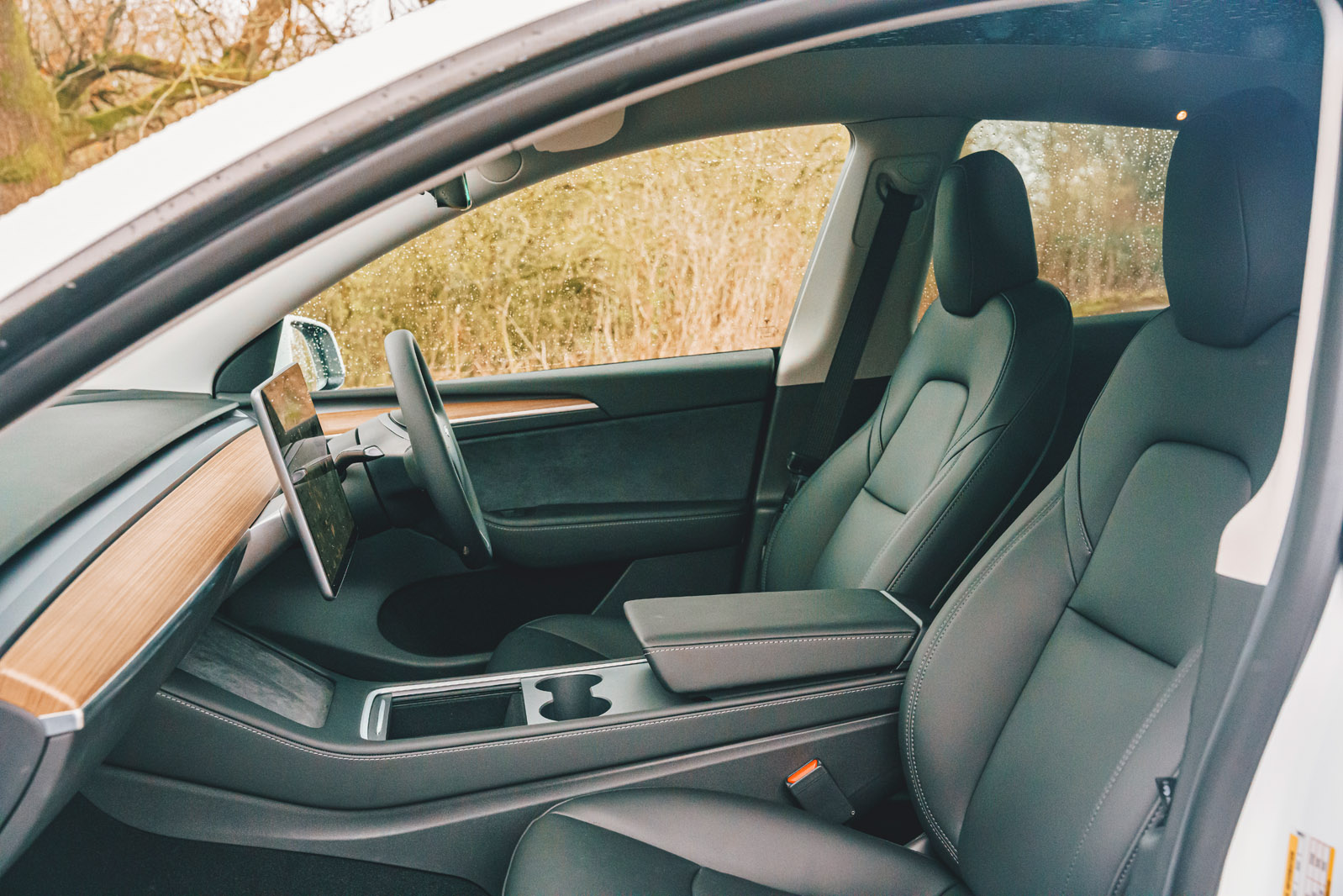
In fact, it’s the uplift in solidity that you notice most in the starkly minimalist cabin of the Tesla. There are still some areas of the car that look a little hand-finished – the cheap LED spotlight in the boot and the thin fabric covering the A-pillar-mounted tweeters – but overall the Model Y is full of appealing materials and exhibits a tight fit and finish.
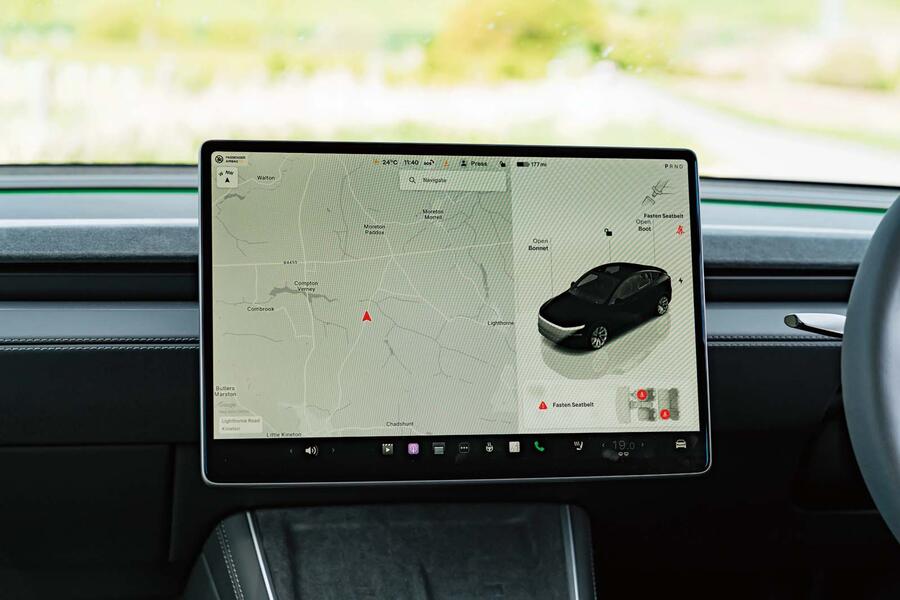
The Tesla also scores strongly for space and versatility, which is surely one of the biggest considerations with cars like these.
There’s a large load area with plenty of underfloor storage compartments, plus the trademark 117-litre frunk. (The Skoda’s bonnet lifts to reveal various EV ancillaries but no space for luggage overspill from its 570-litre boot.)Rear occupants in the Model Y also have plenty of head and leg room, while a powered reclining backrest and completely flat floor add to the feeling of comfort.
What’s more, the addition of a small touchscreen now allows occupants to adjust the temperature and switch on their heated seats without having to issue orders to the driver.
Up front, the sense of space is enhanced by the low scuttle and large windscreen, which helps deliver a more panoramic view of the road than in the Skoda. However, this Sportline-trim Enyaq hits back with heavily bolstered front seats that offer greater support.
Grab the tape measure and you’ll find the Enyaq pretty much matches the Model Y for accommodation. Where the Skoda edges ahead is in those thoughtful details that have become a calling card for the Czech brand, such as the umbrellas secreted in the front doors and the multitude of handy boot dividers, hooks and nets.
That said, you’re unlikely to run out of room for odds and ends in the Model Y, with its large, carpeted door bins, cupholders galore and a lidded cubby between the front seats that’s so deep you’ll need to send Lassie for help if you ever fall in.
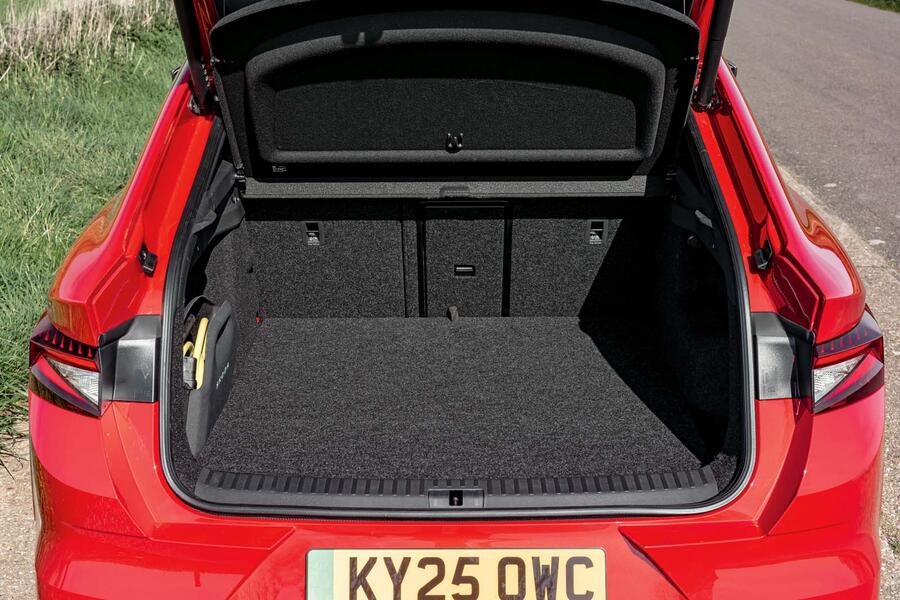
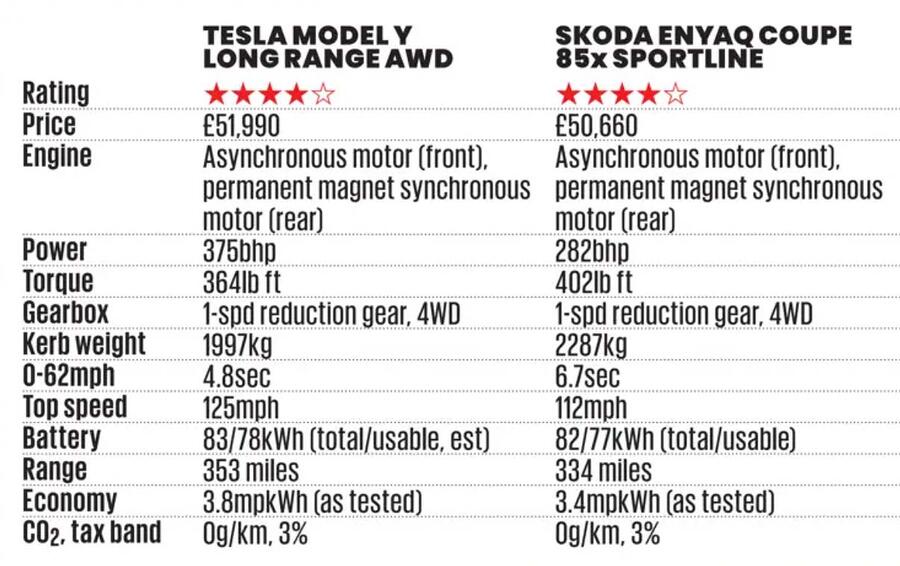
So it’s even-stevens for practicality, but what about performance and poise? Once again, our two dual-motor contenders are separated by the width of a Tesla key card, but they go about their business in slightly different ways. If outright urge is your thing, though, the Model Y is a slam-dunk choice.
With 375bhp and a lower, 1997kg kerb weight, the Tesla is seriously rapid and feels especially so in Sport mode, when its throttle response is even sharper. The 282bhp Enyaq, with a claimed 0-62mph of 6.7sec, is no slouch but it’s left gasping in its rival’s wake on a straight road.
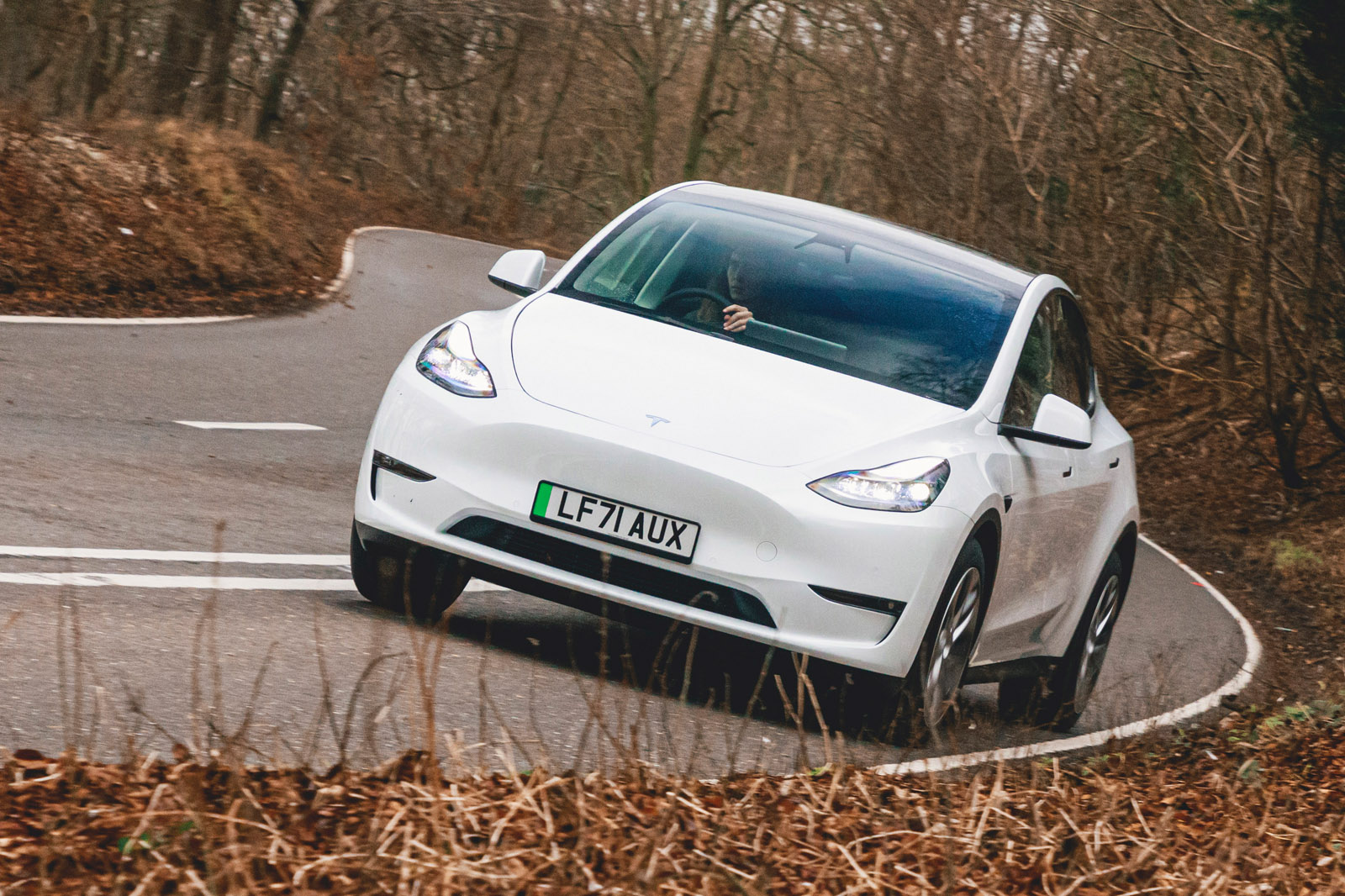
Throw some corners into the mix and there’s less clear air between the two. With its quick, albeit lifeless, steering, the Tesla feels more agile – an impression exaggerated by a rear-biased power delivery that allows you to tighten your cornering line with a dose of throttle.
Special mention also has to go to the new brake-by-wire set-up, which offers a firm pedal and plenty of progression.
With its slower but better-weighted steering, the Skoda feels a little lazier in its reactions, its narrower-section front tyres gently squealing into safe understeer at the limit.
Yet despite its heftier kerb weight, the Enyaq feels better tied down over bumpier stretches of Tarmac, containing body movements more effectively than the Tesla, which can hop and corkscrew a little when pressing on. Traction isn’t a problem for either all-wheel-drive vehicle.
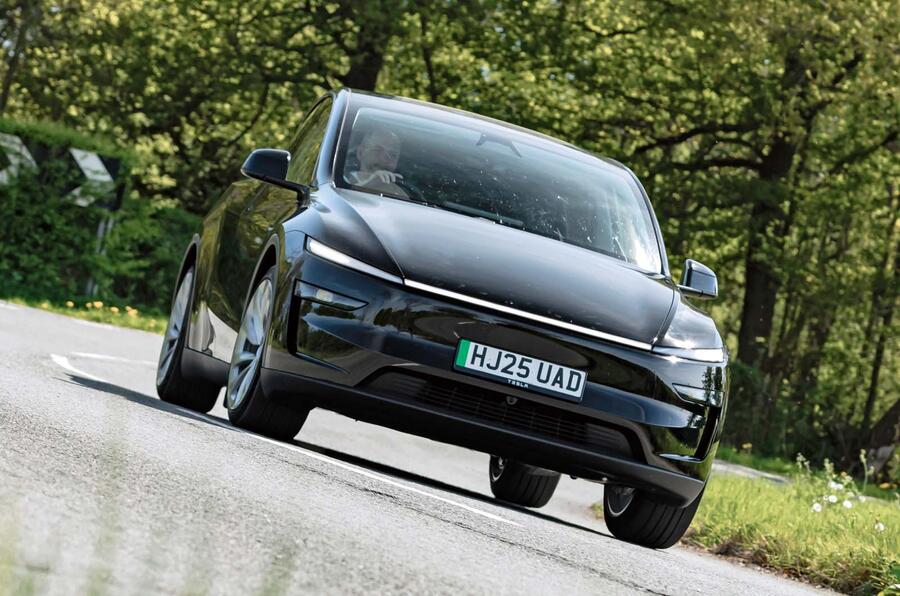
The Skoda maintains a narrow advantage when it comes to cruising comfort. Both have firm low-speed rides – although the newly softened Tesla is much better here than its predecessor – that calm down at speed, and while each delivers decent refinement, the Enyaq does a marginally better job of isolating you from road and wind noise.
You can also tailor the regen brake assistance in each – a first for Tesla – although the Model Y has a more effective one-pedal calibration.
As you would expect, both cars have driver aids galore – and you’ll be either fine or frustrated with that depending on your point of view. On the plus side, turning off the lane keeping assistance is a doddle in either car and the other systems are as unobtrusive as they get these days.
Mind you, because the Model Y uses plenty of cameras (the Enyaq favours radar), its various warnings become increasingly inconsistent as each lens becomes coated with road grime.
So we have established that each of these cars is practical, delivers all the performance you’re ever likely to need and, while you’re unlikely to pick either for a dawn raid on your favourite roads, they both steer and stop with admirable accuracy and agility.
Ultimately, then, it comes down to the numbers – and again the margins are tight, although the more cost-effective contender probably isn’t the one you would expect.
When it comes to claimed range, the Model Y totes a figure of 364 miles as standard, reduced to 353 miles with the optional wheels of our test car, while the Skoda stretches to 334 miles.
Thanks to Tesla’s mastery of battery chemistry, motor efficiency and (relatively) lightweight construction methods, the Model Y gets closer to its WLTP numbers in real-world use. Over the course of our test, it delivered an impressive efficiency return of 3.8mpkWh, whereas the Enyaq could manage only 3.4mpkWh.
Then there’s the thorny issue of cash. In Long Range AWD form, the Tesla’s sticker price is £51,990, a scant £1330 more than the Enyaq. Yet nobody turns up to a dealer with a suitcase full of banknotes for cars like these: they plonk down a deposit and finance the rest.
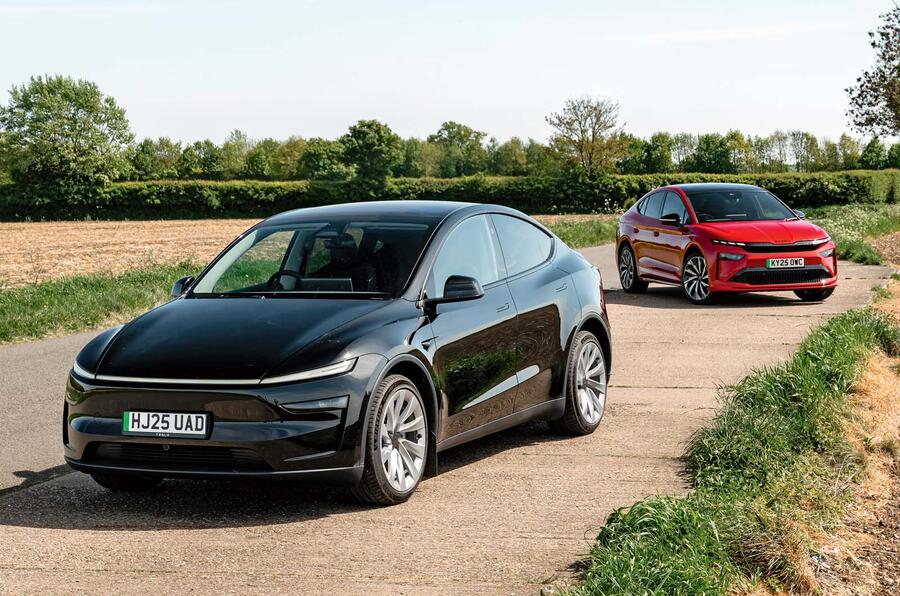
Put your pen to a PCP deal and over four years you’ll shell out £499 a month for the Model Y and £527 for the Skoda. Again, not that much in it, but there’s something significant about Tesla getting one over on a brand famed for delivering value for money.
Are these cost savings enough to swing the result in favour of the Model Y? By the tightest of margins, we would say yes. Sure, Tesla has some PR issues bubbling away in the background, but as a spacious, sensible and swift family wagon that packs genuinely innovative engineering, the new Model Y makes a compelling choice.
Maybe that will give Elon something to smile about.
1st. Tesla Model Y
The revised Tesla Model Y fixes most of its predecessor’s flaws yet retains its efficiency, performance and impressive practicality.
2nd. Skoda Enyaq Coupe
It’s a close-run thing for the Skoda Enyaq, which in facelifted form remains a refined, thoughtfully designed and thoroughly likeable car.