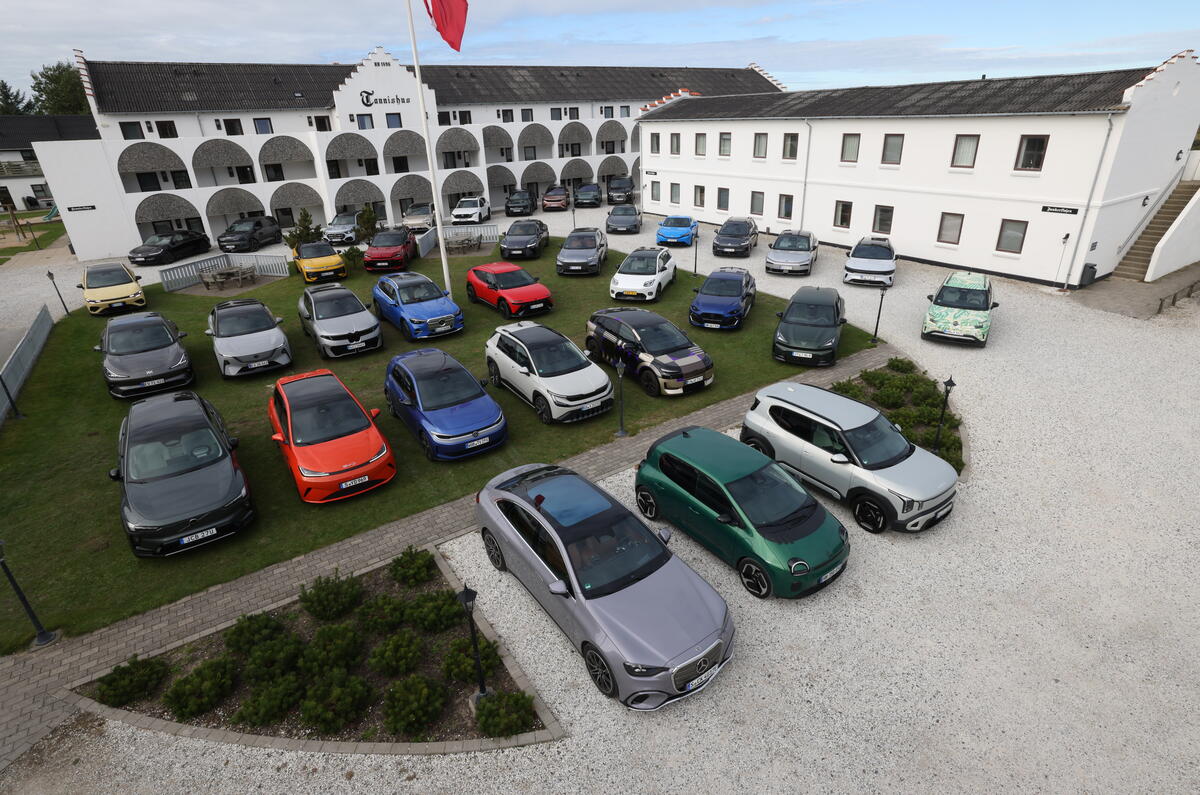

The second stage of the voting for the coveted Car of the Year award for 2027 will, for the first time in the organisation’s six decades of history, be contested by a field of entirely electric vehicles.
The award’s organising committee has just announced its seven shortlisted new cars under consideration during the second stage of voting. They are the BMW iX3, Cupra Raval, Hyundai Ioniq 3, Kia EV2, Renault Twingo, Volkswagen ID Polo and Volvo EX60. The winner will be announced on 8 January 2027 at the Brussels motor show.
There were 38 models in contention in the first round of voting, with 64 jurors from 25 countries each having a say. Only nine of those eligible cars (which have to be new to the market, not considered in any previous year, available to be tested by COTY jurors, and in series production and available to buy within the year in question) had any kind of combustion engine.
Having taken over COTY jury duty on Autocar’s behalf this year, I voted in close consultation with all of our testers. It’s reassuring to see five out of the seven cars that I nominated make the cut.
Among the two that didn’t, then: particularly hard cheese to the Skoda Epiq and Honda Prelude. The Epiq, I think, is a great application of Volkswagen’s all-new MEB+ platform technology, has significant commercial potential and would have been a marginally more deserving shortlisted car than one or two that did make it – as good as they all undoubtedly are.
The Prelude, on the other hand, has rejuvenated interest in both affordable coupés and ‘self-charging’ hybrids. It’s great to drive and, because I think that European customers are still motivated by cars like this, I would have liked to see it recognised. Perhaps that’s Autocar’s particular agenda talking, but I don’t mind copping for it.
It was undoubtedly a competitive field this year, and plenty of other big hitters have fallen early. Among those missing out on a shortlist nomination are the Toyota RAV4 and Mazda CX-5, the Mercedes C-Class, GLB and GLC EVs, the Porsche Cayenne Electric, the Skoda Peaq, the Audi A2 E-tron, the Lexus ES and the Polestar 5. In quieter years, any one of those might have been good enough.
We’ve also still to see another Chinese brand make the COTY final seven, although BYD, Changan, Denza, GAC, Leapmotor, MG, Xpeng and Zeekr were all in contention this year. The BYD Seal, in 2024, remains the only Chinese-brand car to be shortlisted to date (although Chinese-manufactured cars from Western brands have been shortlisted more often).
The elephant in the room, then: is it right for Europe’s pre-eminent new-car award to recognise a selection of entirely electric cars, when only one out of four new cars sold on the continent is an EV? It certainly looks like a conspicuous discrepancy.
I would have preferred a bit more representation for hybrids and PHEVs on the shortlist – and voted that way. But European EV market penetration is rising particularly quickly this year, and this competition can only recognise new-model introductions, rather than the market as a whole.