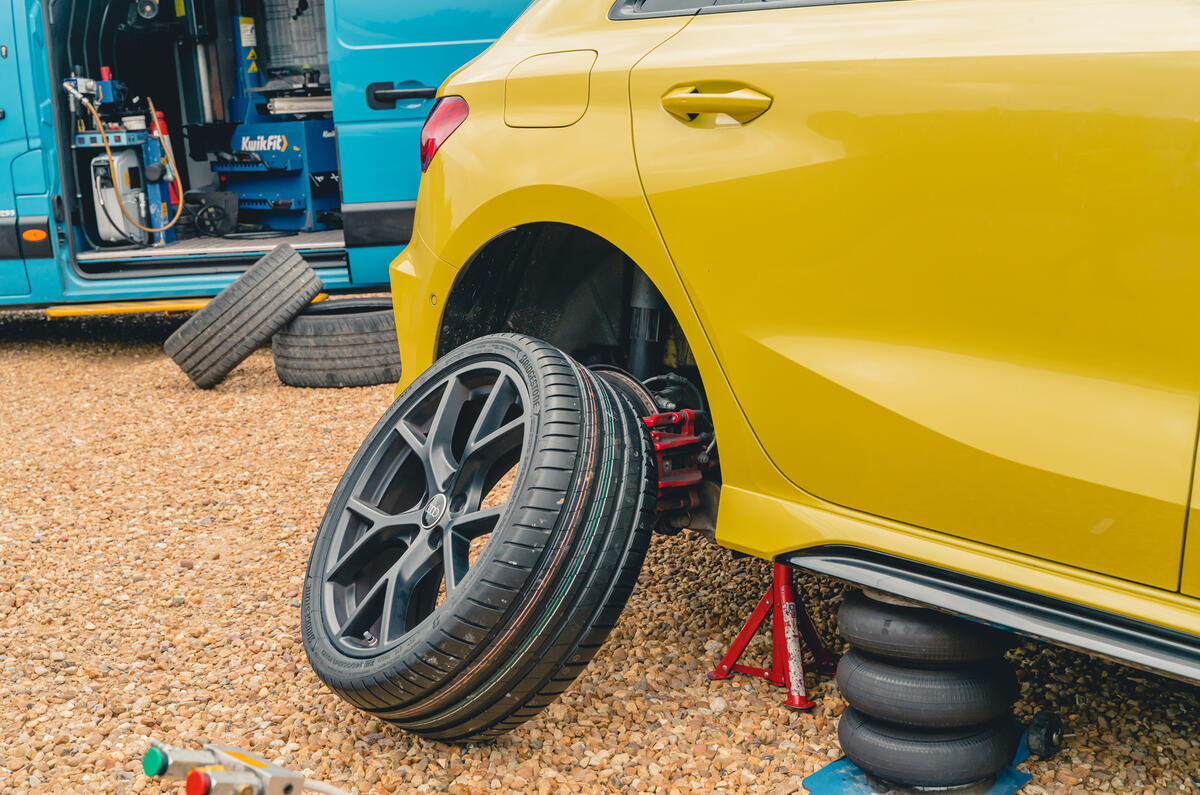



You can’t discuss a car’s ride quality without also talking about tyres. As the only point of contact between the vehicle and the road surface, the rubber wrapped around the wheels are going to play a crucial role in how bumps and lumps are transmitted through to the cabin.
Of course, there are many other factors to consider, such as suspension components and geometry, even the stiffness of the car’s chassis, but here we’re going to take a closer look at tyres.
To most people, tyres are all pretty much the same, which is round and black, but dig deeper and you will find that automotive engineers sweat buckets ensuring they make your car ride as well as they can.
That said, we don’t think you can talk about ride comfort without also considering refinement. It’s all well and good having a car that soaks away surface imperfection, but if the noise from your car’s tyres results in every two-hour journey giving you a four hour headache, then what’s the point of a cushioned ride?
So here we take a little look at tyres, ride comfort and the technology that goes into keeping your car on even keel when the Tarmac gets turbulent.
Ride comfort
Like many areas of automotive engineering, tyre technology is a complicated old business. How a certain type of rubber grips, relays feedback and, yes, rides is dependent on myriad factors. Everything from the construction of the metal carcass to the tread pattern will play its part in determining how smoothly your car deals with the bumps.
As we’ve already mentioned, there are myriad factors influencing ride quality, such as suspension set-up and the body’s structural stiffness. Adding tyres to the mix only makes things more complicated, because, due to the nature of their construction, they act as both a spring and a damper. Influencing this behaviour is the rubber compound, the stiffness of the metal carcass and the overall size of the tyre, just to name a few factors.
However, one of the clearest indicators of how a tyre might tackle bumps is to be found in its sidewall depth. Over the years, an emphasis on ‘sporty’ handling and sharp steering response has resulted in the increased use of low-profile rubber. The profile is the depth of the sidewall represented as a ratio of the tyre’s width, so a 225/40 18 example has a profile that’s 40% of that 225mm width.
Theoretically, the lower the profile, the more ‘immediate’ the car will feel on corner entry as the smaller, stiffer sidewall deforms less under lateral load for better precision and grip. Yet the downside of this is obviously less ‘give’ in the tyre under vertical load, leading to a less comfortable ride. This tends to be more clearly noticeable over sharper road imperfections, such as potholes.
Assuming the suspension has been tuned to work with various different tyres sizes, the same car fitted with, say, a 205/55 16 tyre instead of that 225/40 18 will feel smoother over the bumps, its squidgier sidewall helping absorb some of the sharper shocks.
Yet as ever with tyre technology, it’s more complicated than that. Take run-flat rubber for instance, which has been favoured by BMW over the past couple of decades. To allow the car to carry on driving even after a puncture, these tyres have very stiff sidewalls, which – you’ve guessed it – result in a rather discombobulated ride.