
We often hear about technology crossing over from motorsport. But if hydrogen fuel cells ever do make it to mainstream cars, it's looking as though trucks, not racing, will play a major part in establishing the technology first.
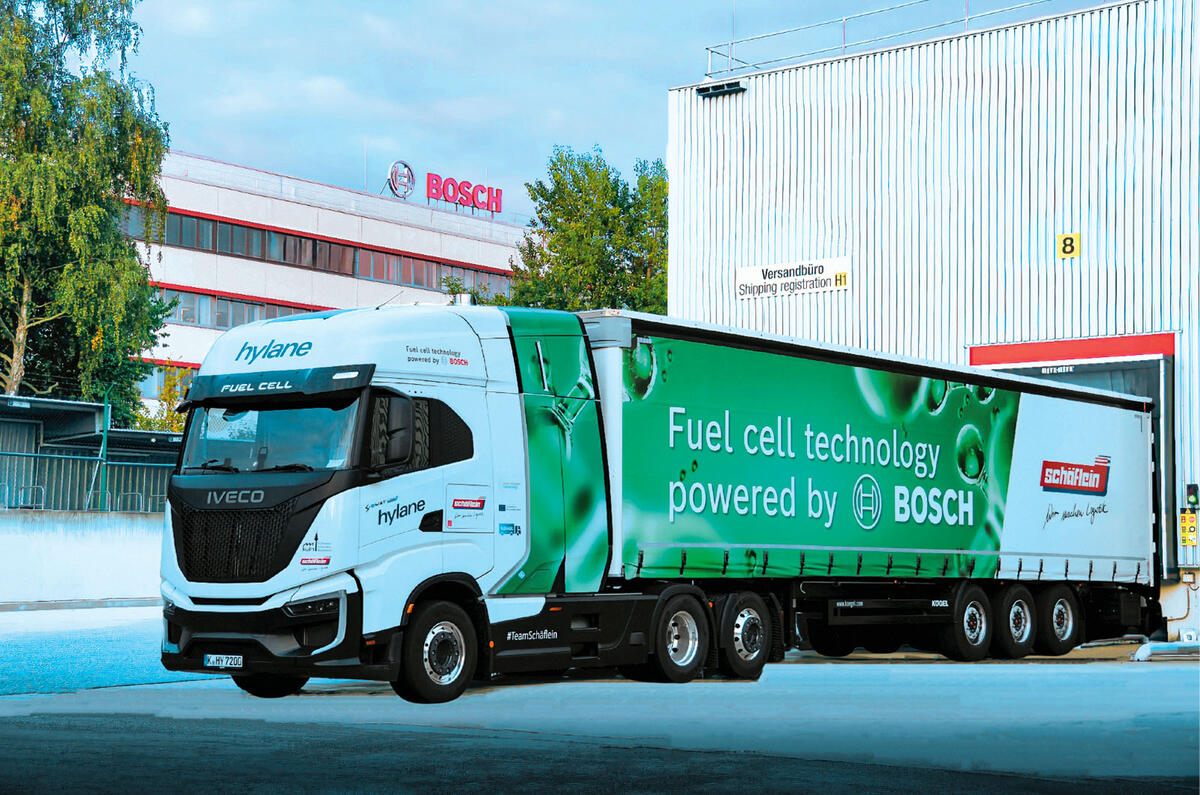
Bosch sees hydrogen as a major contributor to decarbonisation in the future and has recently put an articulated lorry powered by its fuel cell power module (FCPM) into service at its plant in Nuremberg, Germany. It has good reason to feel positive about a future hydrogen economy. Bosch expects a global hydrogen energy capacity of 100-170GW and sales revenue for the company running into billions by 2030.
Fuel cells consuming hydrogen and electrolysers making it have more than a little in common because one is effectively a reverse of the other. Fuel cells consume hydrogen and oxygen to make electricity, with heat and water as by-products, while electrolysers consume electricity to 'split' water by electrolysis and make hydrogen, with oxygen as a by-product.
It's not surprising, then, that Bosch is focusing on the development of both in conjunction with specialist partners. The 40-tonne Iveco truck is intended to set an example to support Bavaria's Hydrogen Strategy 2.0, but it's not alone and there are several thousand trucks worldwide that are also powered by Bosch fuel cell systems.
Large-scale production of the FCPM started in 2023 in Stuttgart-Feuerbach. The truck is expected to cover just under 7500 miles a year and has a range of around 500 miles fuelled by 70kg of hydrogen gas stored in five tanks at a pressure of 700 bar. The fuel cell system produces a total of 200kW but there are two high-voltage battery packs storing electricity, giving a total power output of 400kW. Refuelling times are said to be similar to that of refuelling a diesel truck.
Earlier this year, Bosch showed its Hybrion PEM (proton exchange membrane) electrolysis stacks, which form the heart of a 2.5MW system supplied by electrolyser specialist Fest. A proton exchange membrane is a fine polymer membrane a few microns thick that, in an electrolyser, allows hydrogen protons from water to pass through it to form hydrogen gas.
Elsewhere in Germany, BMW is planning a hydrogen pipeline link, aiming to make its Leipzig plant the first in the world to receive hydrogen in this way. A 1.2-mile pipeline will connect the plant to a hydrogen network and supplies are due to start in 2027.
Hydrogen is seen as a sustainable way to produce power in car manufacturing facilities and BMW plans to use the plentiful supply of piped hydrogen for some of its most energy-intensive processes, such as curing ovens in paint shops.
It already operates a fleet of 230 logistics vehicles, which are refuelled at nine hydrogen stations within the plant. The pipeline will connect the plant to Germany's Core Hydrogen Network, which will consist of more than 5600 miles of hydrogen pipeline in the country by 2032.