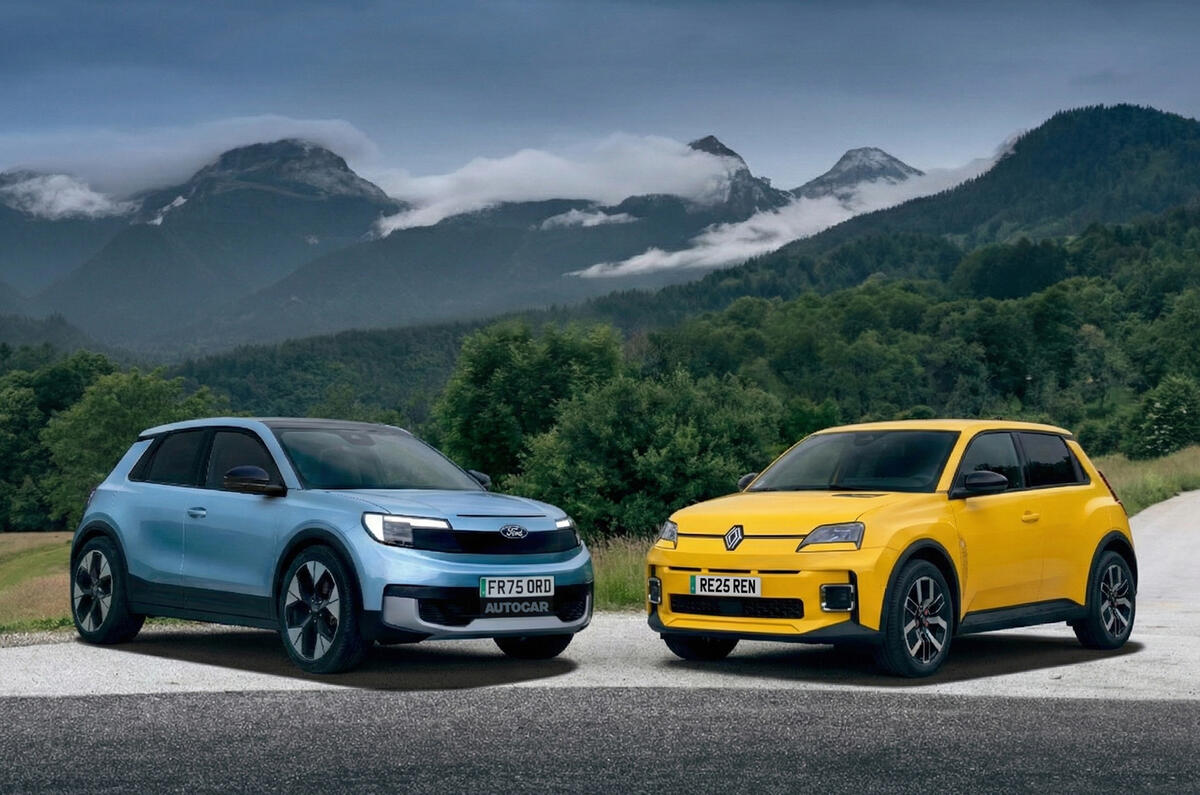

Ford has announced a landmark strategic partnership with Renault, setting it up to launch at least two new electric cars based on the French firm’s Ampr EV platform - including a Fiesta successor.
The first of these new “affordable” EVs will arrive in early 2028 and is expected to be a successor to Ford’s hugely popular supermini, closely related to the Renault 5 and built alongside it at the ElectriCity complex in Douai, France.
The second Ampr-based Ford EV is expected to be a small electric crossover derived from the Renault 4, which could replace the Puma Gen-E, but no timeframes or specific details for this car have yet been given.
Unlike the Nissan Micra, which is effectively a rebadged 5, Ford’s small EVs will be highly bespoke propositions, with the company pledging they will be “distinct Ford-branded electric vehicles” designed entirely in-house.
They will also “feature distinctive driving dynamics”, the American company said, with “authentic Ford-brand DNA and intuitive experiences”.
Otherwise, though, the new Ford EVs are likely to share most of the Renaults’ hardware, which means a motor on the front axle producing between 121bhp and 215bhp, depending on spec, and a choice of a 40kWh or 52kWh battery – which by 2028 will have been swapped from NMC chemistry to more cost-efficient LFP.
The supermini that comes first will take Ford back into a segment from which it has been absent since retiring the Fiesta – after eight generations and nearly half a century – in 2023 to make way for production of the Explorer and Capri electric SUVs at its factory in Cologne, Germany.
Ford has previously suggested it could return to the affordable supermini market as part of a plan to rebuild its market share in Europe (from a record high of around 12%, it currently has less than 4%) and compensate for lower-than-expected demand for its much more expensive electric crossovers.
Sales of the Capri and Explorer have been so slow that Ford was recently forced to cut up to 1000 jobs at Cologne and take the site down to a single-shift production pattern - having already reversed its decision to go all-electric in Europe by 2030 in light of the region’s EV uptake severely lagging earlier forecasts.
With Focus production having ended last month, Ford's car line-up in Europe is now composed almost exclusively of SUVs and MPVs based on different versions of the Transit van - and with prices starting at more than £26k, it's much more expensive on average than at any point in the firm's long history.
Bringing back a Fiesta-sized model – presumably at a similar price to the £22k Renault on which it's based - will be crucial in restoring the brand to true mainstream status and helping it claw back the market share it's lost as a result of its shift upmarket - and doing so in the most cost-effective way possible, saving substantially on new model development.
The new tie-up with Renault is Ford’s second such arrangement in Europe, the company having already used Volkswagen’s MEB architecture for the Capri and Explorer. The German firm's smaller MEB Entry platform – as used for the upcoming ID Polo and ID Cross – had been seen as a likely basis for a reborn Fiesta but was ultimately usurped by Renault's more cost-effective Ampr platform.