Currently reading: Ferrari 12Cilindri Manuale driven: Maranello goes back to the future

On a cold start it all seems a bit two-dimensional – five minutes later the story is quite different

Ferrari development drivers experienced enough to have the 599 GTB on their palmares felt a pang of emotion when work began on the 12Cilindri Manuale. The snick-snack of steel on aluminium, ringing through the cabin with every gearshift, had a rejuvenating quality about it.

This is one of those times when the cultural significance of a car - in this case the 1499-off, £508,000 Manuale - exceeds the reality of the product. Here we have little more than a new gearbox option for the 12Cilindri, and not even that, strictly. The existing eight-speed dual-clutch automatic unit, co-developed with Magna, remains in situ.

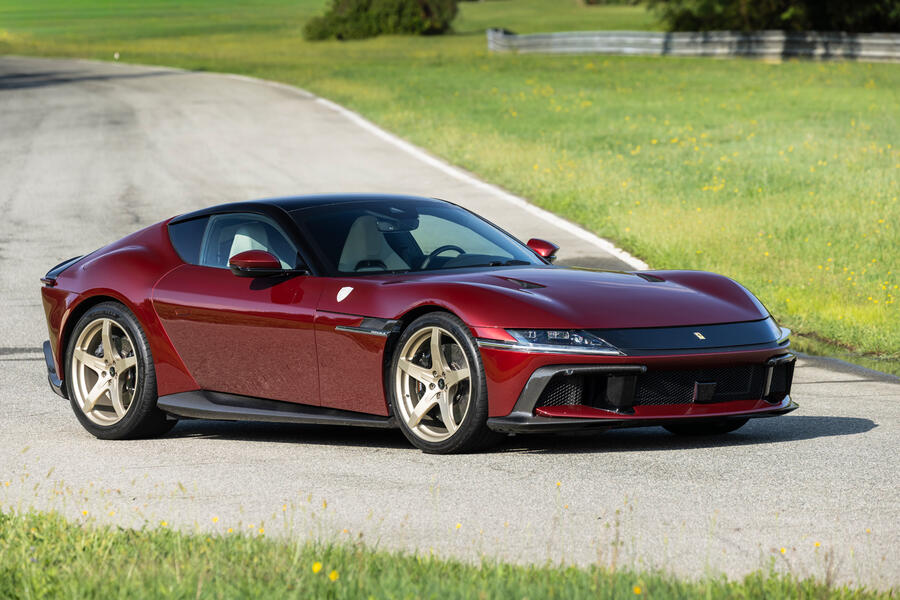
However, the Manuale – distinguishable from the regular car by its Group A-style five-spoke wheels – is also an inflection point. This is the most storied supercar maker on the planet sacrificing speed for simple fun, having met emissions requirements for an epic V12 paired with an old-school H-pattern shifter in a series-production model. Where Ferrari goes next we will have to wait and see, but we're told the tech also works with hybrids.
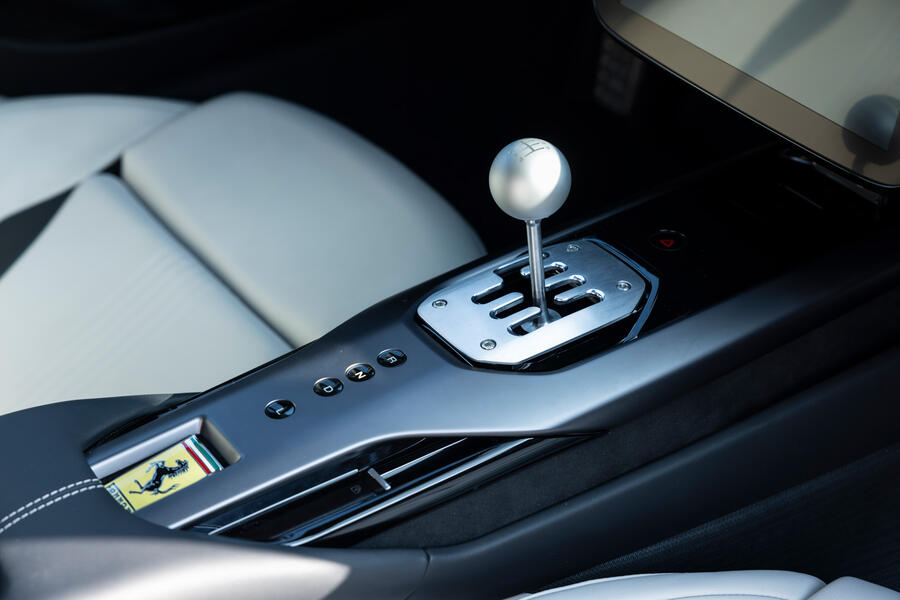
So how have they done it? It's common knowledge that there's no mechanical linkage between the Manuale's pretty gearlever (with its anodised knob of precisely 48mm in diameter, as per the older Ferraris) and the rear-mounted dual-clutch transmission (DCT).

Reasons why the Manuale isn't truly manual range from the inability of a suitable single-clutch transmission to cope with the 500lb ft of torque from the 6.5-litre engine (tell that to the twin-turbocharged V12 Pagani Utopia and its 811lb ft) to the fact that ditching the DCT would diminish the overall 12Cilindri package.

Lose the DCT and you lose the electronic limited-slip differential and its integration with the torque vectoring and ABS. All of that is critical for Ferrari's Slip Control and the astonishing playfulness it allows. The 12Cilindri wouldn't drop out of the sky without its DCT, insists test chief Raffaele de Simone, but it wouldn't be in any recognisable sense a 12Cilindri. So the DCT hardware stays and the manual bit is all done by wire.

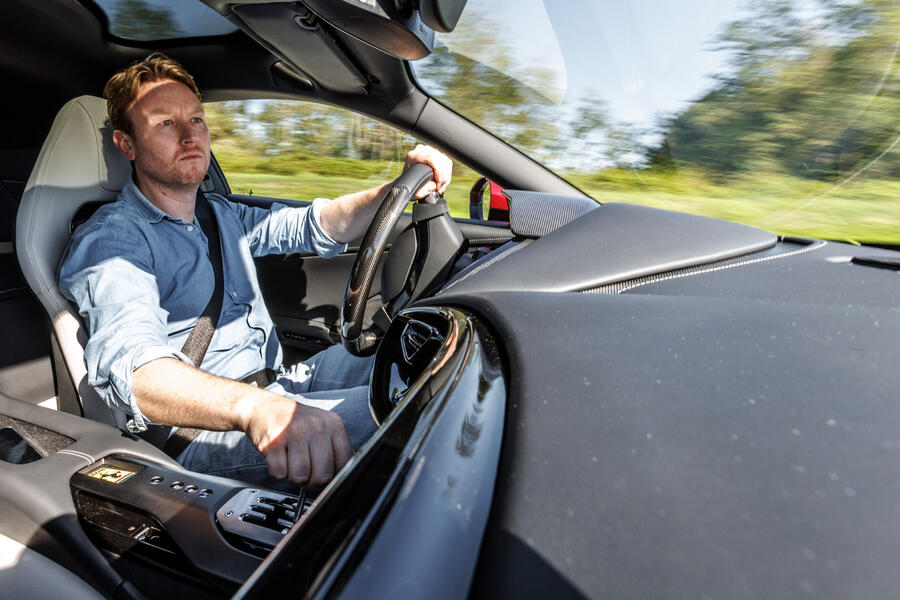
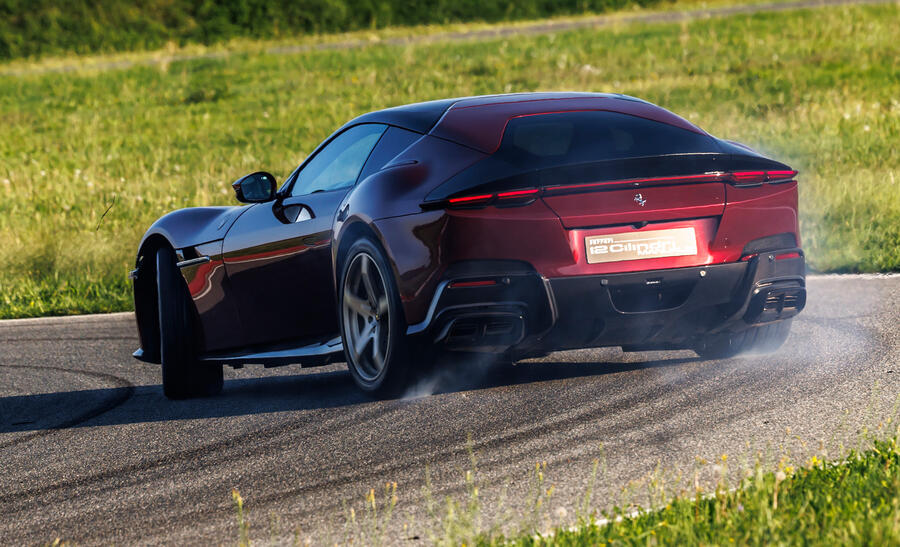
Pulling off the mark in first gear at Balocco proving ground, knowing a position sensor on the artisanal clutch-pedal assembly is informing the precise degree of engagement of a clutch buried somewhere behind me, is an odd sensation, admittedly. But if I were none the wiser as to the underlying technology (as well I might be, given you can start up the paddle-less Manuale as you would a real manual), might I be fooled?
Back to top

Possibly, although on a cold start the sheer ease of selecting first is the potential giveaway. The lever slips home with such insouciance it's as if one of those test engineers has warmed the oil with a thrash at Fiorano. Being picky, you also don't feel the clutch pedal gently steeling itself as various plates meet and the driveline fuses; there's no great sense of an idling engine furtively taking up the weight of the car. It's all perfectly precise and linear, and you would have to be clumsy to stall (which you can). But it's also a bit two-dimensional if your idea of three-pedal V12 heaven is a 550 Maranello.

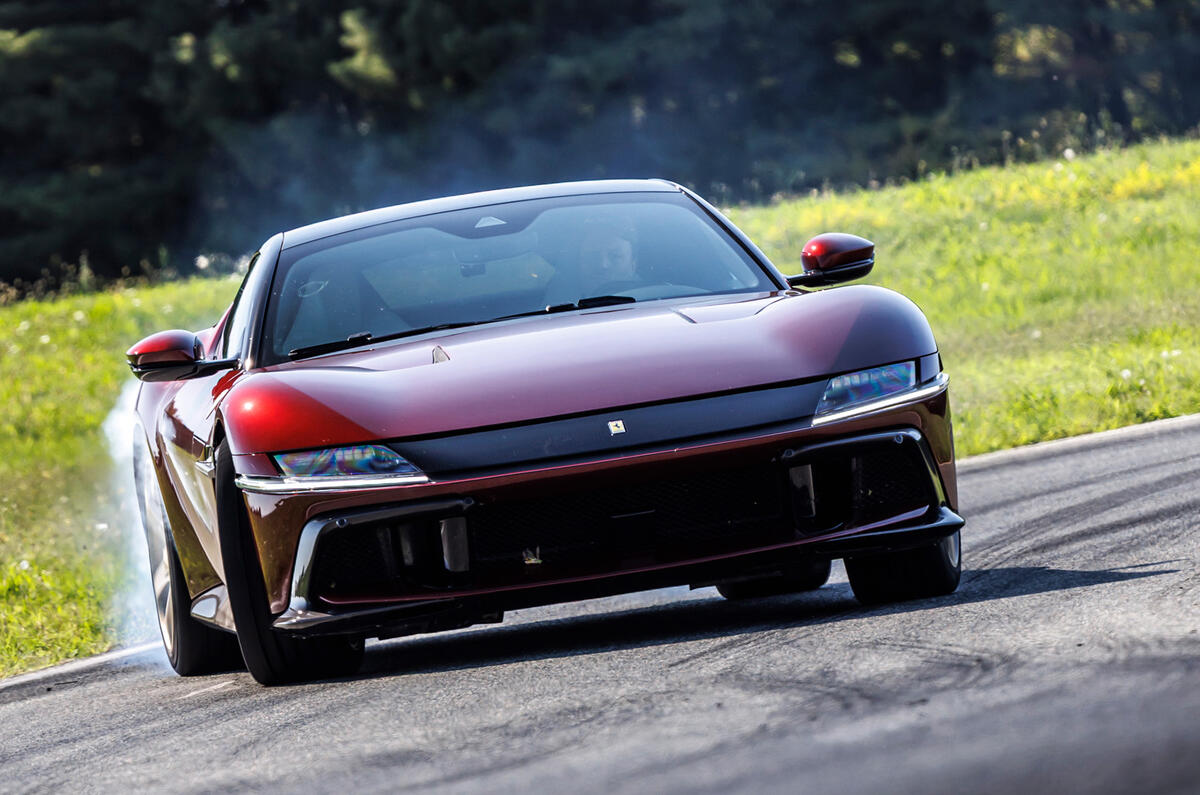
Five minutes later, with the Manuale tearing around Balocco, the story is quite different. Once up and running the elasticities and slick load curves of the clutch and the gearlever actions, accompanied by that addictive metallic zing, feel more convincing.

In fact, very soon the brain accepts the Manuale as the real McCoy: an 819bhp modern, manual Ferrari, with a pin-sharp throttle and turn-in as well as that hallmark handling mischief. All of which, it almost goes without saying, feels absurdly special. Churlish to have doubted Ferrari, the current master of calibration.

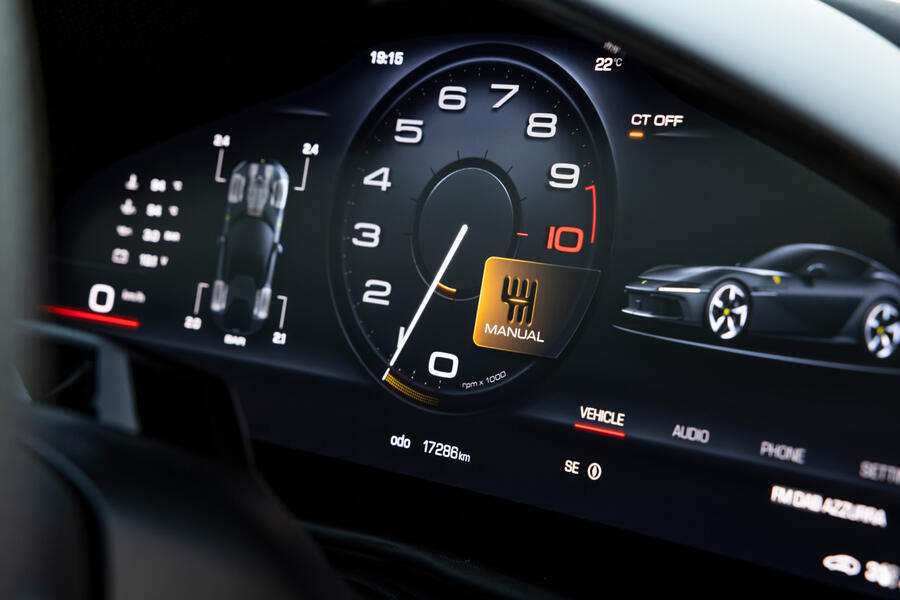
As for initation on the move, it's straightforward. To slip the car into manual mode, simply push the clutch pedal and so long as you're below 45mph the H-pattern icon on the knob will glow orange to tell you all three pedals are now yours to use. Want it to go back into auto? Press the D button on the centre console at any time.

Back to top

When it comes to the calibre of the deception, the kinematics of the lever, with its underslung oscillating assembly, are particularly neat. The mechanism is made from a billet of high-strength steel, hardened for lifelong durability and machined to an ultra-high tolerance for maximum precision. The weight of the throw and the way the lever subtly draws itself home are then governed by a spring-loaded piston acting in concert with eccentric rollers, although the roughness of the various surfaces in contact with one another is also used to generate 'feel'.

There's also a solenoid that will physically lock out the mechanism to prevent over-revving downshifts, although this will be rare, because the mechanism is so intuitively accurate.

More broadly, not once does the system hiccup during this brief but frantic and at times very quick drive at Balocco. This is impressive given that, in the regular 12Cilindri, clutch two need only be ready to engage the ratios adjacent to clutch one. In a manual, snatching fifth gear from second - for example, to settle the engine because you're taking a call - wouldn't be unusual. Likewise a driver in fourth might go to second... or to sixth. The sensors in the Manuale's lever start sending predictive signals the moment that knob begins to move, and try as I might I can't wrong-foot the system.

The pedals are also very well positioned for heel-toe downshifts. In fact, the only thing you can't do, aside from blowing the V12 with an errant downshift or melting the clutches through lazy footwork in traffic, is clutchlessly powershift.

Back to top

Anyone ruing the inability to powershift is of course taking everything too seriously, and there's a lesson here: the Manuale's system isn't a perfect recreation of a real manual but rather a fun innovation that celebrates 'the traditional gesture', as de Simone puts it. Ferrari could just as easily have kept this technology forever hidden away in the 'interesting ideas' drawer. We should be delighted it didn't.

Ferrari 12Cilindri Manuale
Far from a half-hearted gimmick; to all intents and purposes, the manual Ferrari has returned
Price £508,000
Engine  V12, 6498cc, petrol
Power 819bhp at 9250rpm
Torque 500lb ft at 7250rpm
Gearbox 8-spd dual-clutch automatic, RWD
Dry weight  1565kg
0-62mph 2.9sec
Top speed More than 206mph
Economy 18.2mpg
CO2, tax band 353g/km, 37%
Rivals  GMA T.33, Pagani Utopia

Join our WhatsApp community and be the first to read about the latest news and reviews wowing the car world. Our community is the best, easiest and most direct place to tap into the minds of Autocar, and if you join you’ll also be treated to unique WhatsApp content. You can leave at any time after joining - check our full privacy policy here.

Richard Lane

Richard Lane
Title: Deputy road test editor

Richard is Autocar's deputy road test editor. He previously worked at Evo magazine. His role involves travelling far and wide to be among the first to drive new cars. That or heading up to Nuneaton, to fix telemetry gear to test cars at MIRA proving ground and see how faithfully they meet their makers' claims. 

He's also a feature-writer for the magazine, a columnist, and can be often found on Autocar's YouTube channel. 

Highlights at Autocar include a class win while driving a Bowler Defender in the British Cross Country Championship, riding shotgun with a flat-out Walter Röhrl, and setting the magazine's fastest road-test lap-time to date at the wheel of a Ferrari 296 GTB. Nursing a stricken Jeep up 2950ft to the top of a deserted Grossglockner Pass is also in the mix.