Currently reading: Volkswagen Golf Hybrid driven: Honda-style HEV nudges 60mpg

Wolfsburg goes after Civic and Corolla with its first full-hybrid, aiming to boost MPG in the city

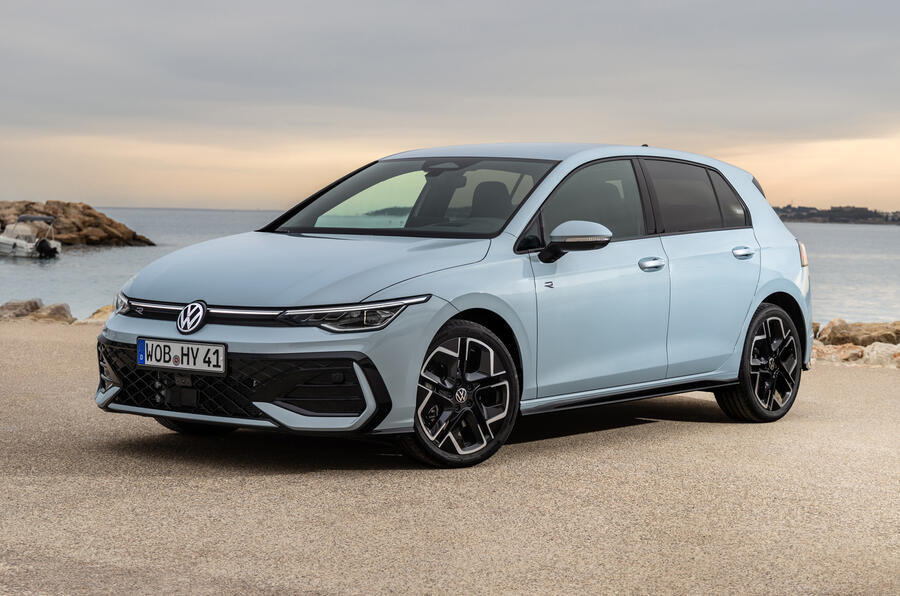
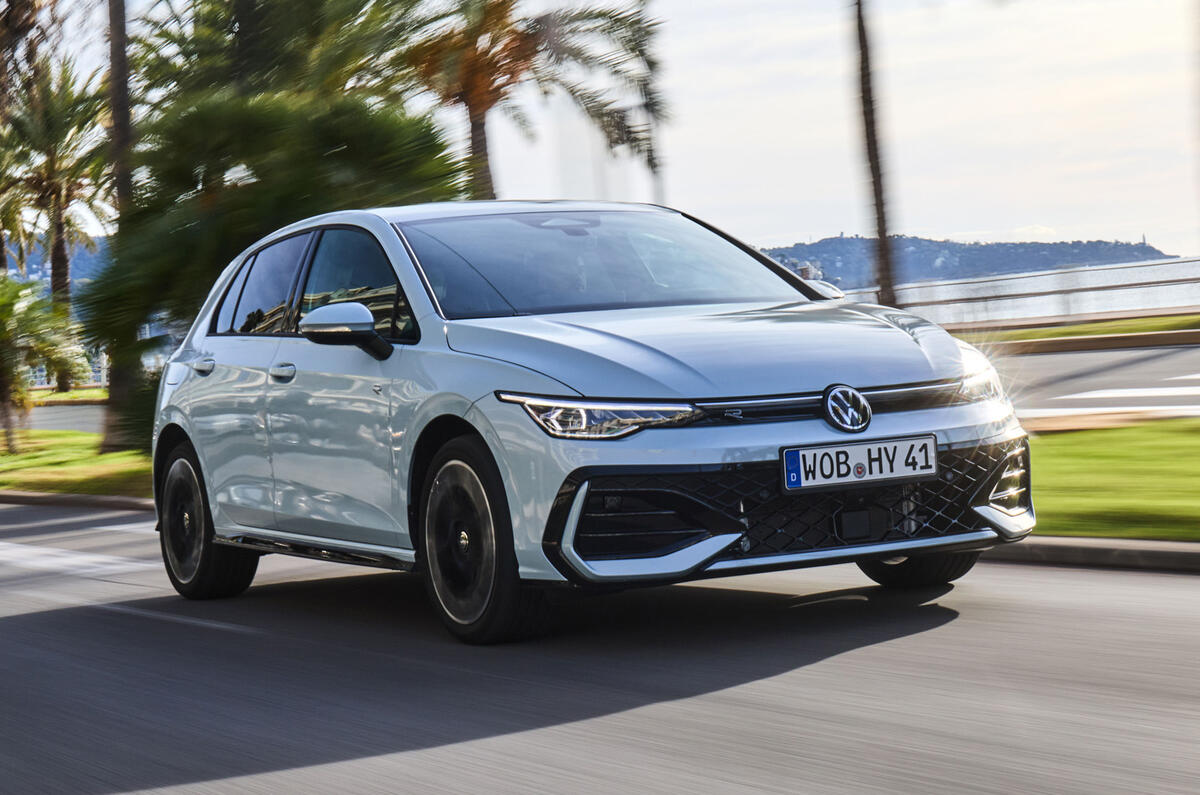
Never a huge surprise to see us testing a new Volkswagen derivative, given the company's sprawling and ever-evolving portfolio, but when did we last test a new powertrain type from Wolfsburg? Possibly not since our first spin in the electric e-Golf a decade ago. So the new Golf Hybrid seems like a landmark of sorts.

It arrives following the recent demise of the stalwart diesel Golf in the UK but is pitched very differently to that car, with a petrol-engined full hybrid system that's engineered to cut emissions and boost efficiency about town, rather than achieve mega-MPG figures on non-stop motorway schleps.

Sitting between the eTSI mild hybrid and the eHybrid PHEV, the new Hybrid (capital H to avoid confusion, natch) will be offered in all trim levels and with either 134bhp or 168bhp (we're testing the latter version here), commanding a premium of around £1200 over the equivalent eTSI.

This powertrain will also be offered in the T-Roc crossover (see below) and the flexibility of the MQB platform means it could soon follow in other Volkswagen Group models.
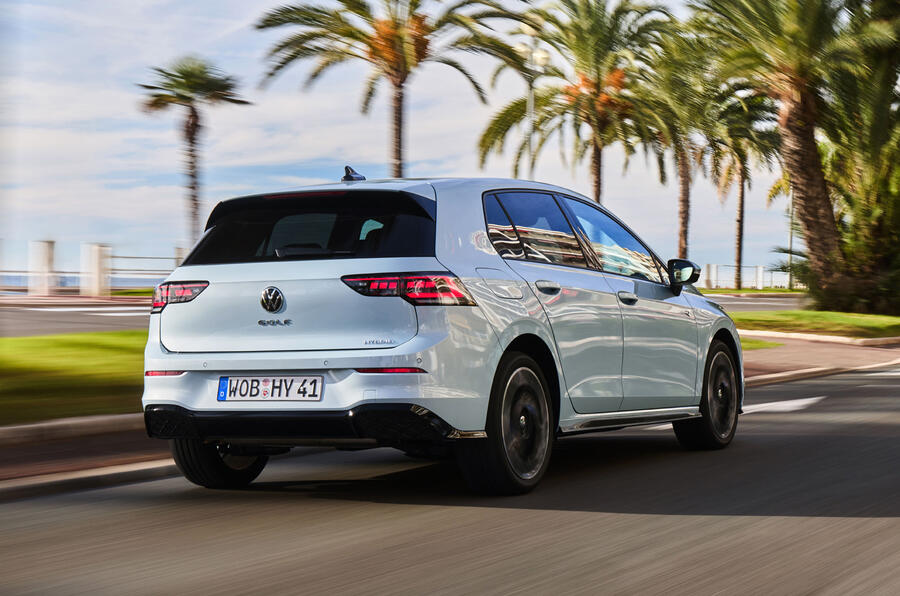
The new set-up combines Volkswagen's ubiquitous 1.5-litre turbo four-pot with a small electric traction motor and a 48V starter-generator, with a 1.6kWh battery under the back seat providing enough juice for regular bursts of low-speed engine-off running.

For the sake of comparison, it's more like the Honda Civic's e:HEV powertrain than the Nissan Qashqai's e-Power system, in that the engine can either drive the wheels directly at a cruise, serve as a generator to top up the 1.6kWh battery (as a series hybrid) or work in tandem (as a parallel hybrid) with the electric motor to provide the full power output.

Like in the Civic, there's no traditional gearbox here either, with the Golf instead choosing different combinations of its power sources depending on load and speed. The electric motor drives the front axle at speeds of up to 37mph, beyond which point the clutch closes and the engine hooks up to the wheels through a single-ratio gearbox, which is said to be roughly equivalent to a sixth gear in a conventional automatic. You can’t manually select which power source drives the wheels, but the Sport driving mode favours series-hybrid operation for sharper acceleration while turning up the regen braking.

In WLTP testing, the electric motor drove the Golf for 66% of the time, while Volkswagen's own tests on public roads around Wolfsburg returned a 59% EV mix — a more realistic figure.

Volkswagen says the Hybrid consumes up to 11% less petrol than the eHybrid in urban running, and while official figures have yet to be revealed, it should incur lower VED and BIK tax figures too.

Back to top

The company also touts the drivability benefits of a full hybrid, claiming it allows for the smooth take-up and easy in-town mooching of a pure-electric arrangement.

That largely bears out in practice: the Hybrid gathers pace predictably, comfortably and about as quickly as you could reasonably want — although the lower-powered version's 8.8sec 0-62mph time might feel a touch laborious.

Judicious applications of your right foot can keep the engine from waking up for extended periods, and indeed it drives much like an EV — albeit a slightly underpowered one.

When the engine does chime in to juice up the battery, it does so seamlessly and unobtrusively, thrumming away quietly at idle and doing nothing to change the driving characteristics while the car continues to be propelled exclusively by the electric motor in series-hybrid mode.

But place more demand on the system with a quick overtake or steep hill — and the engine quickly becomes more boisterous and thrashy as it takes over propulsive duties, emitting a fairly unpleasant drone that's at odds with an otherwise slick and modern driving experience.

This is exacerbated by the fact that as in rivals with a CVT — the revs are always out of step with your speed, creating the much-maligned elastic-band effect.

Back to top

Plainly, this is a powertrain optimised for low-demand, low-speed operations — a remit that it serves admirably. Over the course of a hilly, 40-mile circuit around the suburbs of Nice and into Monaco (what was that about the Hybrid's lower tax implications?), I averaged 56.5mpg without trying too hard — which is about on par with what we have achieved on UK roads in the Civic and the Toyota Corolla. Volkswagen's engineers reckoned the mild-hybrid Golf would have returned nearer 50mpg in the same conditions.

It's worth noting that we previously recorded a 60mpg touring figure for the eTSI, but our relatively short and urban-focused experience in the Hybrid means we can't conclusively compare the two Golfs' efficiency credentials yet.

Assuming it only costs a few quid more per month than the equivalent eTSI, though, it's easy to imagine making your money back on fuel bills if you drive the Hybrid the right way — particularly with pump prices as they are now.

It's another interesting take on future-proofing the combustion engine, and for a certain type of buyer it could well be the best yet.

Volkswagen Golf Hybrid 125kW R-Line
Price £35,200 (est)
Engine 4 cyls in line, 1498cc, turbocharged, petrol, plus 48V ISG and electric motor
Power 168bhp
Torque 229lb ft
Gearbox 1-spd reduction gear, FWD
Kerb weight 1484kg
0-62mph 7.5sec
Top speed 112mph
Economy 61mpg
CO₂, tax band 107g/km, 27% (est)
Rivals Honda Civic, Toyota Corolla

How does the Volkswagen T-Roc Hybrid compare?

Back to top

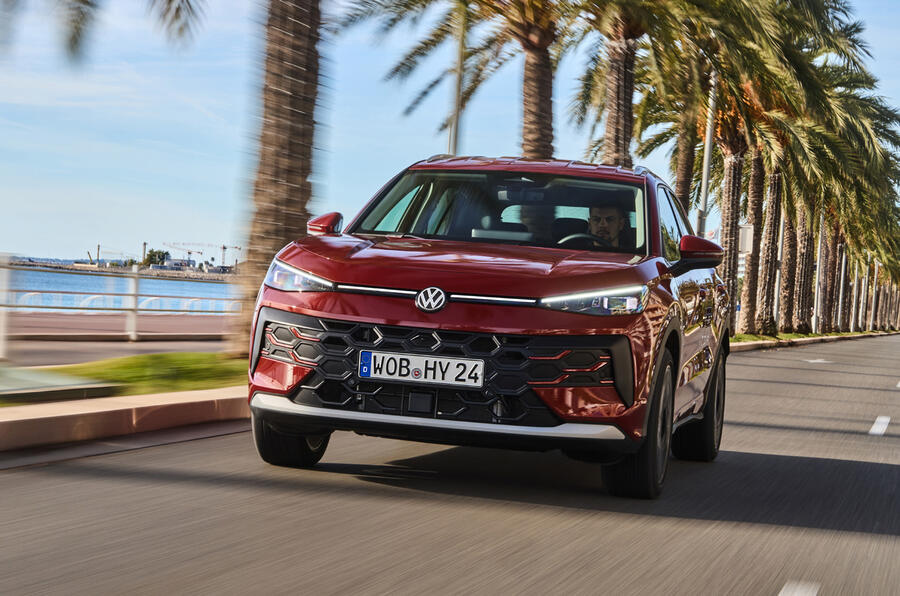
As Golf Hybrid is to Civic, so T-Roc Hybrid is to HR-V. Mechanically the crossover is identical to the hatchback, and the extra ride height and heft incur only a tiny efficiency penalty on paper — although a larger one on pace, with the 168bhp variant needing a whole extra second to hit 62mph from rest.

In practice, though, the T-Roc Hybrid drives much the same as the Golf Hybrid and likewise returns the highest MPG figures in high-traffic, low-speed areas, which means it would suit the same sort of city-slicking families.

It's worth noting that our Golf Hybrid test car was fitted with Dynamic Chassis Control (adaptive dampers) while the T-Roc rode on standard suspension and the hatchback was far more adept at smoothing out the kind of speed bumps, cobbles and potholes that blight our urban environments.

If you're going to choose the powertrain that best fits your surroundings and use case, you might as well pick a chassis set-up that suits too.

Join our WhatsApp community and be the first to read about the latest news and reviews wowing the car world. Our community is the best, easiest and most direct place to tap into the minds of Autocar, and if you join you’ll also be treated to unique WhatsApp content. You can leave at any time after joining - check our full privacy policy here.

Felix Page

Felix Page
Title: Deputy editor

Felix is Autocar's deputy editor, responsible for leading the brand's agenda-shaping coverage across all facets of the global automotive industry - both in print and online.

He has interviewed the most powerful and widely respected people in motoring, covered the reveals and launches of today's most important cars, and broken some of the biggest automotive stories of the last few years.