








A revolutionary Lotus five-door crossover is being developed at top speed at the company’s Hethel design studios.
It is described by CEO Jean-Marc Gales as “a real Lotus” and “the world’s first lightweight SUV” and will be made in an all-new Lotus factory in south-east China.
The new car is tipped for production in 2019 and is very likely to become the best-selling model in Lotus’s 67-year history.
However, Gales is clear that Hethel will remain Lotus’s management and design hub and continue as the manufacturing centre for its three-tier sports car range. Sales of improved Elise, Exige and Evora models expanded by 55% to just over 2000 last year and are tipped to beat 3000 this year.
The crossover is the first fruit of a three-way joint venture between Lotus, its Malaysian owner Proton and Goldstar Heavy Industrial, a Chinese engineering and trading company.
The aim is to take advantage of exploding SUV demand in China, especially in the C-segment, where sales recently topped three million. Porsche’s Porsche Macan is selling at a rate of around 30,000 units a year in China and is tipped to reach 50,000 in a couple of years.
The launch of the new Lotus SUV represents the third phase of Gales’s ambitious but believable development plan revealed about a year ago.
The first phase, nearly achieved, was to take sales beyond 2000 units in the first year and get trading into the black. The second is to press towards 4000 sports car sales, with further improved versions of the current models coming fairly soon. The third, planned for the end of the decade when the SUV and all-new versions of the sports cars hit the market, is to beat 10,000 units. Encouraged by early progress, Gales is already dreaming of a stage four.
The new crossover will bow to Lotus tradition by having a name beginning with ‘E’. It will aslo offer 4x4 capability, at least as an option, like most of its class rivals.However, it will differ from the rest by being both lighter and faster, says Gales, with more emphasis than any rival on fine steering and handling.
After satisfying initial demand in China, Lotus will consider launching the model in Europe and Japan, where design and safety legislation is relatively similar to China’s.
US sales would be a more difficult proposition, Gales says, because of the modifications needed. He acknowledges that demand for the SUV could eventually drive total Lotus sales beyond 10,000 but is anxious “not to run before we can walk”.
DESIGN
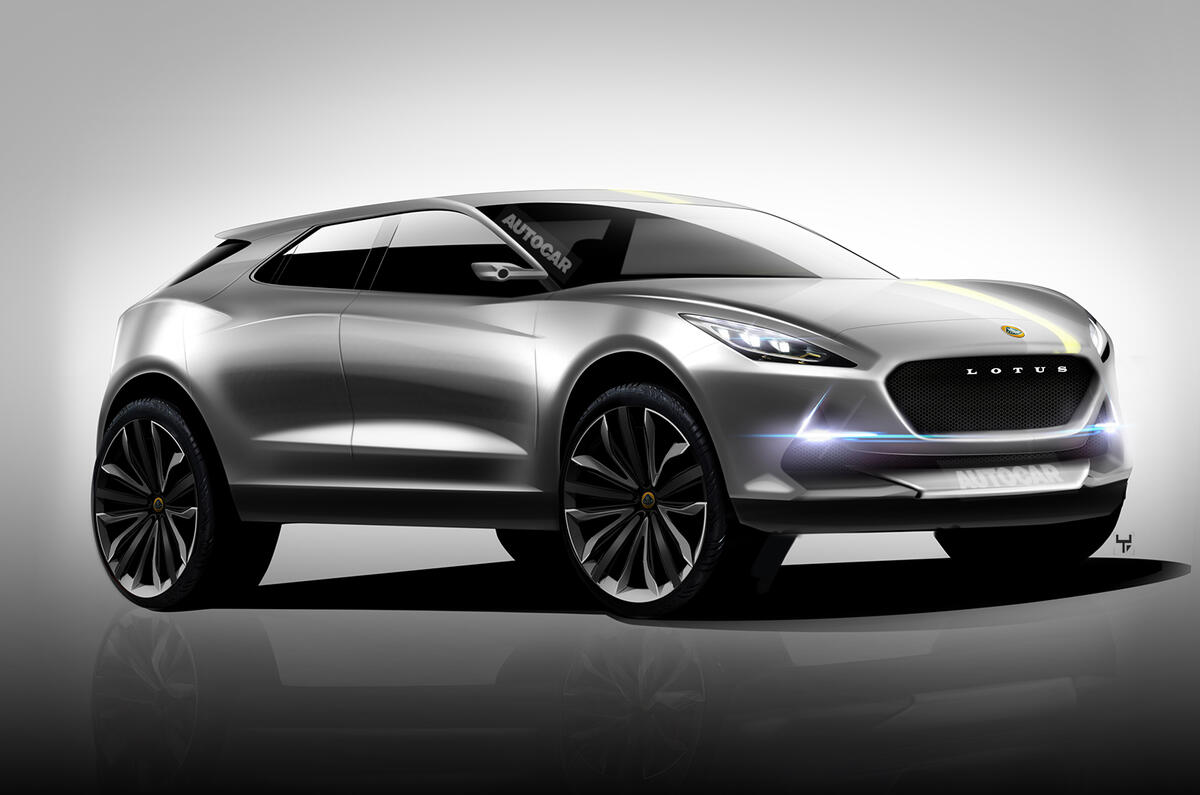
As our sketches show, the new crossover uses familiar design cues in a new way, with a new grille treatment that alludes lightly to famous Lotus models of the past and clearly suggests light weight and high performance.
The new Lotus is expected to be a fairly low-riding model, similar in length and wheelbase to the Macan and Audi Q5 but about 3cm lower (to get the centre of gravity down) and a shade wider. Lotus says the low roofline can be achieved without compromising the generous rear cabin space that is essential in a car for the Chinese market.