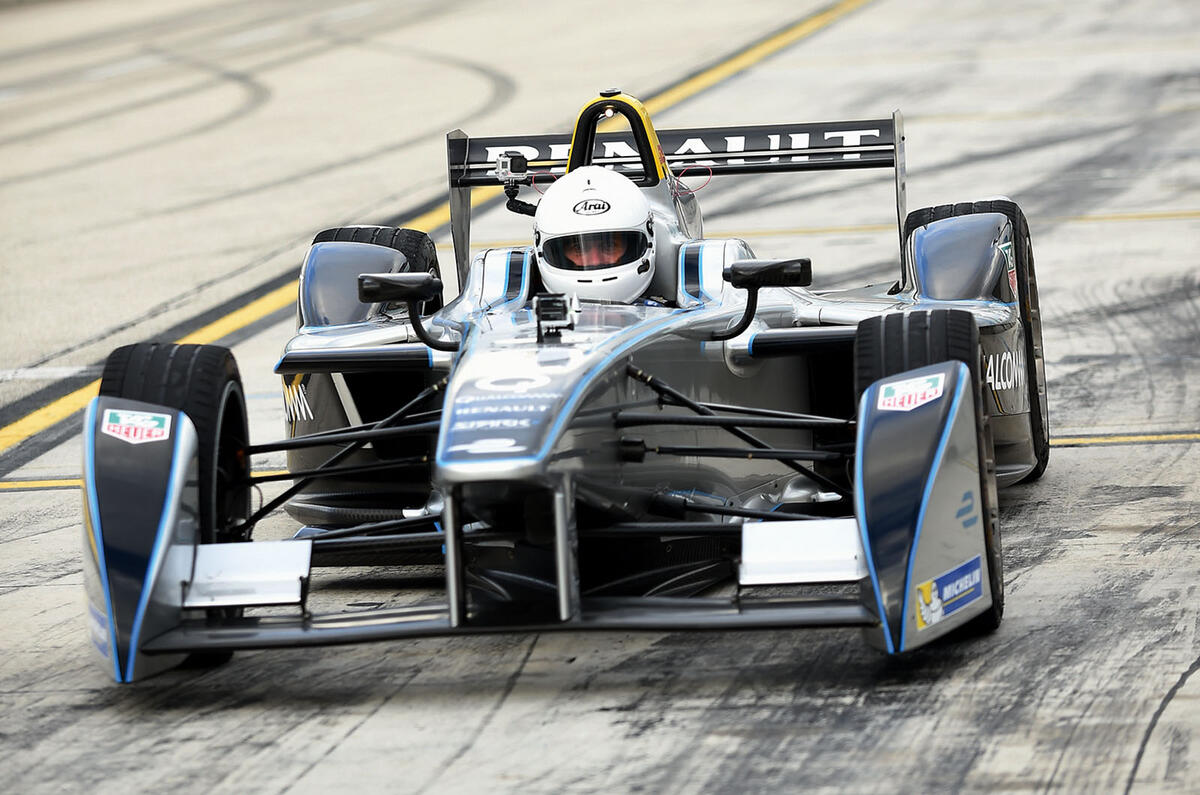

Homestead-Miami Speedway usually echoes to the roar of Nascar V8s and 65,000 adoring fans.
That might explain why every marshal I whisper past in my electric racing car looks more than a little bemused. This Formula E machine may be an eye-catching winner, but the Florida marshals are scratching their heads. Where’s the growl of an 850bhp Hemi, spitting fire and high octane from every tailpipe?
It’s true that Formula E doesn’t offer ear-splitting decibels, but after experiencing the inside of the cockpit at 140mph, I can tell you that it still screams pure excitement.
I’ve travelled 4500 miles from London to the Sunshine State to be the first British journalist to drive a Formula E car in the US. This may be the land of the free, but strict public liability laws mean I’m not allowed to drive on the Miami road circuit currently being fenced off in the city centre. (The Miami ePrix was eventually won by Nicolas Prost.)
Instead, I’m hurtling around the 2.2-mile road course at Homestead, which incorporates some of the banked oval of the Nascar circuit. With 14 bends and full-throttle curves, it’s pure adrenalin for rookies like me.
As I pass the pit lane flat out, the advice of my mentor, former Formula 1 driver Nelson Piquet Junior, is still ringing in my helmet: “Be careful of the carbon brakes. They’re very strong and easy to lock. Heat them up slowly, which sometimes means braking early into a corner.”
Comparisons with an F1 car are obvious. It’s tough keeping my head still because of the wind buffeting my helmet. The cockpit has all the comforts of a medieval torture chamber and I’m developing Popeye’s forearms in trying to hit the apex of every curve.
I drove an F1 car in 2001 and struggled to cope with the bottomless pit of power on tap. And although Formula E cars can be catapulted to 60mph in three seconds, the 800kW battery developed by Williams provides more than enough kick to keep it wildly entertaining.
Even braking late into a second-gear hairpin, the set of 18in Michelin tyres glue the car to the track. As I accelerate onto the straight, a handful of spent rubber bounces over my crash helmet and HANS (head and neck support) device.
I’m on lap five and it’s only the four paddles on my detachable steering wheel that still require some mastering. They’re so close together that it’s easy to squeeze the wrong one – especially on an uneven stretch of Homestead asphalt.
The top two paddles change up and down through the four-speed, fixed-gear transmission (the latest Formula E cars are five-speed). However, it’s the bottom pair that are unique to this style of racing. The bottom right one activates energy regeneration under braking – topping up the car’s battery pack and conserving power.
The fourth paddle, meanwhile, is tagged FanBoost, which allows fans to play a role in determining the outcome of a race using an online voting system. The driver with the most votes receives a power boost of 30kW (40bhp), meaning that the car will drive with up to 270bhp. The boost lasts for only five seconds, but it can be vital on a narrow circuit where there are few overtaking opportunities.
Below a central LCD screen are three rotary dials that I’ve been told not to touch. Two of them regulate regeneration under braking, and the third controls torque during the race.Inside the cockpit, the car is anything but quiet. It sounds like a distant fighter jet under full throttle when you floor the accelerator. However, it’s not all good. A grating whine from the transmission at lower speeds more resembles a British Leyland gearbox.
F1 and Formula E do compare on one level: comfort in the cockpit. It’s hot, sweaty and uncomfortable. By the time I unclip my five-point harness, my fireproof underwear and racing suit are drenched. I’m smiling and would happily take on another five laps, given half a chance.
Later, I ask Piquet, who now competes in Formula E for China Racing, how similar the Formula E car is to an F1 machine. “Although the two cars look the same, youcan’t really compare them,” he explains. “F1 technology has been advancing for 70 years. Twelve months ago, the first Formula E car wasn’t even built.
“Both cars handle in a similar way, but the driving technique is totally different. In Formula E we only race on street tracks and use one set of all-weather radial tyres. The aim is always to conserve energy, rather than worry about a complicated strategy for taking on fuel and changing tyres.
“It’s different in the cockpit, too. In F1, you play around with the KERS settings or adjust the angle of the wing. We pay more attention to energy conservation, especially temperature levels around the battery pack, which affect performance.”
Piquet admits that the only electric car he had driven before joining Formula E was a two-hour road test in a Tesla. “I never considered an electric car before, but now I realise that the technology we use in Formula E will accelerate the development of the electric cars we drive on the road,” he says. “I think Formula E is a much purer form of racing, because drivers don’t get constant diagnostic feedback from their team. They are out there on their own, making decisions for themselves.”
The surge of interest in the inaugural series means that an incredible 50 cities have already offered venues for the 2015-2016 season. By the time this year’s 10-race series reaches its climax at the London ePrix in Battersea on 27 June, more than 500,000 fans will have watched electric car racing live for the first time and tens of millions more will have tuned in on TV.
And although all Formula E cars are currently built to the same specification, car manufacturers will join the fray next season. That will raise the level of competitiveness within Formula E even higher. Battery life will improve, speeds will increase and more teams will be lured into the pit lane. Who knows? Maybe soon F1 will be looking over its shoulder at the future of single-seat motorsport.
E-mazing facts
Formula E has 10 teams and 20 drivers. Races last 40 laps. Drivers pull in to the pit lane halfway to swap into an identical, fully charged car.
The sound of a Formula E car can reach 80 decibels, which is slightly louder than a conventional road vehicle.
Cars are charged from glycerol generators. Glycerine is a carbon-neutral by-product of biodiesel production. It’s so pure you can drink it.
Teams are allowed two spare wheels per car — one for the front and one for the rear. The rule has dramatically reduced running costs.
Formula E uses a BMW i8 hybrid as the safety car — the only combustion engine you will ever see on the track.
Jeremy Taylor
Get the latest car news, reviews and galleries from Autocar direct to your inbox every week. Enter your email address below:

Join the debate
Add your comment
Formula E
The biggest problem with electric cars is range, especially when driven at speed and they get round this in Formula E by – changing cars at half distance!! If only you could do that with a Nissan Leaf on the M1!
Also, have you noticed that none of the 'tracks' used have ever had any other kind of race held on them? Just imagine how these racers would look if they ran somewhere where you could compare the speeds with real racing cars.
re easeaton
Well, if noise isn't