
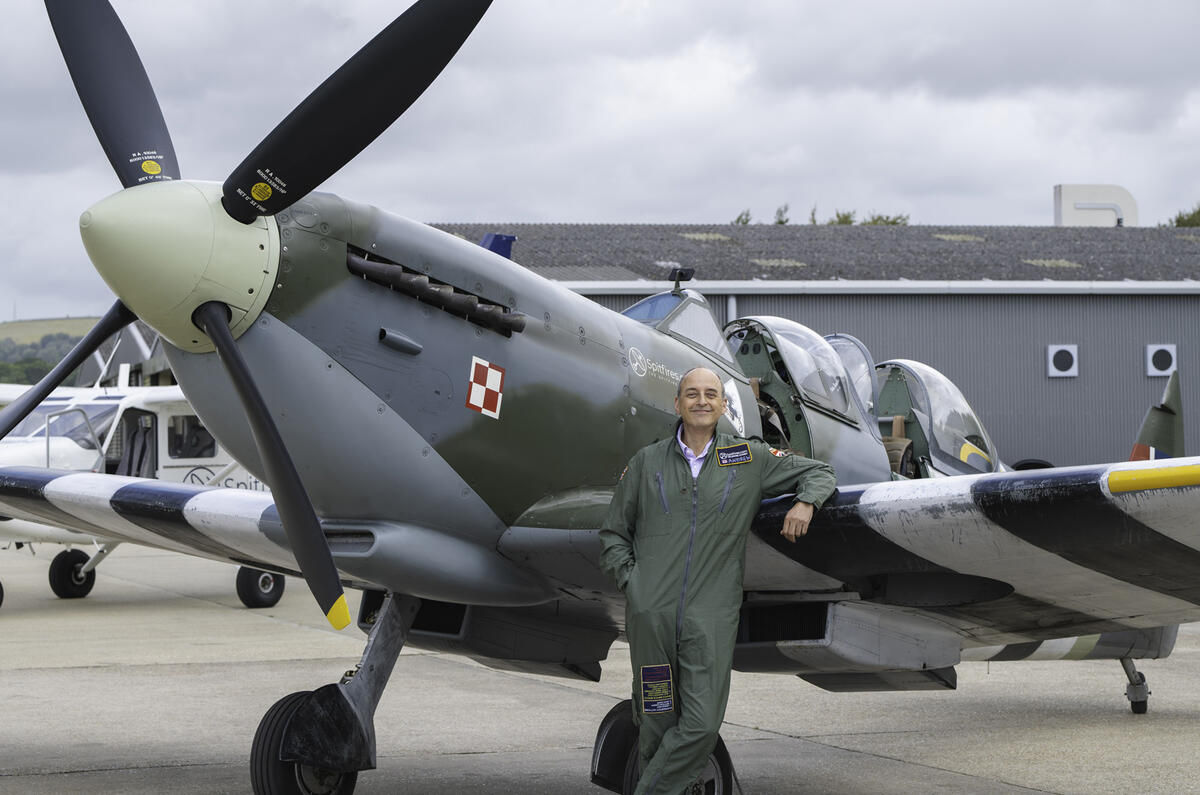

A cough. A splutter. A jet of flame for good measure and the Merlin is prised from its slumbers and into rambunctious life. Many of you, perhaps even most, will have heard one of these engines, at Goodwood or an airshow. But unless you’re physically strapped into an aircraft boasting one, you can never claim to have felt one too. But I have. For I am in a Supermarine Spitfire, parked on the grass that forms the infield at Goodwood and, very shortly now, I shall be flying it.
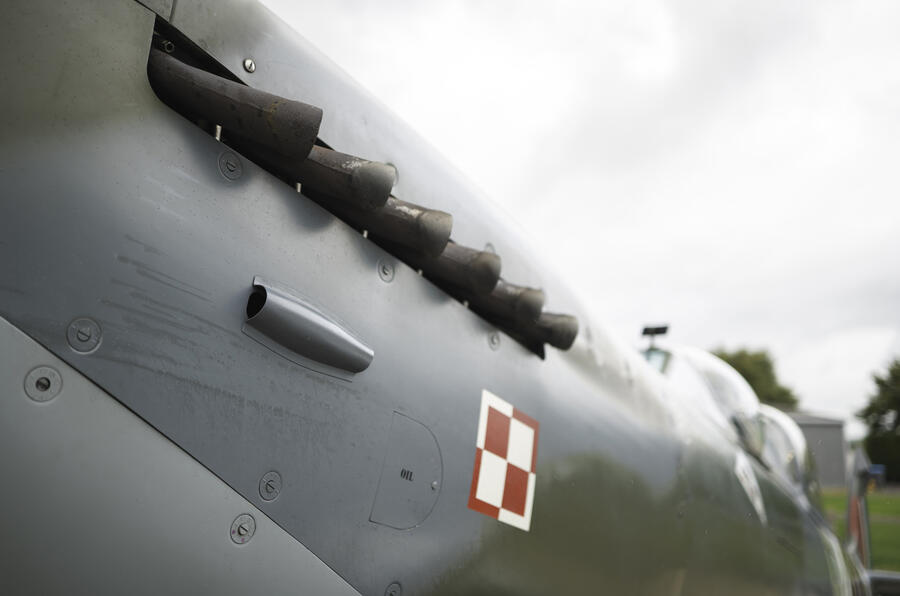
We know the Goodwood aerodrome for the wonderful Revival and Members’ Meetings it hosts, but before any of that, it was RAF Westhampnett, a Spitfire base and, indeed, from where the double-amputee flying ace Douglas Bader departed for his final flight before spending the rest of the Second World War as a prisoner of war. Old aerial photos of the base show that what is today a race track was then the airfield’s perimeter road – what you drove around to get to where your kite was parked. In this case, it’s a Supermarine Spitfire MkIX, complete with 27-litre, twin-stage-supercharged, 48-valve, V12 Rolls-Royce Merlin 61 engine.
We all know the Merlin was named after the wizard of Arthurian legend, and in that regard, if no other, we are all wrong. It’s actually named after Europe’s smallest falcon. It was produced in a dizzying array of forms, including one used in tanks, from 1936 to 1950, in which time almost 150,000 were built, most famously for the Spitfire, Hawker Hurricane, de Havilland Mosquito and Avro Lancaster. Although a Rolls-Royce engine, it was built under licence by Packard in the US and by Ford in Manchester. Rolls-Royce facilities included factories in Derby, Glasgow and, of course, Crewe.
Indeed, it was to make the Merlin aero engine, and not cars at all, that the Crewe factory was built as re-armament took place in the face of Nazi aggression and the increasing realisation that war was coming. The factory opened its doors in 1938 and was camouflaged to look like residential housing from the air.
The disguise was an almost complete success: the factory was significantly bombed just once, with 17 workers tragically losing their lives. During the war, more than 25,000 Merlins were made there, with an untold effect on enemy forces. Only once hostilities had ceased did thought turn to car production, at which point the factory was adapted to make the Bentley MkVI and Rolls-Royce Silver Wraith from 1946.
It seems strange that anything manufactured by Rolls-Royce could be making such a racket, but the Merlin was loved by the pilots it powered, both for its performance and for its reliability. Indeed, it had just one notable flaw: a tendency to flood its bucket-sized carburettor during negative-g manoeuvres. This was fixed when a gifted engineer and car and motorcycle racer called Beatrice Shilling invented a restrictor that limited the flow of fuel in such circumstances, allowing Hurricanes and Spitfires to keep up with enemy aircraft that used fuel-injected engines. The device has been known ever since as Miss Shilling’s Orifice.
The Spitfire itself was the brainchild of Reginald Mitchell, whose revolutionary elliptical wing design made it the most manoeuvrable fighter plane the world had yet known. But he was an ill man by the time the Spitfire first flew in 1936, and he died of cancer aged just 42, long before the aircraft ever took to the skies in anger.
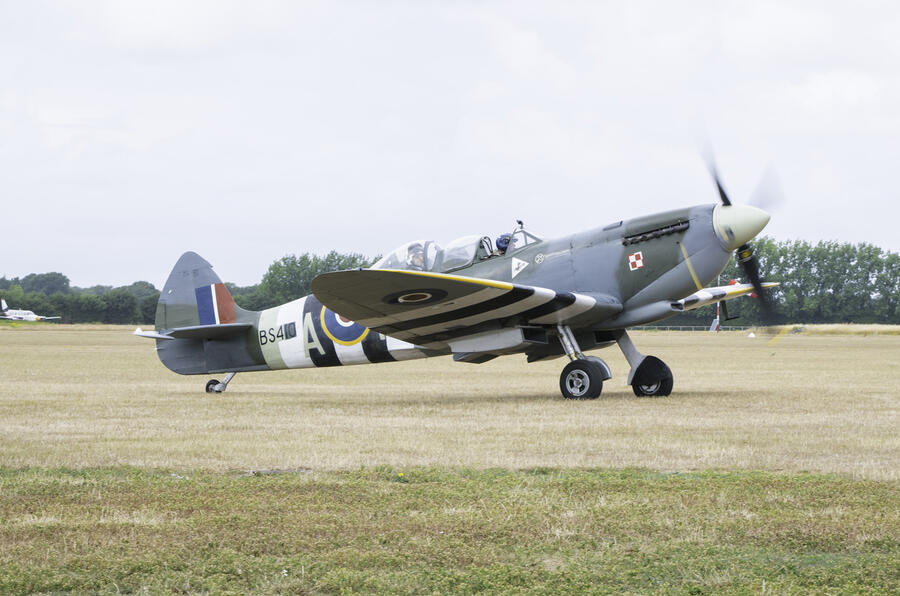
It is said that nothing advances technology like global conflict, and just as the First World War began with cavalry and ended with tanks, so the Second started with biplanes and ended with jet fighters. The Spitfire is a good example of this accelerated evolution, developed as it was into 24 different marks while the output of its engine essentially doubled from just about 1000bhp on first flight to more than 2000bhp by the end of the conflict.
The MkIX had a Merlin 61, the first with two-stage supercharging, for around 1540bhp, powering an aircraft weighing about the same as a large electric SUV such as a BMW iX – enough to propel it through the air at more than 400mph straight and level.
Plenty of Spitfires never saw the enemy or were left unassembled or simply built after the war, but this one is a combat veteran which both shot at and was shot down by the enemy. That is why it spent more than 60 years in a French marsh before being exhumed, converted to two-seat specification and returned to the skies.
And that is just as well for me, because I am not a pilot. He is called Charlie Huke and sits in an entirely separate cockpit up front. He is ex-RAF and has flown more than 250 different kinds of aircraft; I could not be in safer hands.
I have been fully briefed both online and in person by the brilliant staff of Spitfires.com, which runs this aircraft on behalf of its owner, and I am left in no doubt about both how unlikely it is that anything should go wrong and precisely what I have to do in case it does. Bail out, essentially, unless it’s a forced landing. I’m wearing my normal clothes but have a flight suit on top, with a life jacket over that and the parachute I’m sitting on strapped to my backside and, finally, my harness over that. If you have to get out in a hurry, it’s important you hit the quick-release buckle anchoring you to the aircraft and not the one that undoes your parachute straps…
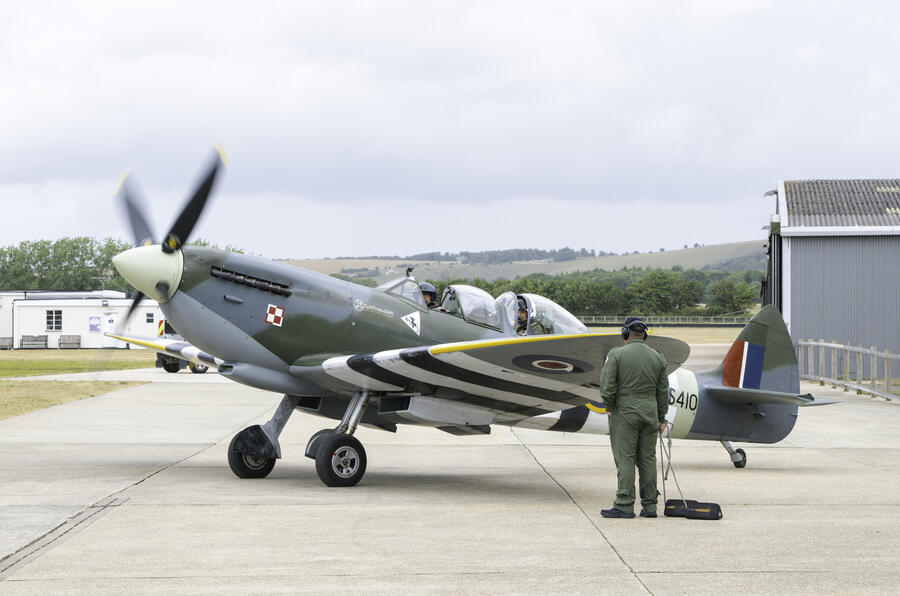
I can’t see Charlie and, as he revs the Merlin to take-off speed (about 2500rpm – it’s all done by 3000rpm), the noise is so great I can no longer hear him either. I watch the dials dancing in front of me as the stick rows fore and aft, left to right between my legs. It makes very little difference to our direction of travel until there’s enough forward speed for the Spitfire’s aerodynamic surfaces to start gripping the air. It’s bumpy as hell in here until, suddenly, it’s not. It’s Rolls-Royce comfortable now, and it doesn’t take long to work out why: I’m flying in a Spitfire.
But any suggestion this is going to be a perhaps noisy but essentially gentle experience evaporates within the next second when Charlie flicks left to avoid the trees that line the circuit. The Spitfire turns like a fly dodging a swatter, and instantly you’re subjected to the kind of ‘g’ you would ordinarily experience only on one of the world’s more evil rollercoasters. Except that it’s not momentary but sustained, and that’s what really drags your stomach into your shoes.
We probably didn’t pull more than around 3g, a level that the Spitfire, unlike its passenger, would barely have noticed. Its airframe is good for 8g, which is more than enough to cause many a pilot to lose consciousness.
We head up towards our Cessna Caravan camera plane, and when we reach it Charlie parks the Spitfire off its starboard wing so we can capture the shots you can see here. For just a moment I want to be in the Cessna, because the view must be unbelievable. But the problem is that the Spitfire can only just go slow enough to stay level with the Caravan travelling flat out, so we can’t stay for long. A few minutes and Charlie peels away and heads for the coast. Then…
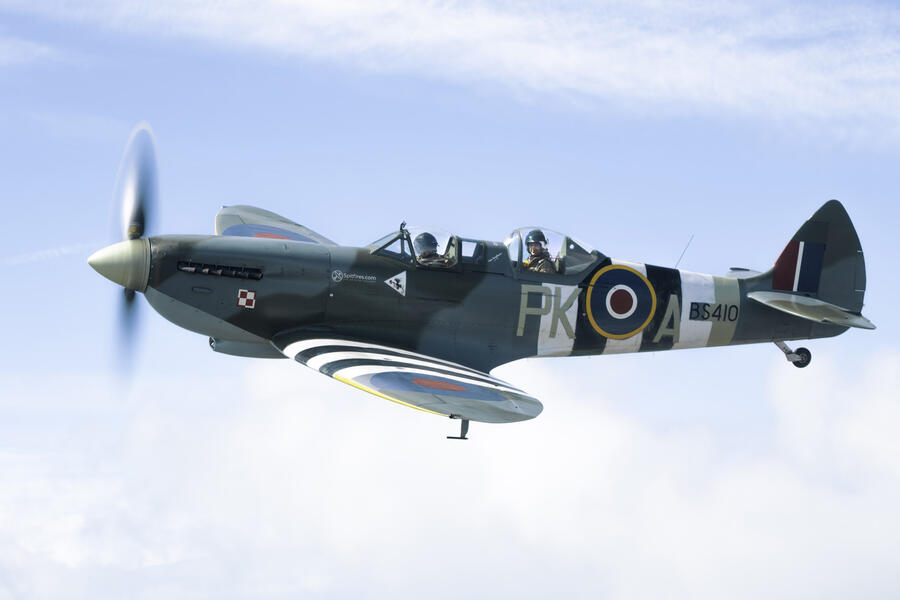
“Do you want to fly her?” Charlie asks – words I had imagined all my life but never dreamed I would actually hear. I have read enough and am sufficiently geeky to understand the basic aerodynamic principles of flight – that thrust and lift must overcome mass and drag before a plane will fly and so on – but I am not a pilot.
I place my feet on the rudder bar and my right hand on the stick, and ahead of me I can just see the tips of Charlie’s fingers in his bubble as he raises his own hands to the roof to prove it really is me flying a Second World War active-service combat-veteran Supermarine Spitfire. I spell it out because, even now, it helps reassure me that it actually happened.
I ask what I can do, where I can go, and am told it’s ‘my’ plane and can do whatever I want. I think ‘within reason’ is a given, so I will be leaving the Immelmann turns to someone else. Instead I practice less violent manoeuvres, up, down, left and right as I fly the Spitfire out over the Channel, just as so many did with rather more serious agendas a lifetime or more ago.
It is phenomenally responsive, a Caterham of the skies. It doesn’t really want to fly straight and level but instead dodge and dart. For although I am a passenger, this is not a passenger plane but a weapon of war, designed to hunt, to kill and nothing else. Of course I knew that, but to be confronted so starkly with what that actually means in real life is extraordinary. I just thought because it was so old it would be a bit slack and imprecise, just as were most cars designed in the 1930s. I thought wrong.
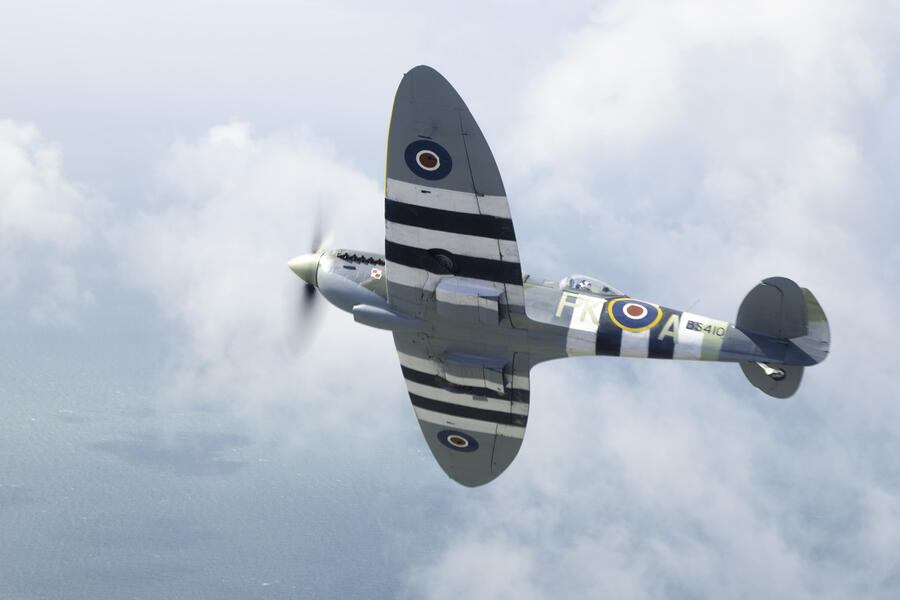
There is no amount of time at the end of which it would not be too soon to give this up. But I can barely believe it when Charlie says it’s time to be heading back to Goodwood. I hand back, he does a quick aileron roll – you and I would call it a victory roll – so I can say I’ve been upside down in a Spitfire too, and returns to base.
Such is the precarious nature of the times in which we live that I sometimes wonder how it will all end. But even as they drag me kicking and screaming from my home, I will still be able to look them in the eye and say ‘at least I’ve flown a bloody Spitfire’, for that is something no one can take away. And as long as you can afford to invest a few grand into an experience you will remember the rest of your days, you can too. Just go to Spitfires.com and they will do the rest.



Add your comment